


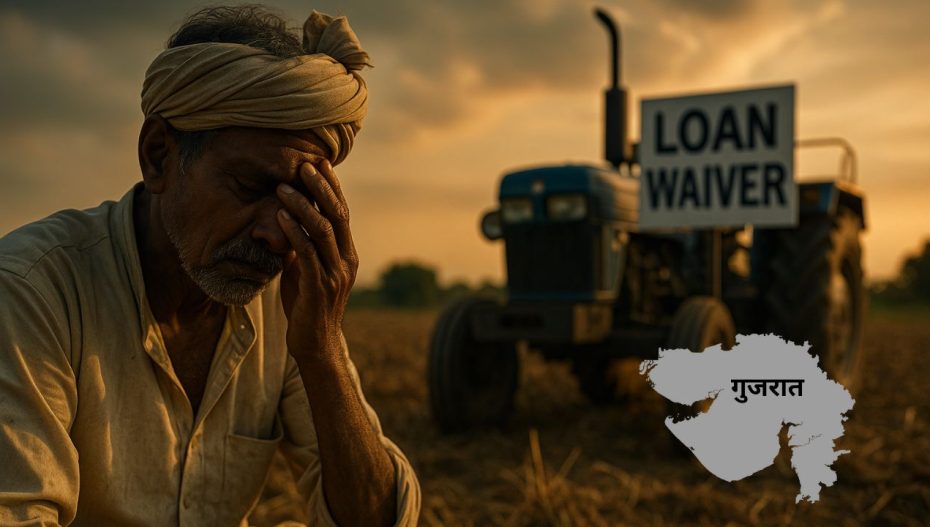
The people who work day and night to put food on our plates are themselves struggling to afford the cost of growing it. Across Gujarat, farmers are increasingly depending on bank loans to buy seeds, fertilisers, pesticides and even pay for labour. The situation is becoming increasingly worrying as the very people responsible for feeding the population find themselves trapped under growing debt. When farmers cannot afford to cultivate their own land without borrowing money, it raises a serious question about the condition of the rural economy and the future of agriculture.
The scale of the problem is visible in the state’s agricultural lending figures. In just five years, agricultural loans in Gujarat have increased by more than 90%, rising from Rs 84,834 crore in 2020-21 to Rs 1,66,466 crore in 2025-26.
This sharp increase suggests that farming is becoming increasingly dependent on borrowed money, with many farmers struggling to manage the rising cost of cultivation through their regular income.
For a farmer, preparing land and starting a new crop season requires a considerable amount of money. But over the past five years, the cost of almost every major farming requirement has increased.
Seeds, fertilisers, diesel, pesticides and agricultural labour have become more expensive, pushing up the overall cost of cultivation. Farmers who once managed their expenses through household savings and earnings from previous crops are now finding it increasingly difficult to do so.
As a result, many are turning to banks for loans even before the new sowing season begins. In several cases, farmers also need fresh loans to repay their previous debts.
This creates a difficult cycle. Farmers borrow money to grow crops, but when their earnings are not enough to cover production costs and existing loans, they are left with little choice but to borrow again.
Rising cultivation costs are not the only challenge. Unpredictable weather has made farming even more financially uncertain.
Over the past two years, excessive rainfall and unseasonal showers have caused significant crop losses across Gujarat. Farmers who had already invested money in seeds, fertilisers and labour suffered financial setbacks when their crops were damaged.
This year, the situation has become worrying again, with weak monsoon conditions raising fears of drought and further agricultural losses.
For farmers, the problem is particularly serious because crop losses mean that the money invested in cultivation may never return. Without sufficient earnings from their harvest, repaying bank loans and interest becomes increasingly difficult.
The situation has become so difficult that some farmers have reportedly started selling their agricultural land and moving towards other occupations because they can no longer sustain farming.
The financial pressure on Gujarat’s farming community is reflected in another figure. According to the information provided, the average debt per farmer in the state stands at approximately Rs 45,000.
While the banking sector may view rising agricultural lending as an expansion of credit facilities, economists and those observing the rural economy see the sharp increase as a warning sign.
More agricultural loans do not necessarily mean that farmers are becoming financially stronger. If borrowing is increasing because farmers cannot meet basic cultivation expenses or recover their investments, it points to a deeper problem.
The concern is that if agricultural borrowing continues to grow at the present rate, farmers may find it increasingly difficult to repay their loans.
The situation becomes more concerning with drought conditions prevailing in four districts of Gujarat. Farmers facing crop losses and rising expenses are already under financial pressure, leaving them with fewer options to manage their debts.
Agricultural experts believe the government needs to take steps to reduce the financial burden on farmers before the situation becomes worse.
They have called for higher subsidies on agricultural equipment, fertilisers and seeds to bring down cultivation costs. Farmers also need better prices for their produce so that their earnings cover production expenses and leave them with a reasonable profit.
Apart from this, interest relief on agricultural loans and a simpler crop insurance process could provide some financial support, particularly during seasons affected by extreme weather.
However, despite the difficult situation in several parts of the state, the Gujarat government is not inclined towards waiving farmers’ loans.
The growing dependence on bank credit raises a larger question about the sustainability of farming in Gujarat. If farmers have to borrow more every year simply to continue cultivating their land, the rising loan figures cannot be treated as a sign of agricultural progress alone.
After all, a state cannot have a financially secure agricultural sector if the people growing its food are struggling to escape debt.
Also Read: No Election Wins, Rs 206 Crore Donations: Court Rejects Garib Kalyan Party Treasurer’s Bail