


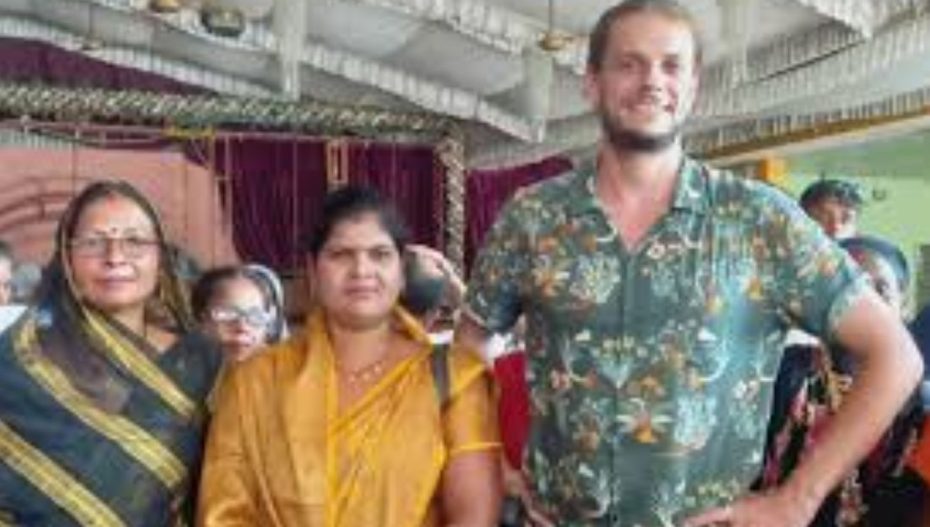
Valentin Hénault came to India in 2023 with a documentary project and a lifelong dream. He left with a book about prison.
The 32-year-old French author and filmmaker has published J’avais un rêve indien. Dans l’enfer de la prison de Gorakhpur. In English, it means “I Had an Indian Dream: In the Hell of Gorakhpur Prison.”
It was launched in India on January 15, 2026, and is currently available only in French.
“I had an Indian dream like others had an American dream,” Hénault was quoted as saying.
The Arrest
Hénault had arrived in India on a business visa to research and film stories about caste-based discrimination and atrocities faced by Dalit women across Bihar, Jharkhand, and Uttar Pradesh.
On October 10, 2023, he attended the Ambedkar’s People’s March, a protest in Gorakhpur focused on land rights for landless Dalits, OBCs, and Muslims.
“I was just there. I was not filming anything. I was just present,” he reportedly said. “After maybe ten minutes, the police saw that there was a white guy in the crowd, and they came and surrounded me.”
That night, police came to his hotel and arrested him. An FIR was filed on November 11, 2023, at Cantt Police Station in Gorakhpur, charging him under Section 14B of the Foreigners Act, 1946, for allegedly participating in activities not permitted under his business visa.
He was also accused of illegally financing the protest, which he has categorically denied.
“I think the real goal of the arrest was to make a little media buzz about how a heroic police force in Gorakhpur arrested a dangerous foreigner, because they didn’t really have a judicial, legal matter on which they could base my arrest,” he said.
“I think there was another reason because I was on a business visa in the name of a production company. What they stated later in the charge sheet was that I had violated the terms of my visa by illegally financing NGOs. I was not financing anything,” he was quoted as saying.
His arrest drew wide coverage, with a news agency running a headline titled: French national arrested in Gorakhpur for violating visa norms.
Hénault was eventually allowed to return to France in 2024.
Inside Gorakhpur Jail
The book, structured into around 16 chapters, documents what Hénault witnessed inside. His first night set the tone.
There was no space, he was quoted as saying. “There were 300 people in the same barrack. I had no space to sleep or turn around.” He slept on his side, pressed against strangers.
He witnessed people dying inside the jail. “The guards didn’t open the door. This is very shocking,” he said.
He said witnessing people die in front of his eyes deeply affected him emotionally.
Caste and religion shaped life behind bars just as they do outside. Muslims were housed together in a separate barrack, he said. Upper-caste inmates occupied the relatively better central areas. Those from lower castes were pushed to the darker corners near the toilets.
“People were Brahmins in the center. And then next to the toilets, where it’s very dark, were dozens of people, obviously from lower castes,” he said.
As a foreigner, Hénault said he was treated comparatively better. He did not shy away from naming it. “For me, it’s white privilege, which is also disappointing for me.”
He communicated with English-speaking inmates and picked up some Hindi along the way. “Thoda thoda Hindi aata,” he said.
The physical toll was significant. The psychological one was worse. He called the uncertainty of not knowing when (or whether) one’s case would be heard “mental torture.”
He said many inmates did not know how long they would remain in jail, with no hearings or court appearances scheduled.
“This is a story of survival — how, in extremely hard conditions, you try to maintain yourself, to stay powerful, energetic, to keep yourself alive,” he said.
The Filmmaker
Hénault graduated with a master’s degree in finance at 20 before abandoning that path for documentary filmmaking.
His first short documentary, L’Homme du sous-sol (2019), about a homeless man beneath Paris’ business district, was selected at the Cinéma du Réel international documentary film festival in Paris.
Michel et la vague jaune (2020) engaged with social movements in France. La Désertion (2022) was a black-and-white fictional short about children in an abandoned village.
His first feature documentary, Les Repentis (2023), follows a Roma man navigating identity and social exclusion.
The book is his first work of writing. It is, he said, both personal memoir and collective testimony.
“It’s my personal story — the month I spent in Gorakhpur jail. And it’s also the stories of the other inmates I met there.”
Also Read: Now, a Gujarat Dalit Is Assaulted For Going To A Hindu Temple https://www.vibesofindia.com/atrocities-on-dalits-in-gujarat/