

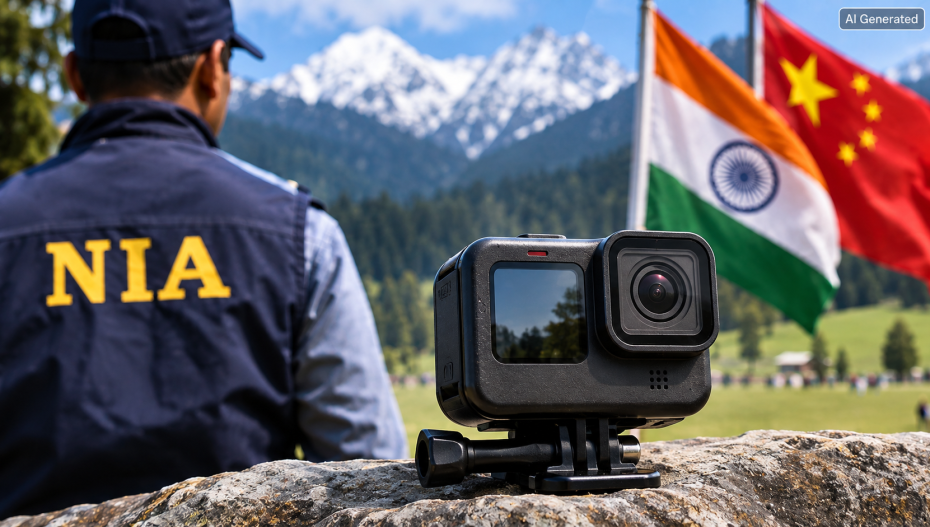
A GoPro camera recovered during the investigation into the Pahalgam terror attack has become an important clue for investigators trying to understand how the attackers prepared for the massacre. The device was originally supplied to a distributor in China and was first activated in the Chinese city of Dongguan in January 2024. However, how it eventually reached the terrorists remains unclear.
India has approached Chinese authorities for information about the camera’s ownership and supply chain, but has not received a response so far. The National Investigation Agency (NIA), however, says it has collected forensic evidence as it continues to investigate the device’s possible connection with the attack.
NIA Director General Rakesh Aggarwal confirmed the delay on Friday. Speaking to reporters, he said, “We have not received any reply so far… But we have some forensic evidence.”
The NIA recovered a GoPro Hero 12 Black camera during its investigation. The device carries the serial number C3501325471706.
To establish where the camera came from, investigators contacted its US-based manufacturer, GoPro. The company informed the agency that the camera had originally been supplied to an authorised commercial distributor in China, AE Group International Limited.
According to the company’s records, the device was first activated on January 30, 2024, in Dongguan, China. However, GoPro did not have information about later transactions or the person who eventually purchased it.
This has left investigators with several unanswered questions. They are trying to establish who bought the camera, whether it changed hands through intermediaries and how it reached the Pakistan-based terrorists allegedly involved in the attack.
The NIA wants to trace the camera’s journey from its original distributor in China to the people accused of carrying out the attack.
Investigators are examining whether the device was used to record the area before the attack, study movement patterns or prepare for the operation. They are also looking into whether the camera was part of a larger network through which equipment and other resources were supplied to terror groups operating in Jammu and Kashmir.
India and China do not have a bilateral Mutual Legal Assistance Treaty (MLAT), which normally provides a formal framework for countries to help each other with legal investigations.
Therefore, the request is being pursued through legal and diplomatic channels. After the Union Home Ministry cleared the request, a special court in Jammu granted permission on March 2 to approach Chinese judicial authorities through a letter of rogatory. This is a formal request asking authorities in another country to assist with an investigation.
The camera has drawn attention because of its possible connection to the April 22, 2025, attack at Baisaran Valley in Pahalgam, Jammu and Kashmir.
The attack claimed 26 lives, including 25 tourists and a local pony operator. The Resistance Front (TRF), described as a proxy of Lashkar-e-Taiba (LeT), claimed responsibility for the massacre.
The NIA is examining whether the camera could provide information about the attackers’ preparations and movements before the incident. However, its exact use in the attack has not yet been established.
In July, security forces killed three terrorists identified in connection with the attack during an encounter in the Dachigam forests on the outskirts of Srinagar. The operation was named Operation Mahadev.
The NIA later filed a chargesheet against Lashkar-e-Taiba and six individuals in connection with the case.
The three terrorists killed during the encounter were named as Faisal Jatt alias Suleman, Habeeb Tahir alias Chottu and Hamza Afghani. The chargesheet also named self-styled LeT commander Sajid Jatt alias Sajid Jutt.
Two local residents, Bashir Ahmad Jothatd and Parvaiz Ahmad, were also named. They were accused of providing food and shelter to the attackers for five hours a day before the massacre.
While the chargesheet has named the accused and security forces have killed three terrorists linked to the attack, investigators are still trying to establish the complete network behind the incident.
The GoPro camera could help answer questions about the movement of equipment and the possible support network used by the attackers. The NIA is also examining whether other tactical equipment and resources are being supplied to terror groups through similar channels.
For now, the camera’s journey beyond its first activation in China remains unknown. The NIA is waiting for China’s response while continuing its own forensic investigation.