


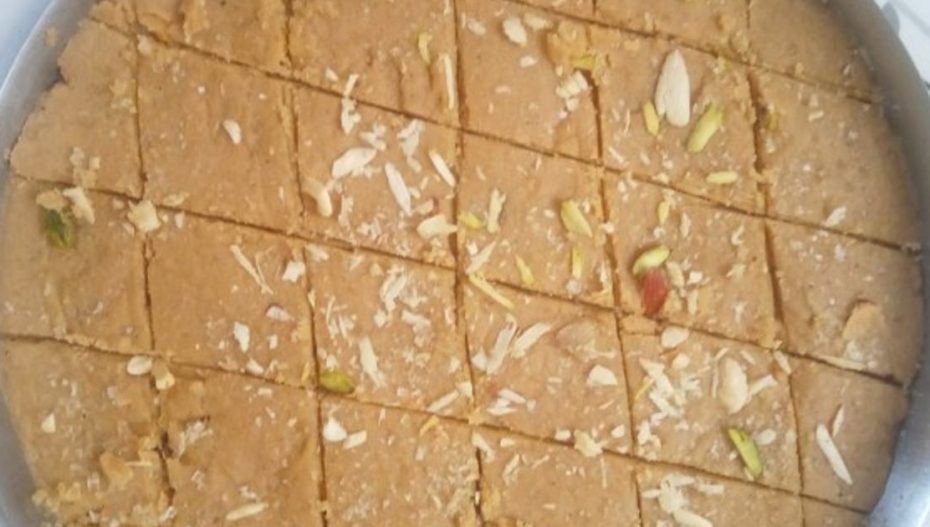
The Gujarat government has discontinued the weekly serving of sukhdi — a traditional Gujarati sweet made from wheat flour, jaggery and ghee — from the state’s government school mid-day meal programme, affecting nearly 38.5 lakh students enrolled in approximately 32,230 government schools across the state.
The decision, taken under the Centre’s ‘Fit India’ initiative, removes a food that nutrition experts have long regarded as a culturally embedded, high-calorie supplement well-suited to children facing chronic undernutrition. The timing is striking: Gujarat’s own government told the state Assembly in February 2024 that 5.70 lakh children in the state are malnourished, with 1.31 lakh classified as severely underweight.
Officials said a committee reviewing the state’s nutrition plan recommended reducing oil and fat intake in children’s diets, prompting the removal of sukhdi — whose ghee content was flagged as inconsistent with the Fit India programme’s dietary guidelines. The change brings Gujarat in line with the Centre’s push for leaner school menus.
BACKGROUND: WHAT SUKHDI IS AND WHY IT WAS INTRODUCED
Sukhdi — also known as Gol Papdi — is one of Gujarat’s oldest and most universally consumed foods. Prepared by roasting whole wheat flour in ghee, then mixing in melted jaggery off the flame, it sets into dense, calorie-rich squares that have served as an energy food in Gujarati households for generations. It is offered as prasad at temples, packed in school tiffin boxes, and historically given to children as a quick, sustaining meal.
Nutritionally, the combination delivers complex carbohydrates from wheat, fat-soluble vitamins and high caloric density from ghee, and iron, potassium, and magnesium from jaggery — micronutrients that are frequently deficient in the diets of undernourished children. The Akshaya Patra Foundation, one of India’s largest mid-day meal implementers, cites sukhdi as part of its regionally calibrated, nutritionally sensitive menu specifically for Gujarat.
Gujarat introduced the weekly sukhdi serving to government school meals in March 2024, explicitly to boost caloric and micronutrient intake among students. The state’s own mid-day meal portal described the recipe as “approved by CFTRI and nutrition experts.” In November 2024, the government launched the Mukhyamantri Poshan Alpahar Yojana, expanding the supplementary snack programme further to include chana chaat, millet-based sukhdi, and other items. Now, less than two years after its introduction, the traditional wheat-ghee-jaggery sukhdi has been removed.
THE MALNUTRITION CONTEXT
Gujarat’s child nutrition figures present a sharp contrast to its image as one of India’s most economically prosperous states. According to the National Family Health Survey-5 (NFHS-5), approximately 39-40 per cent of children under five in the state are stunted — chronically undernourished to the degree that physical growth has been permanently affected. Gujarat has the highest rates of severe wasting among the three major states studied alongside Bihar and Maharashtra.
The NITI Aayog’s SDG report for 2023-24 ranked Gujarat 25th in the national hunger index, placing it in the ‘aspirant’ category — alongside Bihar, Jharkhand, and Chhattisgarh — despite the state’s per capita income ranking among India’s top five. The Centre has allocated Rs 2,879 crore to Gujarat under the Poshan Abhiyaan over three years, yet the number of beneficiaries actively enrolled in nutrition programmes has declined during the same period, from 4.28 million in 2021-22 to 3.78 million by March 2024.
Government data presented in the Gujarat Assembly acknowledged 5.70 lakh malnourished children in the state, of whom 4.38 lakh are underweight and 1.31 lakh are severely underweight. Kheda district recorded the sharpest single-year rise — 9,634 additional malnourished children — followed by Ahmedabad (3,516), Bharuch (1,584), and Valsad (1,335).
The children enrolled in Gujarat’s 32,230 government primary schools — who are directly affected by the sukhdi withdrawal — are disproportionately from Scheduled Caste, Scheduled Tribe, and Other Backward Class families. The state’s tribal belt districts — Dahod, Dang, Narmada, Sabarkantha, Banaskantha, Bharuch, Panchmahal, Tapi, Vadodara, Valsad, and Navsari — record the state’s worst child nutrition indicators, with malnutrition rates consistently above the Gujarat average. For many children in these areas, the government school meal is the most nutritionally reliable food they receive each day.
QUESTIONS OVER THE FIT INDIA RATIONALE
Public health experts have questioned the application of ‘Fit India’ dietary guidelines — which were designed primarily to address obesity and sedentary lifestyles in urban India — to a school feeding programme serving children facing chronic caloric and micronutrient deficits.
The Fit India movement, launched in August 2019, was conceived to combat lifestyle diseases arising from excess food intake, not undernourishment. Its dietary recommendations — reducing fats and oils, increasing fibre and vegetables — address the nutritional concerns of India’s growing urban middle class, not the energy deficits of malnourished children in government schools. Nutritionists have noted that ghee, specifically, provides fat-soluble vitamins (A, D, E, K) and caloric density that are directly beneficial to underweight children.
The sukhdi served in government schools was itself a committee-reviewed, nutritionist-approved formulation, according to the state’s own MDM records — not an unregulated indulgence but a calibrated supplement designed specifically for the school nutrition context.
WHAT REPLACES SUKHDI
Under the revised Mukhyamantri Poshan Alpahar Yojana menu, the traditional sukhdi is replaced by a rotation of: moong chaat, vegetable poha, mixed pulses chaat, millet sukhdi, and vegetable upma. Officials say the new items provide a more balanced nutritional profile while aligning with health and fitness guidelines.
The state has allocated Rs 617.67 crore for the snack programme in the 2025-26 financial year. Gujarat is the first state in the country to provide supplementary nutritious snacks to all students from Balvatika to Class VIII in addition to the meals provided under the PM Poshan Yojana, according to a government release.
Nutritionists note that pulses-based options such as moong chaat and mixed pulses chaat provide protein and fibre, while poha and upma offer iron and complex carbohydrates. However, they caution that caloric density — the measure most directly relevant to children facing undernutrition — is lower in these options than in traditional sukhdi, and that preparation complexity for the new dishes may pose challenges for minimally staffed and equipped village school kitchens.
A SHIFTING POLICY TIMELINE
The movement of sukhdi in and out of Gujarat’s school nutrition programme within two years has drawn attention to the consistency of the state’s dietary planning. The supplement was introduced in March 2024; the supplementary snack programme was expanded in November 2024; and the traditional sukhdi has now been withdrawn in 2026.
Gujarat launched a Nutrition Mission in March 2025 under the Viksit Gujarat Fund, with a Rs 75 crore allocation for 2025-26 — acknowledging that child malnutrition remains a structural challenge in the state. Officials noted at the time that a similar initiative proposed in 2011-12 had failed to produce the intended results.
Also Read: Food, Faith and Fascism in New India https://www.vibesofindia.com/food-faith-and-fascism-in-new-india/