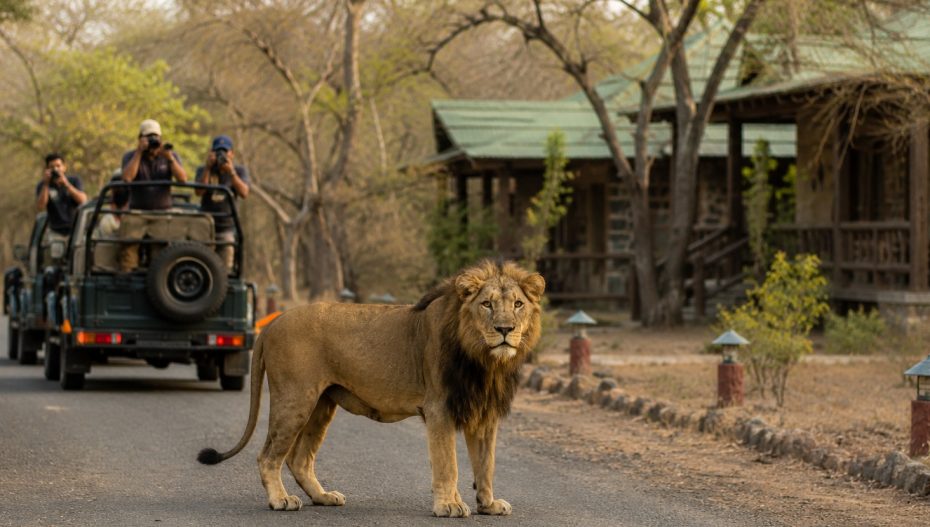
Following a sharp rise in lion-human conflict incidents in the Greater Gir region, the Gujarat government has announced a series of strict measures to improve wildlife protection and public safety. Officials said that 10 incidents involving lions and humans have been reported in just the last 45 days, prompting the government to tighten rules on tourism, illegal resorts and movement inside the Gir landscape.
The state has decided that no new permissions will be granted for resorts or hotels in and around the Gir region until a complete review of tourism infrastructure is carried out.
Forest and Environment Minister Arjun Modhwadia said the government will also take strict action against resorts that are operating without permission.
“The government has decided not to approve any new resort or hotel permission in Gir and Greater Gir. Those operating without permissions will be closed and their structures will be demolished,” he said.
Illegal Resorts Under Scanner
According to forest department officials, a large number of resorts have come up over the years, many of them operating under the name of homestays. Authorities believe this has increased human activity in areas that are important habitats for Asiatic lions.
Officials also said that some of these establishments have allegedly been linked to illegal lion shows and unauthorised wildlife tourism, practices that conservationists have repeatedly raised concerns about.
A survey will soon be conducted to identify resorts and hotels that are operating without proper approval.
Dhari-Tulsishyam Route Faces Special Attention
The Dhari-Tulsishyam corridor is among the areas that will be closely monitored. Around 30 resorts have been developed along this route, which is commonly used by pilgrims travelling to Diu as well as tourists hoping to spot lions outside the official safari zones.
Officials said the increasing number of visitors stopping along this route has added pressure on the wildlife habitat.
Hundreds of Homestays Expanded Into Commercial Resorts
Forest officials estimate that nearly 550 homestays are currently operating across the Talala, Sasan and Mendarda areas, mainly catering to tourists visiting Gir.
Many of these properties were originally approved as homestays but later expanded into commercial resorts, allegedly violating the conditions under which they received permission.
Officials also pointed to one homestay in Dhari that continues to operate even after its permit was cancelled. Despite being classified as an illegal establishment, a proposal was reportedly moved by the Dhari forest division seeking forest land diversion to provide road access to the same property.
The Gujarat High Court has, on several occasions, directed the forest department to take action against illegal resorts in the Gir region.
Stricter Monitoring on Sanctuary Roads
The government is also planning tighter control over vehicles using roads that pass through the Gir sanctuary.
While these roads remain open for local residents and public transport, officials said tourists often misuse them by stopping their vehicles to look for lions.
To prevent this, surveillance at checkposts will be strengthened and technology will be used to monitor vehicle movement.
A similar system is already functioning on the Sasan-Talala road, where vehicle speeds are tracked and alerts are generated if motorists cross the speed limit of 30 kmph.
Officials are now considering adding systems that can also detect vehicles that remain parked for long periods in sensitive wildlife zones.
Pilgrim Movement May Also Be Regulated
Apart from tourists, the forest department is also studying ways to better manage the growing number of pilgrims visiting temples located inside the Gir landscape.
Unlike safari visitors, whose numbers are already limited, pilgrim movement is currently not regulated.
The government is considering measures such as limiting the number of pilgrims during busy periods and allowing entry in staggered groups. Each group could be accompanied by trained forest trackers to ensure safety and reduce disturbance to wildlife.
Officials are also planning to train local doliwalas, who carry pilgrims to hilltop temples, so that they move only with designated groups and follow wildlife safety guidelines.
Balancing Conservation and Public Safety
The latest measures reflect the government’s effort to balance tourism, religious visits and wildlife conservation in one of India’s most important lion habitats.
With lion-human conflict becoming more frequent, officials believe stricter regulation of tourism infrastructure, better monitoring of vehicles and improved management of visitor movement will help reduce risks for both people and the Asiatic lions that call the Gir landscape home.
Also Read: 12-Year-Old Boy Killed After Being Dragged Away By Lion On Girnar Steps In Gujarat https://www.vibesofindia.com/12-year-old-boy-killed-after-being-dragged-away-by-lion-on-girnar-steps-in-gujarat/