


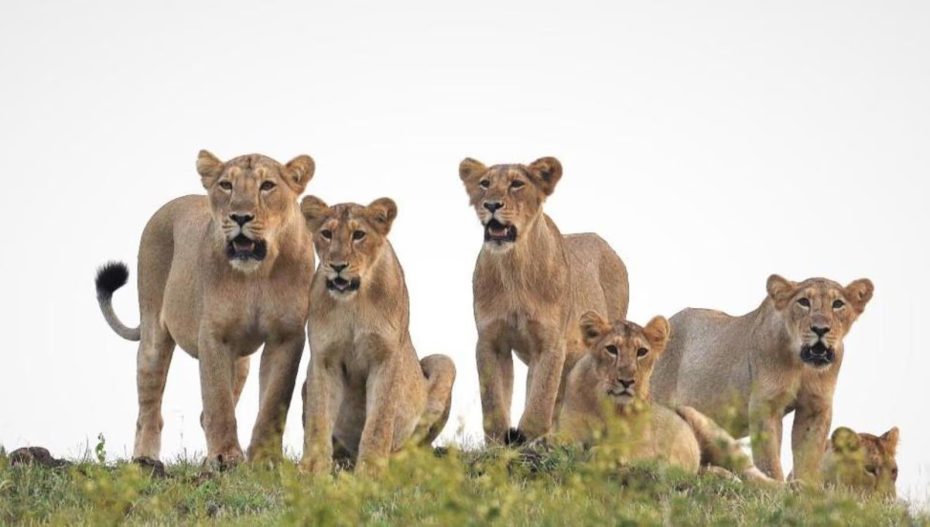
Gujarat’s Asiatic lions are no longer staying within the traditional forests and scrublands of the Gir region. As their numbers continue to grow, the big cats are increasingly moving into farms, villages and other human-dominated areas across Saurashtra.
A new projection presented during a World Lion Day seminar suggests that by 2047, the lion landscape in Gujarat could expand to nearly 50,000 square kilometres. If that happens, lions could be spread across 11 districts and around 80 talukas of Saurashtra.
The expansion is being seen as a major success for lion conservation, but experts have also warned that a larger lion population and a wider habitat will bring new challenges. Protecting the animals will require more than forests and protected areas. Local communities, farmers and residents will also have to become an important part of the conservation effort.
Lion territory could expand by 15,000 sq km
At present, the lion landscape covers an estimated 35,000 sq km across Saurashtra. Over the next two decades, this range could increase by another 15,000 sq km, taking the total area to nearly 50,000 sq km by 2047.
The projected spread would mean lions moving further into agricultural fields, villages and other areas where people live and work.
The change is closely linked to the steady rise in Gujarat’s Asiatic lion population. The state’s lion population has grown by more than 70% over the past decade, increasing from 523 lions in 2015 to 891 in 2025.
The latest population estimate also includes around 330 adult lionesses.
While the rise shows that conservation efforts have helped the species recover, the growing population is also putting pressure on available natural habitats.
Conservation success is moving beyond protected forests
Principal Chief Conservator of Forests Jaipal Singh said Gujarat’s success in protecting lions has been possible because of the participation and support of people across the state.
However, he stressed that conservation cannot remain limited to protected forests as the lion population continues to expand.
As lions move into new areas, communities living around these areas will increasingly come into contact with them. This makes it important to create systems where people and lions can live alongside each other safely.
The challenge, therefore, is no longer simply to protect lions inside forests. It is also to manage the growing interaction between lions and people outside protected areas.
Experts call for a secure second home
Former president of the Board of Trustees of WWF-India Divyabhanusinh Chavda said Gujarat must create a secure second home for lions as the population continues to grow.
He questioned whether Barda, which is being promoted as a possible second home for the species, would provide enough geographical separation from the existing lion population.
Barda is located around 150 km from the present lion habitat. According to Chavda, this distance may not be enough to protect the wider lion population from a disease outbreak.
He specifically raised concerns about diseases such as canine distemper virus (CDV). If a disease spreads through a population concentrated within the same broader landscape, a large number of lions could be at risk.
A geographically separate second population would therefore provide an additional layer of protection for the species.
Nearly half the lions live outside protected areas
Another major concern is the gap between the number of lions and the amount of protected habitat available to them.
Gujarat currently has 891 lions, but only around 1,890 sq km is projected to be protected lion habitat.
Nearly half of the lion population is believed to live outside protected areas.
This means that villages, farms, roads and other human-use areas are already an important part of the landscape in which Gujarat’s lions live.
As the lion range expands towards 50,000 sq km, this overlap is expected to become even greater.
Rising human-lion conflict is a concern
The wider movement of lions also raises concerns about human-animal conflict.
Chavda pointed to seven human-attack incidents reported in one area over the past two months and called for an investigation into the reasons behind these incidents.
He said authorities should examine whether illegal activities or other local factors were contributing to the attacks.
The concern is that if lions continue moving into areas with greater human presence, encounters between people and animals could increase. This could create risks for both communities and lions.
The projected expansion makes it important to understand these incidents early and identify measures that can prevent similar situations in the future.
Conservation must include local communities
Experts have stressed that people living in lion areas cannot be treated only as residents living near wildlife. They need to become active partners in conservation.
Chavda called for greater employment of local people in conservation-related work. Giving communities a stronger role could help create both livelihoods and a sense of responsibility towards protecting the lions.
The approach could also help ensure that people who live alongside lions have a direct stake in maintaining a safe environment for both humans and wildlife.
As the lion landscape expands, conservation will increasingly depend on cooperation between forest officials, local residents, farmers and other communities.
Questions remain over the second lion population
The idea of creating a second home for lions has been discussed for years. Earlier plans to move some lions to Kuno did not make progress.
Chavda said Gujarat now needs the political will to establish a genuinely separate and secure lion population.
The concern is not simply about finding another forest where lions can live. The second home needs to be large enough, suitable for the species and sufficiently separated from the main population to provide protection against threats such as disease outbreaks and other large-scale risks.
Documentary highlights the journey of Gir’s lions
The World Lion Day programme also saw the release of “Gir Ki Amulya Dharohar,” a documentary focusing on the conservation journey of the Asiatic lion and the efforts made to protect the species.
The film, prepared by Rajya Sabha MP and wildlife enthusiast Parimal Nathwani, highlights the role of lionesses in raising cubs and helping sustain the next generation of the species.
It also showcases the relationship between lions and the Maldhari community, while recognising the contribution of forest officials, frontline staff, trackers and local communities to lion conservation.
The documentary comes at a time when Gujarat’s lion population has reached a major milestone.
The lion population has increased from 523 in 2015 to 891 in 2025, while the species’ range has expanded to around 35,000 sq km across 58 talukas in 11 Saurashtra districts.
India celebrates the rise in Asiatic lions
The growth in Gujarat’s lion population has also been highlighted at the national level.
Union Environment Minister Bhupender Yadav said the rise in the Asiatic lion population reflects India’s commitment to wildlife conservation and biodiversity.
Prime Minister Narendra Modi has also spoken about the growing lion population and the country’s efforts towards conservation.
The increase from 523 lions in 2015 to 891 in 2025 is a significant conservation achievement. But the next stage may prove more complicated.
The next challenge: Protecting a much larger landscape
The success of Gujarat’s lion conservation programme has created a new challenge: where will the growing population live safely?
A lion population spreading across nearly 50,000 sq km would be a remarkable development, but it would also mean that wildlife management would have to extend far beyond traditional protected forests.
More lions in villages and agricultural areas could mean more encounters with people. A larger population concentrated within the same broad region could also remain vulnerable to diseases. At the same time, the limited amount of formally protected habitat may not be enough to support the population in the long term.
This is why experts are calling for a carefully planned second home, stronger protection outside protected areas and greater participation of local communities.
Gujarat’s lions have made an extraordinary comeback. The next task will be to ensure that their expanding roar does not come at the cost of human safety or the long-term security of the species. By 2047, the success of lion conservation may depend not only on how many lions Gujarat has, but also on how safely lions and people can share the much larger landscape they are expected to occupy.
Also Read: Lions In Conflict With Humans To Be Kept In New 100-Hectare Ambardi Facility https://www.vibesofindia.com/gujarat-ambardi-safari-park-100-hectare-enclosure-lions-human-attacks/