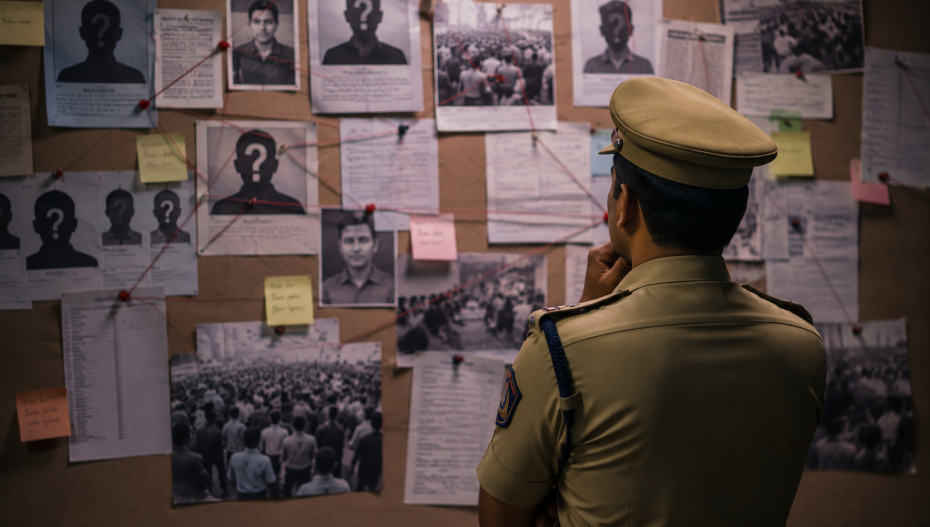
A wanted list is supposed to help police identify and track people who are accused of crimes and are believed to be evading arrest. But in Gujarat, questions are being raised about how useful some of these records actually are.
The state’s police wanted register currently contains 1,682 entries, but several records provide descriptions so vague that officers may struggle to determine exactly who they are looking for.
Some entries do not provide a name at all. Instead, they describe an accused simply by appearance, age, relationship or the circumstances in which the person was identified.
Among the records are descriptions such as an “unidentified elderly woman,” “two unidentified labourers,” and even a “mob of around 10,000 people.”
The problem is not limited to missing names. In some cases, the same accused may appear under different names or aliases in different police records, raising concerns about the accuracy and consistency of the database.
A wanted person described as a crowd
One of the most striking examples comes from a riot-related case registered by the Detection of Crime Branch in 2017.
Instead of identifying an individual accused, the wanted record simply describes the accused as a “mob of around 10,000 people.”
Such a description may indicate that investigators knew a large group was involved but did not have enough information to identify each person individually.
For a wanted register, however, this creates a major practical problem. Police officers trying to trace an accused cannot act on a description of an entire crowd unless individual identities are established.
Elderly woman and unidentified labourers also on the list
Other entries are similarly unclear.
A 2015 case from Sanand reportedly contains an entry referring to an “unidentified woman near land.”
In another case, Shaherkotda police have an entry for an “unidentified elderly woman.”
Chandkheda police, meanwhile, have listed “two unidentified labourers” as wanted.
These descriptions may have been useful when the cases were first registered, especially when investigators had not yet established the identities of the accused. But when such entries remain in the wanted database for years without being updated, they become much less useful for tracking people.
Some records offer only an age range
The problem is also visible in records where a person has been given an approximate age but no name or other clear identity details.
For example, a 2016 case in Maninagar describes a fugitive only as a “male aged 40 to 42 years.”
There is no name or other identifying information that would allow an officer to confidently establish who the person is.
Such descriptions can make it extremely difficult to distinguish one accused person from another, particularly when the description is based only on an approximate age.
Old FIR descriptions remain in the system
A review of the register suggests that some descriptions recorded when FIRs were first filed have remained in the system for years without being properly updated.
At the beginning of an investigation, police may not know the identity of an accused. In such situations, a description based on appearance, age or circumstances can be understandable.
The problem arises when investigators later gather more information but the wanted record is not revised.
Names, photographs, verified addresses and other identifying details may become available during an investigation, but if those details are not added to the wanted database, the original vague description continues to remain there. That can severely reduce the usefulness of the register.
Names and aliases can also create confusion
Another issue is that some accused people appear under different names or aliases in separate police records.
This can make it difficult to determine whether two entries refer to the same person or to different individuals.
For police officers working across districts, consistency in names, photographs, addresses and other identifying information is particularly important.
If one station records an accused under one name while another uses a different alias, tracking the person can become more complicated.
It can also make it harder to determine whether an accused has already been identified, arrested or otherwise dealt with in another case.
Why outdated records are a problem
The wanted register is meant to help police quickly identify and locate people who are wanted in criminal cases.
But vague or outdated entries can turn the database into a list where police know that an accused is wanted without necessarily knowing who that person actually is.
This creates what can be described as a basic identity problem.
Police may know that someone connected to a particular case is on the run, but the record may not contain enough information to establish the person’s identity or locate them.
The issue becomes even more important when old records remain active for years without verification.
Many records begin with incomplete information
Police officials have indicated that such descriptions generally originate at the FIR stage, when the identity of an accused has not yet been established.
This explains why records can initially contain descriptions such as an unidentified woman, an elderly woman or unidentified labourers.
However, the concern is whether these records are subsequently revised when investigators obtain additional information.
If a person is later identified through investigation, photographs, addresses, documents or other evidence, those details need to reach the wanted register as well.
Without regular updating, the original description can remain even when better information is available.
A database needs regular updating
The issue points to the importance of keeping police records current. A wanted register becomes far more useful when it contains basic identifying information such as:
Full and verified name
Known aliases
Recent photograph
Verified address
Age and other identifying details
Details of the case
Police station and district handling the case
Updated status of the investigation
When these details are missing, officers have fewer tools to trace an accused.
The problem is especially serious when an entry has remained unchanged for several years.
The larger question of accuracy
The concerns surrounding the wanted list are therefore not simply about missing names.
They raise a broader question about how consistently police records are maintained across different stations and districts.
A person may be known by one name in one record and another name elsewhere. An unidentified person may eventually be identified, but the database may continue to carry the original description. In other cases, investigators may have gathered additional information that has not been reflected in the central record.
All of this can make the register less reliable as a tool for police investigation.
From a list of suspects to a useful tracking system
A wanted register is most effective when it helps an officer answer three basic questions quickly: Who is the accused? What case are they wanted in? And where can they be found?
The examples in the Gujarat register show that some records do not provide enough information to answer even the first question.
The presence of descriptions such as a large mob, an unidentified elderly woman or two unidentified labourers highlights the difficulties police face when identities remain unresolved.
The challenge now is to ensure that old records are reviewed, new information is added and names, photographs, addresses and aliases are verified regularly.
For Gujarat Police, maintaining an accurate wanted database is not merely an administrative exercise. It can directly affect the ability of officers to identify, trace and arrest people who are wanted in criminal cases.
The basic problem is clear: police may know that someone is wanted, but outdated or incomplete records may not always tell them exactly who that person is.
Also Read: 12 Years Later, A Birthday Wish On Facebook Leads Police to Missing Girl https://www.vibesofindia.com/amreli-missing-girl-found-after-12-years-facebook-birthday-post/