

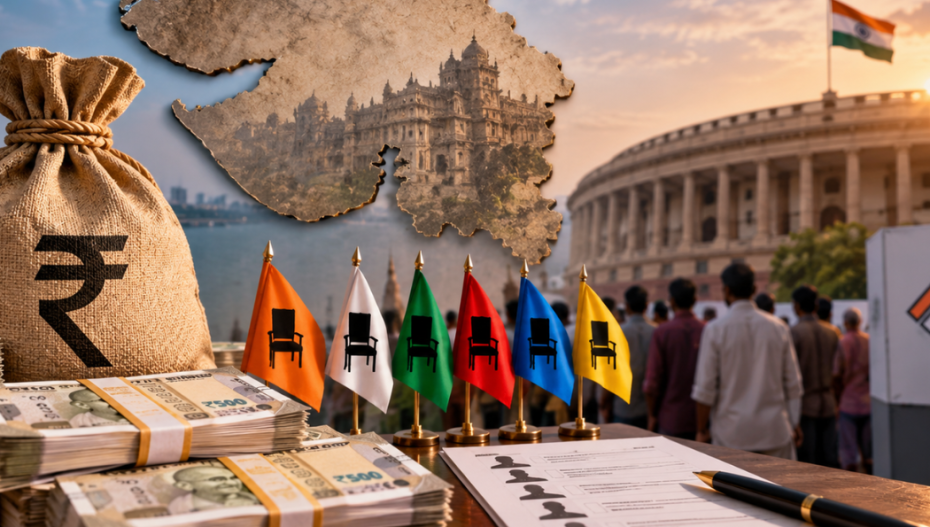
Six registered but unrecognised political parties based in Gujarat received more than ₹1,500 crore in donations in 2022-23, according to an investigation into their finances and electoral activities.
The six parties together fielded only 15 candidates in the 2024 Lok Sabha elections, despite receiving donations ranging from ₹138 crore to ₹620 crore in the 2022-23 financial year.
The parties are Satyavadi Rakshak Party, Aam Janmat Party, Gareeb Kalyan Party, Swatantrata Avivyakti Party, Bharatiya National Janata Dal and New India United Party. Five of them have their registered offices in Ahmedabad, while one is headquartered in Anand.
The investigation does not allege that the donations were illegal. However, it raised questions about the large amounts received by parties with a limited electoral presence and found little evidence of substantial activity at several of their registered offices.
Aam Janmat Party Received ₹620 Crore
Among the six parties, the Aam Janmat Party was the biggest recipient, receiving ₹620 crore in donations in 2022-23.
The Satyavadi Rakshak Party received ₹330 crore, while the New India United Party received ₹200 crore.
The Gareeb Kalyan Party received ₹138 crore, the lowest amount among the six parties for which the figures were highlighted.
Overall, the six parties received more than ₹1,500 crore during the year.
Despite these large donations, their combined presence in the 2024 Lok Sabha elections remained limited, with just 15 candidates contesting from the six parties.
Parties Had Limited Electoral Footprint
The Satyavadi Rakshak Party, for example, fielded only one candidate in the 2024 Lok Sabha election.
The party claimed that it spent ₹8 crore on campaigning and had spent ₹316 crore on charity from the ₹330 crore it received in donations the previous year.
The party’s president, Swati Ben, lives in another flat in the same residential complex in Anand where the party’s registered office is located.
She said the party had used its donations for charity but maintained no records of the expenditure.
Registered Offices Showed Little Activity
The investigation also examined the physical locations listed as the official addresses of the six parties.
The addresses were traced to residential flats and shops inside commercial complexes. Several of the locations were found shut, with little visible evidence of substantial political activity.
This raised questions about the gap between the large donations reported by these parties and their limited visible organisational and electoral activity.
However, the investigation did not establish that the parties had violated any law.
How Political Party Donations Work
Indian law allows registered political parties to receive donations.
Such contributions can also provide tax benefits to donors, while political parties receiving eligible donations can receive them under the applicable provisions.
The investigation reported that the income tax department had examined some of the contributions and recovered part of the money as tax from some donors.
Chartered accountants also described one possible mechanism through which donations could be routed.
According to them, a donor may receive a donation certificate that can be used to claim income-tax relief. The donor could then allegedly receive much of the money back from the political party after deductions described as “service charges.”
This was presented as one possible mechanism and not as a finding that all donations received by the six parties followed such a process.
Thousands of Political Parties Registered in India
There are around 2,800 political parties registered with the Election Commission of India, but only 73 are recognised by the poll panel.
Six of these are recognised as national parties — BJP, Congress, AAP, BSP, CPI(M) and NPP. The remaining recognised parties are state parties.
The six Gujarat-based parties examined in the investigation are registered but unrecognised.
All registered political parties are required to have their accounts audited and submit annual returns to the Election Commission. These filings include details of donors who contribute more than ₹20,000.
Focus on Six Highest-Donation Unrecognised Parties
The investigation focused on the six unrecognised political parties that received the highest donations in 2022-23.
Their financial figures stood out because of the contrast between the large sums received and their relatively small electoral footprint.
Together, they fielded 15 candidates in the 2024 Lok Sabha elections.
The Election Commission has previously deregistered more than 800 unrecognised political parties for failing to contest elections or field even a single candidate.
The six Gujarat-based parties did contest the 2024 Lok Sabha elections, meaning they maintained an electoral presence despite their limited political footprint.
Questions Over Their Future
The investigation did not establish whether donations to these six parties continued at the same level after 2022-23 or whether the flow of money declined.
If substantial donations stopped after that financial year, the continued existence of these parties on paper could still raise questions about whether they might receive another large round of donations ahead of a future electoral cycle.
For now, the figures present a striking contrast: more than ₹1,500 crore in donations in one financial year, but only 15 Lok Sabha candidates fielded collectively in 2024.
Also Read: After Son’s Death, Gujarat HC Allows 54-Year-Old Man And Wife Over 50 To Seek IVF