


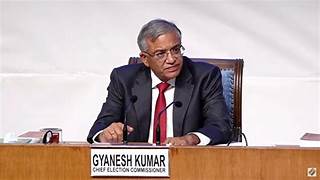
Gyanesh Kumar’s appointment as election commissioner happened suddenly in March 2024, days before the schedule of the general election was to be announced after the abrupt exit of former EC Arun Goel.
This morning, The Indian Express has reported on official communication from within the three-member Election Commission of India which establishes that most orders that have come in the past 10 months, ostensibly from the commission, have not had the consent of the majority of the Election Commissioners (ECs). Gyanesh Kumar Gupta, the Chief Election Commissioner’s (CEC’s) actions have been objected to officially at least 14 times.
This period is very crucial to the sanctity of India’s electoral rolls – the backbone of India’s democracy – as 12 crore names have been struck off in extremely controversial circumstances, with court cases, irate and disaffected voters alleging exclusion. Now it turns out, they violate Article 324 itself, which says clearly that all decisions will be taken unanimously as far as possible, and definitely with the majority in agreement. The powers are vested in the ECI and not the CEC alone.
All three ECs are appointees of the Modi government, and were put in place in accordance with the controversial new law brought in to exclude the presence of the Chief Justice of India (CJI) in the selection committee. The CJI’s presence had been to ensure a non-partisan appointment for such a crucial constitutional office.
But who is Gyanesh Kumar Gupta?
The ECI website describes the 26th CEC of India as a 1988-batch Kerala Cadre Officer of the Indian Administrative Service (IAS). After completing his B.Tech from llT Kanpur, he has also studied Business Finance and Environmental Economics.
A fluent Malayalam speaker, as is demanded by his job, he (in)famously stuck to Hindi in the viral press conference where correspondents from all around India quizzed him on subtle but significant changes in how the Election Commission treated data and CCTV footage from inside polling booths. He evoked the privacy of “ma, beti, bahu” – women – being violated if caught on polling booth CCTVs when activists were up in arms to demand why the footage of voters was not being retained by the commission or being made public.
As Secretary to the government of Kerala, he handled many departments and worked with both Congress and Left Front governments.
ln the government of India, he was Joint Secretary in the Ministry of Defence and Secretary in the Ministry of Parliamentary Affairs. His stint and close work with the ministry of Home affairs, directly with Amit Shah led to his ascent, say colleagues. Newslaundry in a profile earlier this year wrote, that he was “part of the ‘crack team’ tasked with finding a legal and administrative pathway for the removal of Article 370 in Kashmir.” It cites a book published by BlueKraft Digital Foundation – an organisation with close ties to the BJP and Prime Minister Narendra Modi – says while detailing his role in the abrogation of Article 370. The Bluekraft book, has interviews with Modi, Union home minister Amit Shah, National Security Advisor Ajit Doval and several bureaucrats, and “offers a largely hagiographical account of the planning.”
As Joint Secretary and Additional Secretary in the Ministry of Home Affairs and Secretary in the Ministry of Cooperation, he also was key to pet projects of the Modi government, and helped set up the Ram Mandir Trust, being the centre’s pick as ex-officio member in the inaugural body, now extremely controversial after the embezzlement scam has broken out. He was also secretary in the Ministry of Parliamentary Affairs. When with the Cooperation Ministry, the Centre had enforced the Multi-State Cooperative Societies (MSCS) (Amendment) Act, 2023, and set up three pan-India cooperative organisations, Amit Shah’s baby which has given unprecedented central control over the most decentralised of India’s organisations, the cooperatives. Kumar’s last assignment in the service was the post of secretary in the cooperation ministry, headed by Amit Shah.
Less than two months after retiring from the IAS on January 2024, he was appointed as the Election Commissioner in Election Commission of India on March 15, 2024. It may be worth recalling that this was another deeply disturbing phase in the EC when election commissioner Arun Goel resign abruptly, days before the announcement of the schedule of the 2024 general elections. Sources said Goel left due to high handedness of the then-CEC, Rajiv Kumar, though he officially cited ‘personal reasons’. The President of India Droupadi Murmu accepted his resignation immediately and no questions were asked and no answers given either about what was going on in the commission.
Incidentally, his daughter, IAS officer Medha Roopam, the District Magistrate of Noida just this month has been in the eye of a storm over impropriety in handling the matter of a History graduate Aakriti Chaudhary, who has been jailed under the NSA. The Allahabad high court has slammed the DM, calling officers including her “despotic” and leading UP into “an Orwellian nightmare” and for allowing a “concocted story” to go through and incarcerate Aakriti. Roopam is to pay a fine, compensation of Rs 5 lakh for her role in the arrest. She has filed an appeal in the Supreme Court.
Controversial appointment of ECs
Gyanesh Kumar Gupta is the first CEC appointed under the new Chief Election Commissioner and Other Election Commissioners Act, 2023.
The new controversial Bill replaced the old Act of 1991. It provided for the appointment, salary, and removal of the Chief Election Commissioner (CEC) and Election Commissioners (ECs). The Selection Committee now consists of the Prime Minister, a Union Cabinet Minister, and Leader of Opposition/leader of the largest opposition party in Lok Sabha.
As the Constitution states that the President will appoint the CEC and ECs, subject to the provisions of an Act of Parliament. In the Constituent Assembly debates, Dr. B.R. Ambedkar pointed out that the election machinery should be out of the control of the government. Members of the Constituent Assembly agreed to leave the appointment mechanism of the ECI to the discretion of Parliament. In 1991, Parliament passed the Election Commission (Conditions of Service of Election Commissioners and Transaction of Business) Act. The Act set the salary of the CEC and ECs but it did not dictate any mechanism for their appointment process, which continued to be decided by the President, i.e. was an executive decision.
In March 2023, while examining the appointment of the CEC and ECs, the Supreme Court declared that their appointment should not be done only at the behest of the Executive. The Court noted that the ECI should be independent of Executive control. It mandated a selection process, which would hold until Parliament makes a law. It directed that the appointment be done by the President on the recommendation of a Selection Committee, which will comprise (i) the Prime Minister, (ii) the Leader of Opposition in Lok Sabha, and (iii) the Chief Justice of India. The Chief Election Commissioner and Other Election Commissioners (Appointment, Conditions of Service And Term of Office) Bill, 2023, was introduced in Rajya Sabha on August 10, 2023, keeping out the chief justice, so essentially reducing the process to Modi, Shah and the Leader of Opposition in practice. Notes of dissent against the violation of the Supreme Court’s directions were made by Adhir Ranjan Chowdhury and Rahul Gandhi respectively, as reported in The Indian Express today.