


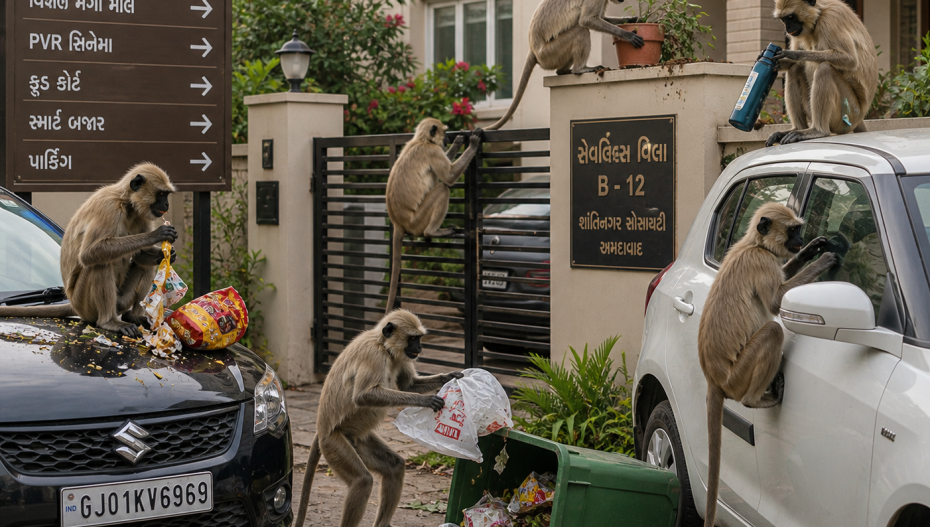
Rising monkey attacks, increasing rescue calls and repeated sightings of langurs in residential areas have prompted authorities to launch Ahmedabad’s first-ever monkey census, marking a major step in tackling what officials describe as a growing urban wildlife crisis.
The forest department has begun an extensive pre-census survey across the city to map monkey populations, identify conflict zones and understand the reasons behind the surge in human-animal encounters. Officials say the move is aimed at replacing the current complaint-based rescue model with a scientific, data-backed strategy.
The exercise comes amid mounting concern over the widespread practice of feeding monkeys near temples, vegetable markets, housing societies and open grounds. Authorities now say what was once seen as a religious or charitable act has become a major cause of aggression, dependency and repeated conflict.
“Once monkeys begin linking humans with food, they lose fear and become increasingly bold,” a senior official said. “That leads to attacks, home intrusions and nuisance behaviour.”
27-Point Survey Begins Across City
As part of the first phase, Ahmedabad Municipal Corporation areas have been divided into zones, with residential societies being asked to fill a 27-point questionnaire circulated through Google Forms.
Residents are being asked to report troop sizes, feeding locations, nuisance levels, waste disposal issues, movement patterns and frequency of monkey encounters.
A trial census will follow the survey to determine the most accurate counting method before a full-scale enumeration is carried out.
The initiative is being led by the Ahmedabad Social Forestry Circle under researcher Deepa Gavli. The proposal was moved by Deputy Conservator of Forests Minal Jani and approved by the Gujarat forest department.
198 Trouble Spots Identified
Officials say monkey presence has become a recurring problem in at least 198 locations across Ahmedabad.
Among the worst-affected areas are Bodakdev, Vastrapur, Navrangpura, Thaltej, Bopal, Ghuma, Ambawadi, Paldi, Shahibaug, Chandkheda, Kubernagar, Naroda, Narol, Sabarmati, Bilasiya, Maninagar and Asarwa.
Residents in several neighbourhoods have reported monkeys entering homes in search of food, snatching bags, damaging property, attacking people and creating panic in apartment complexes.
Feeding Monkeys Now a Crime
The forest department has simultaneously stepped up awareness and enforcement drives, warning that feeding monkeys and langurs is a punishable offence under the Wildlife Protection Act.
Officials said a first offence can attract a fine of Rs 25,000, while repeat violations may lead to imprisonment.
Authorities say indiscriminate feeding has altered natural behaviour patterns, encouraged monkeys to gather in urban clusters and increased dependence on human food sources.
Civic and Image Concerns
Officials also admitted the issue has wider civic implications as Ahmedabad prepares to host more national and international events.
In one example cited by officers, Metro services crossing the Sabarmati River stretch have at times had to slow down or sound horns to drive monkeys away from tracks and structures.
Data to Drive Future Action
Chief Conservator of Forests K. Ramesh, the project’s nodal officer, said the final census is expected to provide crucial data including population size, breeding status, male-female ratio, seasonal movement routes, roosting sites and high-conflict pockets.
The findings will help authorities decide rescue priorities, deployment of teams, capture-and-release strategies and long-term habitat management.
For Ahmedabad, the monkey census is more than a wildlife count — it is an attempt to regain control of an escalating urban menace that has spread from rooftops and riverbanks into the daily lives of citizens.
Also Read: Feeding Monkeys in Ahmedabad Can Now Land You In Jail https://www.vibesofindia.com/377177-2/