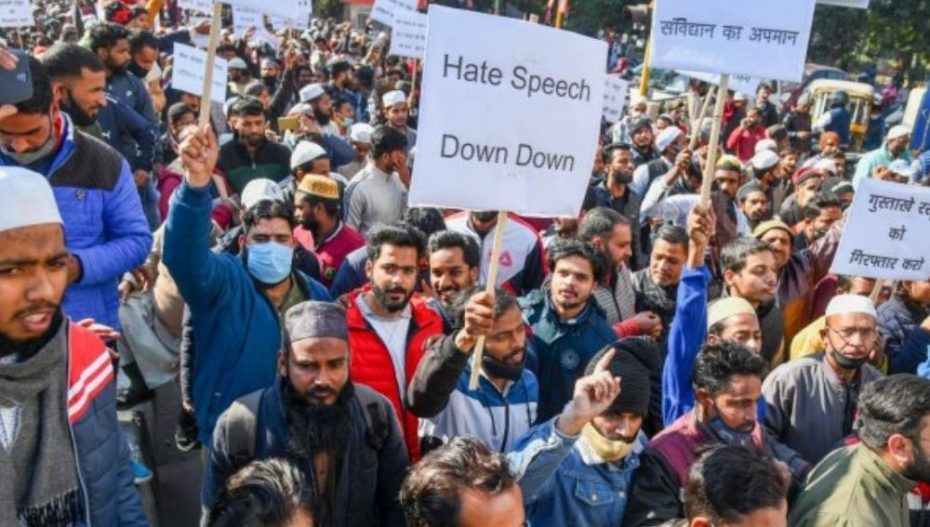
Hate speech in India is no longer a by-product of politics—it has become a deliberate instrument of power. Under Prime Minister Narendra Modi, the Bharatiya Janata Party has systematically turned religious polarisation into a governing strategy, targeting minorities to consolidate votes, silence dissent, and normalise discrimination. What was once coded or dog-whistle rhetoric is now delivered openly, repeatedly and unapologetically. Senior leaders describe Muslims as infiltrators, cast Christians as cultural outsiders and frame critics of the state as disloyal. This is not casual politics—it is the architecture of exclusion. The latest report of India Hate Lab confirms this. In last one year alone, hate speech targeting Muslims and Christians has gone up by 13% in India.
In New India, words are weapons, and minorities are the targets.
Hindus as majority making up roughly 80% of the population. Muslims, the largest minority, account for nearly 14%—around 200 million people—while Christians comprise about 2%, alongside Sikhs, Buddhists, Jains, Parsis, and other communities. Altogether, minorities make up roughly one-fifth of India’s 1.4 billion citizens. Yet instead of embracing diversity, the BJP frames these communities as demographic or cultural threats—a deliberate political calculation designed to consolidate Hindu votes across caste, region, and class.
Diversity is India’s strength; the BJP treats it as a threat.
The consequences of this strategy are clear. According to India Hate Lab, hate speech targeting minorities rose by 13% in 2025, with 1,318 documented cases—nearly double the number recorded just two years earlier. These incidents occurred at political rallies, religious processions, protest marches, and cultural gatherings—public spaces where political messaging seamlessly merges with identity mobilisation. Critically, 1,164 of these incidents were recorded in states governed by the BJP or its allies, highlighting how divisive rhetoric thrives under political protection.
When the state shields hate, violence is only a step away.
Polarisation has become the BJP’s electoral engine. By framing elections as existential battles between a Hindu majority and internal “threats,” the party has repeatedly consolidated votes while distracting from economic distress, unemployment, and governance failures. Nationalist rhetoric surges during crises—such as militant attacks in Kashmir or tensions with Pakistan—casting minorities as collective suspects. In Modi’s India, fear has become a tool for mobilising democracy itself.
Fear is the BJP’s ballot box lubricant.
The human cost is severe and ongoing. In Gujarat, the legacy of the 2002 riots still haunts communities, particularly the massacre at Ahmedabad’s Gulbarg Society, where dozens of Muslims were killed and homes destroyed. Years later, Dalit men were publicly flogged in Una by self-styled cow protectors, showing how vigilante violence rooted in majoritarian ideology can be enacted openly and broadcast as intimidation. Across the country, Muslim and Dalit communities have faced assaults, property destruction, and threats—often under the guise of law enforcement or moral policing.
Citizenship is conditional on religion and fear.
Human rights organisations including Amnesty International and Human Rights Watch argue that these developments are inseparable from policies enacted since 2014: the religion-based citizenship law, anti-conversion legislation, revocation of Kashmir’s special status, and targeted demolition of Muslim-owned properties. Together, they narrow the definition of who truly belongs in India.
Equality before the law has become optional in New India.
The contrast with other diverse democracies is stark. Countries such as Canada and South Africa, both home to large religious and ethnic minority populations, have largely resisted the mainstreaming of state-backed hate speech. While no democracy is free of prejudice, political power in those nations has not been built on vilifying minority populations or stoking fear for electoral gain. In India however, hate speech is politically consolidating the BJP. It bringing more votes to the party. Despite education and world exposure, more and more Indians are becoming susceptible to hate, fascism and bigotry. The BJP is having the last laugh, electorally.
Other diverse nations govern through inclusion; India governs through exclusion.
India Hate Lab follows the UN definition of hate speech—language that promotes discrimination or hostility based on religion, ethnicity, nationality, race, or gender. The BJP dismisses its findings as biased. Yet the steady rise in incidents, their concentration in BJP-governed regions, and their alignment with electoral cycles reveal the pattern clearly: hate speech is not an aberration in Indian politics—it is a strategy. And starting from Gujarat where Narendra Modi was the Chief Minister from 2001 to 2014, now the BJP has mastered this.
Hate is not accidental in India.
Polarisation is now embedded in governance, rhetoric, and electoral strategy. Words have become weapons, fear has become currency, and minorities continue to pay the price. The question is not whether political rhetoric incites division—it is whether India can survive a government that treats fear, exclusion, and hatred as its most reliable tools.
When leaders speak hate, mobs listen.
Human rights groups, including Amnesty International and Human Rights Watch, argue that these developments are inseparable from BJP policy choices since 2014: the religion-based citizenship law, anti-conversion legislation, revocation of Kashmir’s special status, and demolition of Muslim-owned properties. Together, they narrow the definition of who belongs in India, making equality before the law increasingly conditional.
BJP leaders amplify the hate. If we take a few examples, Prime Minister Modi was quoted saying in Rajasthan, ïf the Congress comest to power in India, it would distribute the country’s wealth among “infiltrators” and “those who have more children,” in apparent reference to the Muslim community”.
Ashwini Upadhyay of BJP never misses chance to harp on what he calls population jihad unleashed by Muslims and its’ threat to India.Mahesh Kisanrao Landge of BJP has referred to Muslim areas of India as terrorist hubs. Senior BJP leader and Union minister.Gajendra Singh Shekhawat regularly threatened critics of Sanatan Dharma and has called upon Hindus to pull out tongues and gouge eyes of those against ‘Sanatan’.
When politics depends on hate, democracy itself is at risk. But then this is what is brings votes to BJP in India. So it will continue, Unabated.
Also Read: Food, Faith and Fascism in New India https://www.vibesofindia.com/food-faith-and-fascism-in-new-india/