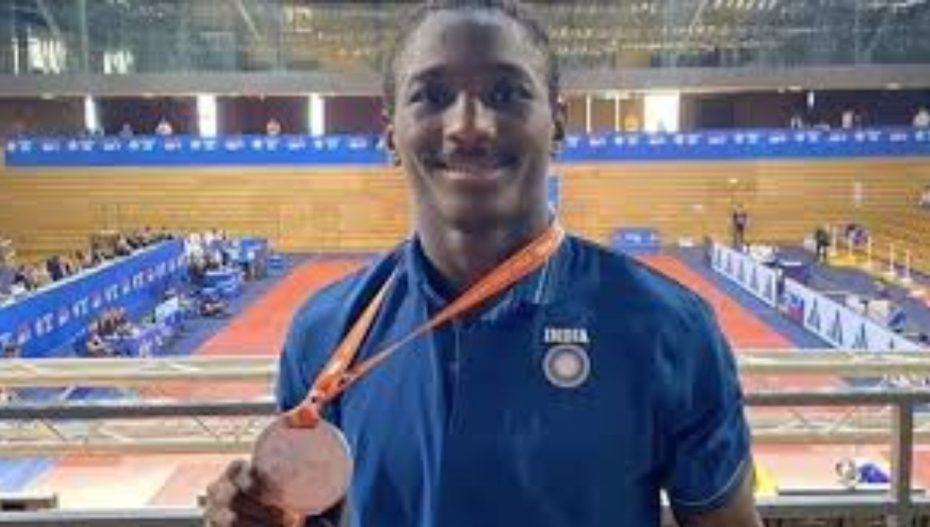
Rohit Majgul has spent a lifetime being told he doesn’t look Indian enough. Now, at 21, the judoka from the Siddi community is making history. He’s making people want that photo with him.
He has withstood the jibes all his life. The stares, the whispers, the names. Flung as abuse, passed off as teasing.
His curly hair and distinctive features have followed him everywhere. These drew comments he never asked for. They reportedly called him African. Explaining that he was not was never the point.
One moment, though, cut deep. At a national under-17 championship in Nadiad in 2019, Majgul had fought his way to the final. As he prepared to step on the mat, a section of the crowd reportedly began hurling racist slurs at him. His cousin and former judoka Afarudin Chovat watched it happen.
Majgul was shaken. He reportedly felt disturbed and deeply hurt. But his friends pulled him back. They told him to block out the noise and focus on his game. He went on to be named the championship’s best judoka.
He resolved that a day would come when people would want to take a photo with him.
Seven years on, that promise is looking less like a boast and more like prophecy.
Last week in New Delhi, Majgul defeated Haryana’s Garvit Hooda in a best-of-three final at the selection trials to claim the -66kg berth.
In doing so, he became the first athlete from the Siddi community to qualify for both the Commonwealth Games and the Asian Games. He did not have time to celebrate. Within days, he was on a flight to Tbilisi, Georgia, for training and competition exposure. He sits there now in the bitter cold, thinking about dal, rice, kachumbar, and a cold glass of chaas. Simple things, home things. Tbilisi, according to a report, reminds him of how far he has come. He means it in every sense.
Jambur, the village he comes from, offers little by way of sporting ambition. Tucked inside the Gir forest in Gujarat and nicknamed ‘mini-Africa’, it is home to the Siddi community, descendants of Africans brought to India by the Portuguese nearly 300 years ago to serve the King of Junagadh.
Who are Siddis?
India’s Siddi community mostly lives in rural pockets of Goa, Karnataka, Maharashtra, Andhra Pradesh and Gujarat. Only a handful of Siddi families have moved beyond these regions. For many, their lives remain deeply rooted in village soil and inherited memory.
Over generations, the Siddi have woven themselves into India’s linguistic and religious diversity. They belong to three major faiths, Hinduism, Islam and Christianity, and their languages reflect this mix.
Depending on where they live, a Siddi family may speak Konkani, Urdu or Marathi at home. Many men and women grow up multilingual, comfortably switching between tongues to speak with neighbours, traders or officials.
According to one account, in areas that once fell under the same administrative regions before state reorganisation, Christian Siddi speaking Marathi lived alongside Muslim Siddi speaking Urdu, each understanding the other with ease.
Their shared identity often bridged linguistic lines. Hindu Siddi communities, however, tend to live in more scattered and isolated settlements. Many primarily speak Konkani and may have limited exposure to other languages.
Religion may differ, but clan bonds run deep. A strong sense of shared ancestry ties the Siddi together, even as their everyday practices and experiences vary across regions.
Yet, beyond their internal cohesion lies a harsher social reality. The Siddi are counted among India’s most marginalised communities. Most live in small villages and modest settlements, often on the edges, socially and geographically.
Within their own community, rigid caste hierarchies do not define relationships. But in the wider social order, they are frequently treated on par with Dalits. While formal “untouchability” is not openly practised, subtle forms of exclusion persist. In some upper-caste households and neighbourhoods, the old barriers surface quietly, in gestures, in distance, in doors that do not fully open.
For centuries, the Siddi have been part of India’s history. Yet their own story of migration, adaptation, faith and resilience often remains on the margins.
Not even basic necessities available
Back in Jambur, most men in the village earn a living through manual labour or by performing traditional dances for tourists at nearby hotels. That is what Majgul’s father Bashir does. His cousins do the same. When Rohit was a child, the family did not have a proper bed or clean drinking water.
It was his uncle Hedubhai who first saw another way. A former athlete himself, Hedubhai had watched his own sons benefit from government sports programmes and secure jobs through the sports quota. He saw no future for his nephew in the village. So he pushed him toward sport.
India had been trying to tap into Siddi athletic potential since the late 1980s through the Special Area Games project, aiming to leverage the community’s natural gifts in athletics and combat sports. The programme did produce Kamala Siddi, who competed in the 100m hurdles at the 1993 Dhaka South Asian Games. But a genuine breakthrough athlete never came. Hedubhai was not waiting for one. He just wanted his nephew to have a life.
Majgul took the chance seriously. He dropped out of school in Class 9. Not out of defeat, but out of a clear-eyed decision. He was not built for books, he says with a laugh, but he believed sport could change his life.
He tried the 400m first before a coach pointed him toward judo, which has since grown into one of the most popular sports among Siddis in Gujarat. What followed was a nomadic stretch of years: hostels in Dahod, Junagadh, Nadiad, and eventually Ahmedabad, all under Gujarat’s District Level Sports School scheme.
His coach at the Vijayi Bharat foundation in Ahmedabad, Aakash Thakor, has worked with him for five years.
He told a section of the media that Siddi athletes carry natural advantages into combat sports: endurance, raw strength, and a fighting spirit that holds up when matches get hard.
Majgul has put those gifts to use. He has won a medal at the Asia-Pacific Youth Games, claimed the Commonwealth Youth Championship, and in December 2025 took gold at the senior national championship.
At every step, he was reminded that he was different. The curiosity, the whispers, the slurs that followed him from one venue to the next. Every time, he used it.
He knows his qualification for the Commonwealth and Asian Games means something far beyond a medal. He says he never even dared to dream of competing at events like these when he first picked up judo.
He only ever imagined it. Now that he is there, he wants the platform to mean something. He hopes to raise awareness about his community, about his people.
Also Read: