Una Flogging Case: A Nine-Year Journey For Hollow Justice
For decades, Gujarat has projected itself as a model of economic growth and governance, often referred to as the “Gujarat Model.” The Una flogging in 2016 had sharply disrupted that narrative. It exposed a dissonance between economic progress and social justice, drew sustained national and international media attention, and forced political acknowledgement of caste tensions that had long been underplayed. Una, in that sense, became shorthand for the limits of development without social equity. But now with the judgment, it seems not much has changed after the horrific public flogging of Dalits in Gujarat.
The victims waited nine years. Finally, the verdict finally came yesterday. Today the judge Jignesh Pandya announced the quantum of punishment. It left Vashram Sarvaiya shocked. Vashram was one of four Dalit men beaten, stripped and paraded through Una town by cow vigilantes in 2016. A sessions court in Veraval yesterday convicted only five of the 41 accused in the 2016 Una flogging case, acquitting 35 others. That includes three policemen. For the family that had filed the complaint and fought the case through nearly a decade of trial, the numbers stung.
Vashram reportedly said the judgment was a sad one. He said they were not satisfied and would challenge it in the High Court and up to the Supreme Court if it came to that. His father Balu, stood beside him and said the same.
Gujarat court on Tuesday sentenced the five men convicted in the 2016 Una flogging case, where four Dalit men were assaulted and paraded by self-styled cow vigilantes, to a maximum of five years’ imprisonment, and a fine of Rs 5,000 each.
While Ramesh Jadav, Rakesh Joshi, Nagjibhai Vaniya, Pramodgiri Gausvami, and Balvantgiri Gausvami were convicted by a Sessions Court in Veraval in Gujarat’s Gir-Somnath district on Monday, the quantum of sentence was declared on Tuesday.
The Una Flogging
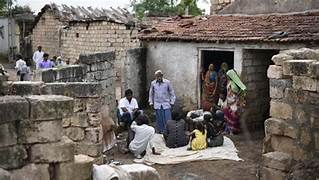
It was July 11, 2016. Vashram and his relatives were skinning a dead cow near Mota Samadhiyala village in Una tehsil. The cow had been killed by a lion. Skinning dead animals is the traditional occupation of their community (they are Dalits).
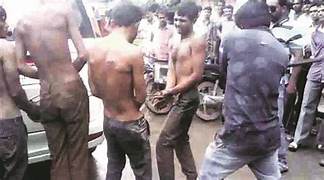
A group arrived. What followed was brutal. The men were partly stripped, tied to a vehicle, beaten with wooden sticks, iron pipes and plastic rods, and paraded half-naked through Una town. Their mobile phones were taken.
Someone filmed it all and put it on social media.
Balu had rushed to the spot after hearing his sons were being attacked. He too was beaten. Four family members (Vashram, Bechar, Ashok and Ramesh) were forced into an SUV and assaulted at multiple locations before being handed over to police. A relative eventually got them to hospital.
The 2016 Una flogging became one of the most defining flashpoints in Gujarat’s recent social history, exposing entrenched caste violence and puncturing the state’s carefully cultivated image of stability and development. It also saw the birth of several social activists and politicians. Jignesh Mevani, now a Congress MLA is one of them.
The verdict
Additional Sessions Judge Jignesh Pandya convicted five men: Ramesh Jadav, Rakesh Joshi, Nagjibhai Vaniya, Pramodgiri Gausvami and Balvantgiri Gausvami. They were found guilty under the IPC and the SC/ST (Prevention of Atrocities) Act — charges including causing hurt with dangerous weapons, wrongful confinement and intentional insult to members of a Scheduled Caste community.
Out of the 35 acquitted, three Una police officials, who had faced charges of abetting the accused, reportedly neglected their duties and forged official records. A fourth officer, former inspector Nirmalsinh Zala, died during the trial.
Defence lawyer V C Mavadhiya, who represents three of the five convicts, said the prosecution could not establish who did what, not in the complaint, not in testimony before the court. That, he argued, was why so many were let off.
He also pointed out that the maximum sentence for the charges the convicts face is five years. All five have already spent more than five years in jail.
The fallout from 2016
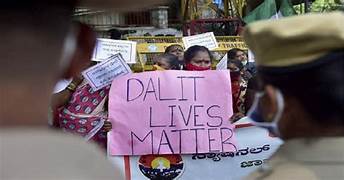
When the videos spread, something broke open across the country. Protests erupted in Gujarat. Public property was damaged. Several Dalits attempted suicide in protest; one person reportedly died.
BSP chief Mayawati raised the matter in Parliament, then visited the family. Rahul Gandhi came to Mota Samadhiyala. So did then Chief Minister Anandiben Patel.
Dalit activist Jignesh Mevani led the protests and emerged as a prominent political figure. He won the Vadgam assembly seat as an Independent, and later joined the Congress.
CID Crime took over the investigation and filed a chargesheet against 41 accused, alleging a conspiracy to falsely implicate the Dalit men in cow slaughter.
On Monday, three of the four victims (Bechar, Ashok and Ramesh) were not even in court. Only Vashram was there to hear the judgment. He did not stay long.
The Una incident had catalysed an unprecedented Dalit mobilisation in Gujarat. Protests spread across districts, culminating in large rallies and a symbolic rejection of caste-assigned labour, with Dalits publicly dumping carcasses and refusing to continue such work. Activists like Jignesh Mevani emerged as prominent voices, reframing the agitation as a broader struggle for dignity, land rights, and economic justice.
As reported earlier by The Wire, though Gujarat is advertised as a model developed state, the conviction rate in atrocity cases against Scheduled Castes between 2018 and 2021 was a mere 3.065% — far below the national average. From 5,369 registered cases in that period, only 32 were proved. In at least 1,012 cases, the accused were acquitted even when charges were as serious as murder and rape. The Mooknayak, in a detailed investigation, reported that Gujarat recorded 1,425 cases of atrocities against Dalits in 2022 — four cases every single day. Despite this, the state has the lowest conviction rate in the nation at just 5.8%.
Let us look at some instances. On July 17, 2024, a 24-year-old Dalit auto rickshaw driver named Ajay Parmar was violently assaulted by upper-caste men in Sabarkantha district, North Gujarat. The trigger? His Instagram profile picture showed him wearing traditional headgear and sunglasses. Upper caste men demanded he remove it — and when he didn’t comply, the confrontation turned violent. Aspiration and visibility among Dalits are not tolerated well in rural Gujarat. Lalji was a handsome man and earned the ire of upper caste men in Anoklali village in the same taluka of Una where public flogging took place. Lalji wore glasses, rode a motorcycle and was reprimanded by some upper-caste men. However, the rivalry turned more serious when he fell in love with an upper-caste girl. In 2012, 11 upper-caste men forced Lalji into a room and set him on fire. After his death, his entire family, which was relatively well off, had to flee the village as they were also threatened. The reality of Vibrant Gujarat is that it celebrates visibility in markets and skylines, but for many Dalits, survival still depends on staying socially invisible and remaining inferior.
Back to today’s Una verdict. It is disappointing, and it seems an upper court will be approached.
Why This Verdict Feels Like a Betrayal
1. The Numbers Tell the Story: 43 people were arrested. Only 5 convicted. 38 walk free. Including the police officers who allegedly helped cover it up.
2. “Time Served” Makes the Sentence Meaningless. Legal experts note that the concurrent sentencing structure has diluted the punitive impact. “It underscores the gap between legal justice and societal expectations.” The convicts have already spent time in custody — meaning they may walk free almost immediately.
3. The Police Got Away It was alleged that the four Dalits were thrashed for almost 4–5 hours. Police allegedly connived with the perpetrators and forged FIR-related documents to help them. https://thewire.in/law/accused-in-una-dalit-flogging-case-didnt-know-victims-were-not-minority-people-counsel All four policemen stand acquitted.
4. Witnesses Were Compromised Throughout 21 of the 43 accused had been granted bail by the Gujarat High Court. There were instances where accused out on bail drove witnesses to court on trial dates — directly influencing them to turn hostile. The public prosecutor had no office space and had to travel 100 km weekly to court.
5. Government Promises Were Never Kept. In November 2018, victim Vasram Sarvaiya had petitioned the President seeking euthanasia, stating that the Gujarat government had not fulfilled its promises and that the family had no income after quitting their traditional work. As of the verdict, the land and jobs promised in 2016 have not been delivered.
Dalits deserve better. Gujarat’s claim to progress will remain incomplete until Dalits are not just protected by law, but empowered in reality.
Also Read: Dalit Groom Attacked In Gujarat For Riding Horse https://www.vibesofindia.com/dalit-groom-attacked-in-gujarat-for-riding-horse/