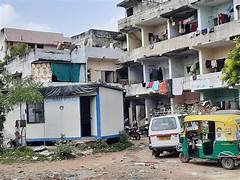
For more than thirty years, the word “disturbed” has shaped where people in Gujarat can call home, who their neighbors are, and what communities look like. It’s not just a word—it’s a line drawn across lives and city maps.
Now, the state government is signaling change—not just in language, but in the way people’s homes, futures, and sense of belonging are governed.
The Gujarat government has proposed amendments to the Disturbed Areas Act of 1991, with the Bill reportedly set to be tabled in the ongoing Budget Session of the Assembly next week.
The background
The Disturbed Areas Act did not begin as a permanent fixture. It started life as a temporary ordinance in the mid-1980s, meant to last barely eighteen months.
What changed its status was the political climate of 1991. A Congress government under Chief Minister Chimanbhai Patel converted it into a standing law, months after the Ram Rath Yatra initiated by the BJP had wound its way through Gujarat, starting from Somnath.
The law was supposed to shield vulnerable families from being forced out of their homes after riots—when fear and desperation made it easy for outsiders to buy up property at a fraction of its value.
Initially applied in Ahmedabad, the Act now covers Vadodara, Surat, Bharuch, Godhra, Himmatnagar, Kapadvanj, and Viramgam.
In practice, any property transfer in a notified area requires prior approval from the District Magistrate, who examines applications, affidavits, police reports, neighbour statements and revenue records before deciding.
After the 2002 riots, several Ahmedabad localities, including Juhapura, Sarkhej and Gomtipur, were added to the list. A notification lasts five years and can be extended.
But the law hasn’t always worked as intended. For years, critics have said it’s done the opposite—turning what should be shared neighborhoods into divided ones, and making it harder for Hindu and Muslim families to live side by side or buy and sell homes freely.
The 2019 amendments sharpened that debate considerably. They gave the District Magistrate powers to factor in polarisation and demographic shifts when evaluating a sale, and enhanced the collector’s powers to prevent transfers between religious communities to avoid “demographic imbalances.”
The Gujarat High Court stayed those amendments in 2021, following petitions from several Islamic organisations, with legal challenges focusing on their constitutional validity.
By 2023, the state had withdrawn the changes entirely and informed the court it was reconsidering. Several cases relating to both the 1991 Act and the withdrawn amendments remain pending in the High Court.
Today, the law remains as it was written in 1991—shaping the everyday realities of families, communities, and hopes for a better life. It’s that backdrop the government wants to redraw.
What is changing?
The most visible change is terminological. The Bill proposes replacing “disturbed area” and “disturbed areas” with “specified area” and “specified areas” throughout the law. It is not just a cosmetic edit. The definition of what qualifies for that tag is being expanded, too.
Under the existing Act, the government can declare an area disturbed in three situations.
First, if public order was disrupted for a substantial period due to riots or mob violence.
Second, if polarisation of a single community has occurred or is likely to occur, it will disturb the demographic balance. Third, if improper clustering of one community has occurred or is likely to occur, it threatens peaceful coexistence.
The new Bill adds another trigger. Areas that “have become or are likely to become prone to disturbance of public order due to communal tensions,” with the specific aim of preventing the “involuntary displacement” of residents.
Who counts as aggrieved?
Under the existing law, an “aggrieved person” means only the buyer or seller involved in a property transaction.
The proposed amendment broadens this significantly: any resident of a specified area can now be considered an aggrieved party. This shifts the protection from transaction-level to neighbourhood-level standing.
A new committee enters.
The Bill proposes a monitoring and advisory committee. Its job is to study areas across the state and advise the government on whether public order has been disturbed, or is likely to be, due to communal tension or mob violence, and whether that situation risks displacing residents.
The committee does not decide. It advises. The government retains the final call.
A Special Investigation Team is also proposed to assist the district collector in identifying areas that may experience breaches of public order due to communal tensions.
The collector’s role gets wider.
The district collector continues to sanction property transfers in specified areas. But the amended law adds a new consideration. The “likelihood of breach of public order due to communal tension” must now factor into the collector’s decision on any application.
The Bill also gives the collector suo-motu powers. If a transferor fails to take possession of a property after a transaction, the collector may temporarily take the property into custody on his own initiative or on an application from any aggrieved person.
On mortgages, the Bill carves out a specific relaxation. Property in a specified area can be mortgaged to a financial institution to obtain a loan, without requiring the standard approval under the Act.
The Bill’s authors say these new rules are meant to “avoid unnecessary hardship.” It’s a rare official nod to the struggles ordinary people face just to get a home loan or secure their family’s future.
The current Bill also notes that, during the implementation of the Act, properties have been transferred in violation of its provisions, and “unscrupulous persons” have come into illegal possession, which it cites as part of the justification for the updated framework.
The Gujarat Disturbed Areas Act is often defended by the Gujarat government as a necessary safeguard against coercion and distress sales in communally sensitive areas. That justification, however, is beginning to wear thin. What was framed as a protective mechanism has, over time, hardened into an instrument that places extraordinary power in the hands of the state while quietly curbing the rights of citizens—most notably minorities—to buy, sell, and move freely.
In cities like Ahmedabad and Vadodara, where residential segregation is already deeply entrenched, the Act does not merely regulate property transactions; it reinforces existing divides. By mandating prior approval from the district collector for inter-community sales in notified areas, the state intervenes in what should be a private, market-driven decision. This is not light-touch regulation—it is direct administrative control over who can live where.
The Gujarat government argues that such oversight prevents exploitation and preserves social harmony. But the lived reality suggests something else. The approval process is opaque, often delayed, and deeply discretionary. There is little transparency in how decisions are made, and even less accountability when transactions are denied. In practice, this creates a system in which bureaucratic gatekeeping overrides individual rights and in which outcomes are shaped as much by administrative bias as by legal criteria.
What’s hardest to ignore is how this law lands most heavily on minorities—especially Muslim families. On the surface, the Act sounds neutral. But in reality, it can trap families in the same neighborhoods for generations. If they try to move out, paperwork and red tape get in the way. If someone from outside wants to buy in, the barriers go up. What’s sold as protection ends up feeling more like a cage, turning cities into patchworks of closed doors and missed opportunities.
This outcome cannot be viewed in isolation from Gujarat’s history. The sharp spatial divides seen in cities today were forged in the aftermath of the 2002 Gujarat riots. A government genuinely committed to social cohesion would work to dismantle these barriers. Instead, the continued expansion and aggressive enforcement of the Disturbed Areas Act suggests a willingness to formalise them. By invoking the need to maintain “demographic balance,” the state moves dangerously close to legitimising segregation as policy.
There is also a high economic cost to this approach. Property ownership is a primary vehicle for wealth creation and mobility. When the state restricts transactions, it distorts market dynamics, depresses property values in certain areas, and limits opportunities for those already on the margins. For minority communities, this translates into a structural disadvantage—one that is not incidental, but built into the way the law operates on the ground.
Gujarat’s leaders like to talk about growth and opportunity, about being open for business. But it’s hard to square that ambition with rules that decide, from above, who gets to move, invest, or dream. You can’t champion free markets and then quietly close some doors to entire communities. That contradiction is becoming impossible to ignore.
What makes the situation more concerning is the absence of meaningful reform. Instead of narrowing the scope of the Act or introducing safeguards against misuse, the state has expanded its reach. More areas are being notified, more transactions are being scrutinised, and more discretion is being concentrated in the hands of officials. This is not a temporary response to extraordinary circumstances; it is the steady institutionalisation of a restrictive regime.
The Disturbed Areas Act today stands as a test of intent. It reveals whether governance is being used to empower citizens or to manage them. In its current form, the law leans decisively toward the latter. By prioritising control over rights and segregation over integration, the Gujarat government risks entrenching the very divisions it claims to prevent.
Also Read: Food, Faith and Fascism in New India