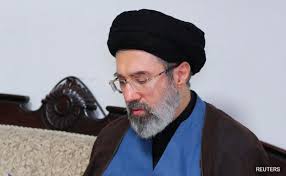
It has been nearly four days since Iran named Ayatollah Mojtaba Khamenei as its next Supreme Leader, yet his whereabouts and the circumstances surrounding his elevation remain unclear. He has neither appeared before supporters nor delivered a video address. Neither Mojtaba Khamenei nor his office has issued even a written statement, with state media relying largely on archival footage to introduce him to the public.
Reports in Iranian state media suggest the 56-year-old cleric may have been injured during the ongoing US-Israeli strikes on Iran — a conflict the Iranian regime has termed the “Ramadan War”. Iranian state television has referred to him as the “Jaanbaz of Ramadan”, meaning an injured war veteran.
Anchors on state television have described Mojtaba Khamenei as a “jaanbaz”, or someone wounded by the enemy during the Ramadan War, while reporting on his elevation as Supreme Leader. No further details have been provided, fuelling speculation about his health, particularly as he has not been seen in public since the conflict began.
While a possible injury could explain the absence of a public or video address, the lack of even a written statement continues to raise questions. Yet despite the mystery surrounding his condition and whereabouts, public pledges of allegiance to the new leader have begun to surface.
Videos from Tehran show a new mural at the historic Valiasr Square depicting the younger Khamenei receiving a flag from his father, Ali Khamenei, while Ruhollah Khomeini — founder of the Islamic Republic — looks on. Murals at Valiasr Square are often used to communicate the state’s narrative, and this one appears intended to portray the transfer of power as smooth and legitimate. The imagery, however, has drawn attention to the contradiction of a father-to-son succession in a system born out of a revolution that overthrew monarchy.
Iranians also gathered in Tehran on Tuesday to pledge allegiance to their new leader. The rally was reportedly organised in response to remarks by US President Donald Trump suggesting Iran’s new leader should be chosen with his approval.
“We want to show that the leader of Iran is chosen by Iranians themselves,” one protester told RT.
Amid speculation about his whereabouts, a US media report claimed that an elite counterterrorism unit has been deployed to protect the new Ayatollah following the assassination of his father. The force, known as NOPO — Iran’s black-clad Counterterrorism Special Force — has reportedly been assigned to safeguard Mojtaba Khamenei, according to a Fox News Digital report.
“With Khamenei gone, NOPO will likely now be protecting Mojtaba Khamenei,” Ali Safavi, an official with the Foreign Affairs Committee of the Paris-based National Council of Resistance of Iran (NCRI), told the publication.
Safavi said the unit, formed in 1991, had the 28th Ruhollah Division — named after Ruhollah Khomeini — as its core. The force typically handles hostage rescue missions and was not originally tasked with protecting the Supreme Leader, he added.
About Mojtaba Khamenei
For much of his 56 years, Mojtaba Khamenei has maintained a low public profile within Iran’s Islamic Republic while quietly building influence within the country’s security establishment, clerical circles and business elite. As he steps into his father’s role, he faces mounting pressure from both external and internal fronts — including a US-Israeli military campaign and a restless population, many of whom oppose the ruling establishment.
The second-eldest son of Ali Khamenei — who was killed in the opening hours of the US-Israel strikes on Iran nine days ago — Mojtaba’s rise comes at a moment when the Islamic Republic faces one of the most serious challenges in its nearly five-decade history.
For many Iranians who have protested against the regime in recent years, Mojtaba represents the continuation of the very system they oppose — one marked by the state’s use of force against dissent, as well as accusations of corruption and cronyism within the political and economic establishment.
His appointment also signals that the regime is unlikely to yield to US demands that Iran surrender its strategic posture. Instead, Mojtaba Khamenei is expected to continue his father’s hardline approach, prioritising the Islamic character of the state and maintaining a staunchly anti-US foreign policy. Observers also suggest that he may seek to avenge the killing of his father, mother and wife in the February 28 strikes.
Also Read: Missiles, Oil, Dead Soldiers and Bombed School: The War Trump Says He’s Winning https://www.vibesofindia.com/375930-2/