



The Great BJP Mughal Erasure Project
The Bharatiya Janata Party has an obsession or rather an allergy. They are convinced that anything bearing the word Mughal must gradually disappear from India’s public landscape. Across the country, roads are being renamed, cities rebaptised, railway stations rechristened and monuments rebranded in what increasingly resembles an ideological exercise rather than routine administrative housekeeping. Names that have existed for centuries are treated as historical errors waiting to be corrected, as if replacing signboards and revising textbooks might somehow erase what they believe is an inconvenient chapter of the past.
This pattern has been unfolding steadily over the past decade. The changes rarely arrive with dramatic announcements; they appear through municipal resolutions, government notifications and textbook revisions that look bureaucratic on paper but carry unmistakable political symbolism. History, it seems, is no longer something to be studied, debated or interpreted. It is something to be administratively edited.
The latest example comes from Surat in Gujarat, where the BJP-ruled municipal corporation has decided to rename the 17th-century Mughal Sarai as Tapi Bhavan while the surrounding neighbourhood long known as Muglisara will now be called Tapipura
Gujarat has long functioned as a political laboratory of the BJP since the mid 80’s. The party has ruled the state continuously since 1998, shaping governance and political narratives in ways that later echo across the country. Leaders who eventually came to dominate national politics, including Narendra Modi and Amit Shah, built their political careers here. Decisions taken in Gujarat often foreshadow the ideological directions that later emerge at the national level. When a symbolic shift begins here, it rarely remains confined to the state.
The structure now being renamed carries a history that stretches back nearly four centuries. Built in 1644 by Eshak Beg Yazdi, a noble associated with the household of Mumtaz Mahal during the Mughal era, it was not intended as a monument celebrating imperial power. It was a sarai, a travellers’ rest house designed for a bustling port city.
Seventeenth-century Surat was one of the most important ports of the Mughal Empire and a vital maritime gateway linking the Indian subcontinent with Arabia and Persia. Pilgrims travelling by sea to Mecca and Medina for the Hajj frequently passed through the city. The sarai offered them free accommodation, while modest fees collected from traders and other travellers funded the building’s maintenance and charitable activities. It functioned as part of the social infrastructure of a port that connected India to the wider Indian Ocean world.
Like many historical structures, it adapted to changing political realities. During British rule the building was converted into a jail, and by 1867 it had been repurposed as a municipal office, a role it has continued to perform for more than a century and a half. The structure survived the decline of the Mughal Empire, the arrival of the British and the upheaval of independence.
What it could not survive, it appears, was contemporary politics.
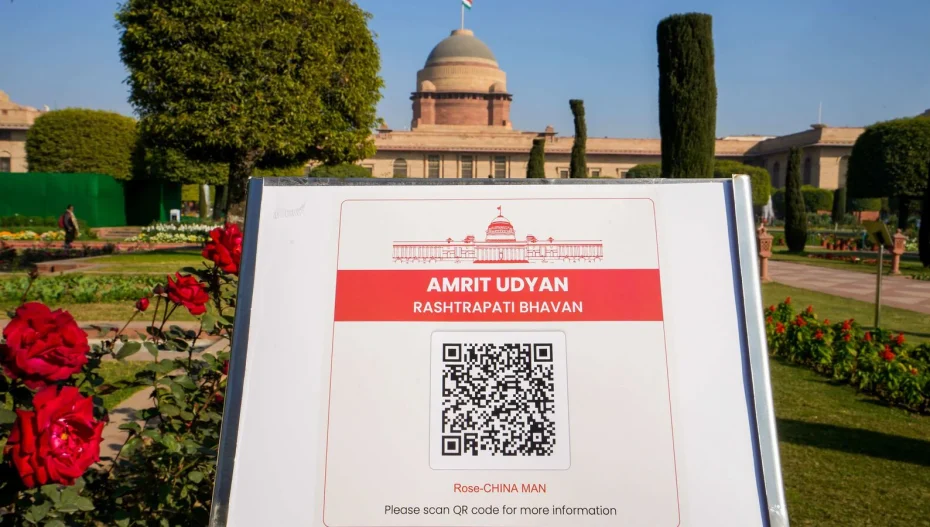
The renaming in Surat fits into a broader national pattern. In New Delhi, Aurangzeb Road was renamed after former president A. P. J. Abdul Kalam, removing from the capital’s diplomatic district the name of one of the most controversial Mughal rulers. The Mughal Gardens inside Rashtrapati Bhavan were later renamed Amrit Udyan, while Rajpath, the ceremonial boulevard that once symbolised imperial authority, became Kartavya Path as part of the Central Vista redevelopment.
Uttar Pradesh has seen some of the most dramatic changes. The historic city of Allahabad, named by the Mughal emperor Akbar in the sixteenth century, was renamed Prayagraj. The major railway junction of Mughalsarai became Deendayal Upadhyaya Junction, eliminating perhaps the most explicit Mughal reference on the Indian railway map.
Elsewhere the trend has continued. Maharashtra renamed Aurangabad as Chhatrapati Sambhajinagar, replacing the Mughal association with that of the Maratha ruler Sambhaji. Even in Gujarat, Ahmedabad — founded in 1411 by Sultan Ahmed Shah — periodically becomes the focus of demands that it be renamed Karnavati.
Yet the historical reality remains stubborn. The Mughal Empire, founded by Babur in 1526 and effectively ending after the rebellion of 1857, governed large parts of the subcontinent for nearly three centuries and left behind a cultural and architectural legacy that continues to define India’s global image. The Taj Mahal, the Red Fort, Humayun’s Tomb and Jama Masjid remain among the most recognisable symbols of the country’s heritage.
Our hope is the fact that history is often stubborn than contemporary politicians. They can repaint signboards and redraw maps, but the past has a habit of refusing political instructions.
Also Read: Food, Faith and Fascism in New India https://www.vibesofindia.com/food-faith-and-fascism-in-new-india/









History is the journal of the recorded past events. Changing name and narrative can’t be replaced with new. As it is backed by records like BAKHAR. The change if at all is incorporated then it is also replaceable to original. Babar and his posterity ruled India for several years it be came school history book by precluding and not telling to students is keeping them ignorant. This is more about our deteriorating education system.