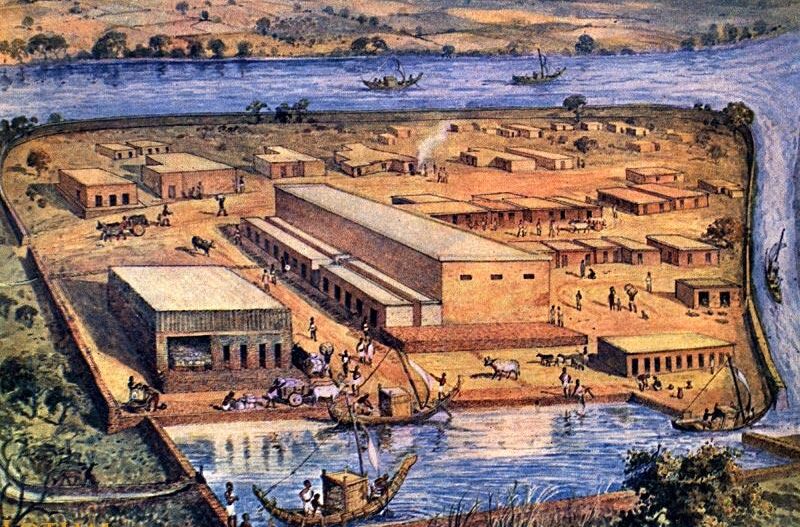
For six decades, Lothal stayed silent. Then the diggers returned. Now, fresh excavations have created a new mystique around Lothal in Gujarat. The last major dig at Lothal happened 60 years ago. What the archaeologists are finding beneath the soil is making them rethink the port’s story entirely.
The Archaeological Survey of India began the new dig in 2025. The excavation covers roughly 300 square metres across three sides of the existing site.
A report highlights bead-making that deserves particular attention. Lothal is one of the very few sites in this entire region where drill bits made of ernestite (a hard, durable mineral used for precision work) have been recovered.
Lying alongside them is a substantial cache of raw material: carnelian, agate, lapis lazuli. And then the finished products, beads, primarily, which were among the most important barter items the Harappans used to trade across their world.
Not merely a port
This wasn’t accidental. The layout of the finds tells a deliberate story. As the report mentions, raw material arrived by waterway. It then moved through a carefully planned town, roughly between what archaeologists call the Upper Town and the Lower Town, the classical division in Harappan urban design.
The material was worked into finished beads along the way and finally stored in a structure the excavation’s pioneer, archaeologist SR Rao, had identified decades ago as a bead factory.
Lothal was not just a port. It was a production centre. A manufacturing hub feeding trade routes that stretched across the ancient world.
Rao had first excavated the site between 1955 and 1962. He found the central citadel, the lower town, and the structure he identified as the world’s oldest surviving dockyard. His work established Lothal’s place as a major Harappan site. But the new excavation is extending beyond what he reached, and it is already finding things that eluded him.
To the south of the site, a well has surfaced. Alongside it, traces of gypsum. Whether the gypsum was part of the town’s drainage system (a channel for carrying waste out) is still being investigated. Near the dockyard itself, structural remains have begun to appear. What they were used for isn’t yet clear. By the time the current dig concludes, archaeologists expect to have answers.
Beyond the individual finds, the excavation is beginning to illuminate something larger: how Lothal fits into the broader sweep of Harappan history in Gujarat.
When Rao was digging in the 1950s, large-scale excavations hadn’t yet taken place across the Saurashtra region. The term Sorath Harappan, used to describe the local cultural variant that coexisted with and then outlasted the Late Harappan period hadn’t been coined yet. So, Rao couldn’t have placed Lothal within that framework even if he wanted to. Maybe, the new excavations can.
Harappan sites are now well-documented across Gujarat and the Saurashtra peninsula. One theory connects the later coastal sites through a sea trade route running along the Saurashtra shoreline.
Another possibility is that the very people who lived at Lothal eventually packed up and moved, migrating to and founding other sites, including Rangpur.
Pottery and other artefacts recovered from the current dig will be analysed to build a clearer chronology and draw connections between Lothal and the settlements around it.
Lothal may hold the key to understanding the transition from the Late Harappan phase, roughly 1900 to 1300 BCE, into the regional civilisation that followed, with its own distinct pottery, its own material culture, its own identity.
The excavation also has a very contemporary purpose.
The findings will directly feed into the National Maritime Heritage Complex being developed near Dholera. The complex is designed to celebrate India’s seafaring history and traditions, and Lothal, as the site of what may be the world’s oldest surviving dockyard, sits at its heart.
the Archaeological Survey of India is preparing to transform Lothal itself into an experiential museum. Excavated remains will be conserved in place. Visitors will be able to engage with the site through augmented and virtual reality. An all-weather shed will come up over the excavation area, protecting both the finds and the people studying them.
A civilisation that traded across oceans four thousand years ago is about to meet the tourists of the future. The ground at Lothal has been patient. It waited sixty years for someone to ask the right questions.
Also Read: 2700 Years Old Vadnagar of Gujarat Set To Be India’s Oldest Living City?https://www.vibesofindia.com/2700-years-old-vadnagar-of-gujarat-set-to-be-indias-oldest-living-city/