


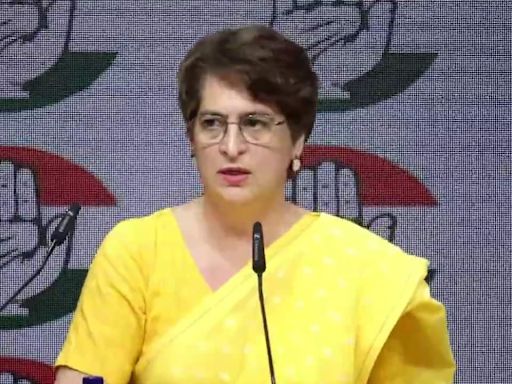
A day after the Modi government suffered a rare legislative defeat, Congress General Secretary Priyanka Gandhi on Saturday termed the failure of the women’s reservation–linked constitutional amendment bill a “big victory for democracy” and a “Black Day” for the NDA, saying the result exposed both the government’s intent and its limits.
Addressing a press conference in New Delhi, Priyanka said the outcome was not merely about a bill falling short in numbers, but about the Opposition collectively pushing back against what she described as a calculated attempt to alter India’s political architecture under the guise of reform.
“What happened yesterday is a victory for democracy and for the Constitution,” she said, adding that the ruling establishment had faced “a shock for the first time” in years.
At the centre of her attack was the Modi government’s decision to link women’s reservation with delimitation — a move the Congress leader described as deeply suspect. She argued that the Opposition could not allow a government, which she accused of repeatedly undermining institutions, to redraw the very structure of parliamentary representation on such a massive scale.
Her criticism went further, framing the bill not as a genuine push for women’s empowerment but as a political instrument. According to Priyanka, the government attempted to package a contentious and far-reaching delimitation exercise inside what she described as a “politically convenient wrapper” of women’s reservation.
In effect, she suggested, the Modi government tried to wrap a hard political project in a soft emotional appeal — presenting a complex restructuring of power as a progressive reform. The messaging was clear: sell delimitation as empowerment, and dissent becomes politically costly.
But that strategy, she argued, underestimated both the Opposition and the public. By clubbing delimitation with the women’s quota, the government attempted to force a binary — support the bill and accept sweeping structural changes, or oppose it and risk being labelled anti-women. The Opposition, she said, refused to walk into that trap.
Priyanka alleged that the entire exercise was part of a broader political design. She claimed the sudden convening of the parliamentary session itself pointed to a larger plan to consolidate power. “A whole conspiracy was hatched to remain in power,” she said, suggesting the government was attempting to create conditions for long-term political dominance.
She also accused the ruling side of positioning itself to claim victory regardless of the outcome. If the bill passed, it would project itself as a champion of women; if it failed, it would blame the Opposition. But the final vote, she said, disrupted that script.
“This was not really about women’s reservation — that is now clear,” she said, adding that women in the country are “not so easily misled.”
Drawing attention to the government’s track record, Priyanka questioned its credibility on women’s issues, citing incidents like Unnao, Hathras, and Manipur. Her argument was blunt: legislative claims of empowerment ring hollow without accountability on the ground.
At the same time, she underscored the political significance of Opposition unity, suggesting that the defeat marked more than just a parliamentary setback for the NDA. “You all saw what happens when the Opposition unites,” she said, framing the moment as a demonstration of coordinated resistance.
Priyanka also made it clear that the Opposition was not against women’s reservation as a principle. She urged the government to bring back the earlier version of the bill — referring to the 2023 framework — which proposed implementing reservation within existing seats without linking it to delimitation.
“If you truly want to do something for women, bring that bill back and we will support it,” she said, reiterating that the Opposition remained open to a clean, standalone proposal.
Her remarks drew a sharp political line: between what she described as genuine reform and what she framed as strategic overreach by the Modi government.
For the Congress, the outcome is being projected as both a moral and political win — proof that the NDA’s legislative dominance is not absolute. For the government led by Narendra Modi, the defeat signals a rare moment where numbers, narrative, and negotiation did not align.
In Priyanka Gandhi’s framing, the message from the House was clear — the Constitution cannot be reshaped through political packaging, and even the most carefully wrapped bills can be unwrapped on the floor.
Also Read: First Crack in 12 Years: Modi Govt’s Constitutional Push on Delimitation Packed in Women’s Bill Falls Short https://www.vibesofindia.com/first-crack-in-12-years-modi-govts-constitutional-push-on-delimitation-packed-in-womens-bill-falls-short/