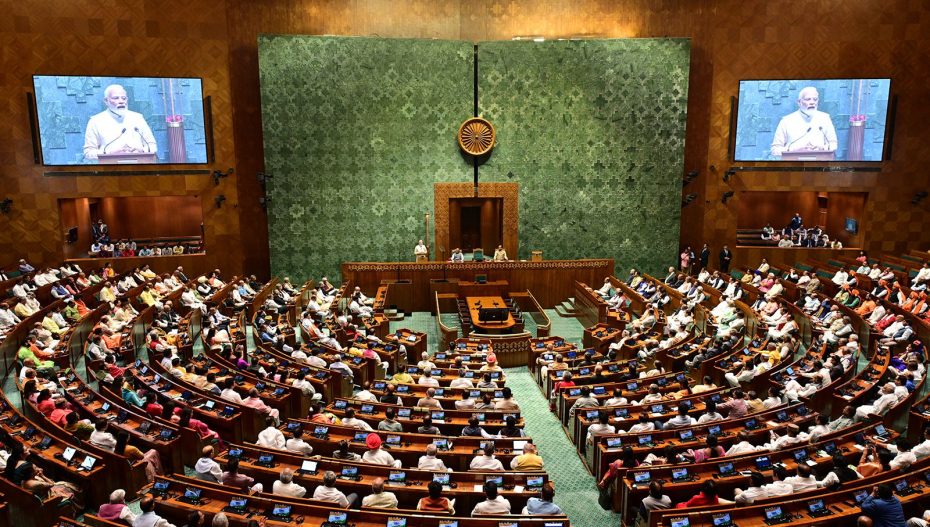
In a rare and politically significant setback, the Modi government Friday saw its constitutional amendment bill on women’s reservation and Lok Sabha delimitation collapse in the House — the first such defeat in its 12-year tenure at the Centre.
The outcome was clinical, not chaotic. With 298 votes in favour and 230 against, the bill secured a clear majority but failed to cross the constitutionally mandated two-thirds mark. A majority is not enough when the Constitution demands consensus.
Announcing the result, Lok Sabha Speaker Om Birla stated that out of 489 members present and voting, the Constitution (131st Amendment) Bill, 2026 did not meet the threshold required for passage.
The proposed amendment sought to expand the strength of the Lok Sabha and enable delimitation of constituencies based on the post-2026 Census — a necessary precondition, the government argued, to implement women’s reservation under the Nari Shakti Vandan framework. But what appeared structurally linked on paper quickly became politically combustible in practice. Delimitation moved from census logic to power politics in record time.
From the very beginning, Opposition parties had drawn a red line around delimitation. Their concern was not with women’s reservation itself, but with the consequences of redrawing parliamentary boundaries based on population. Several leaders warned that such an exercise could disproportionately increase representation of a few large states, thereby skewing federal balance. The fight wasn’t over women’s reservation — it was over who writes the future map of power.
Despite sustained appeals from the treasury benches, including two direct interventions from Prime Minister Narendra Modi hours before the vote, the Opposition refused to budge. Modi urged parties not to “hurt the sentiments of nari shakti,” framing the bill as a moral imperative. ‘Nari Shakti’ became the emotional pitch; arithmetic remained the final verdict.
Union Minister Kiren Rijiju called the bill’s defeat “unfortunate,” squarely blaming the Opposition for blocking what he described as a historic reform. He also confirmed that two other interlinked bills would not be taken up following the amendment’s failure.
Union Home Minister Amit Shah took a more aggressive line, both in the House and later on social media, accusing the Opposition of deliberately stalling women’s empowerment. In a sharply worded speech, Shah argued that while no party openly opposed women’s reservation, they effectively blocked it through conditionalities and procedural objections. No one said ‘no’ to women’s reservation — but enough said ‘not like this’ to kill the bill.
Shah went further, claiming that resistance to delimitation was, in effect, resistance to increasing representation for Scheduled Castes and Scheduled Tribes. He framed the debate as one of constitutional equity, pointing out disparities in constituency sizes — from as high as 49 lakh voters in some seats to as low as 60,000 in others. One person, one vote sounds simple — until representation stops being equal.
To address concerns, Shah responded to Congress MP K.C. Venugopal’s demand for a written assurance on capping the increase in Lok Sabha seats at 50 percent. He offered a verbal commitment, saying the government was willing to incorporate such a provision if the Opposition agreed to support the bill. But the assurance failed to shift the numbers. Verbal guarantees couldn’t substitute legislative trust.
Sharpening his attack, Shah accused the Congress of laying a “premeditated trap” to delay women’s reservation beyond 2029. He argued that demands framed as safeguards were actually tactics to stall implementation. In his telling, the Opposition wasn’t protecting federalism — it was postponing reform.
He also invoked history, pointing to the 1972 delimitation exercise under Indira Gandhi, which increased Lok Sabha seats from 525 to 545, and the subsequent freeze imposed during the Emergency through the 42nd Amendment in 1976. According to Shah, the same party that halted delimitation decades ago was now opposing its revival. The past became the government’s defence; the present remained unconvinced.
Responding to questions on why delimitation was being pushed now, Shah argued that the Nari Shakti Vandan Adhiniyam itself mandates that women’s reservation be implemented after a fresh Census and delimitation exercise. He maintained that lifting the freeze on seat allocation was essential to operationalise the policy. Policy sequencing, however, ran into political sequencing.
The Home Minister also addressed concerns about the delayed Census, attributing it to the COVID-19 pandemic that disrupted the scheduled 2021 exercise. He said the government had since decided to conduct a caste census alongside the 2026 Census, following consultations with political parties, state governments and social groups. The government insisted there was no delay; the Opposition insisted there was distrust.
Shah rejected allegations that the bill was a tool to defer caste enumeration, reiterating that a timeline had already been announced and that the process was underway. He sought to reassure the public that the government remained committed to both census and caste data collection. Assurances were repeated; scepticism persisted.
He also pushed back against narratives suggesting a North-South divide, asserting that all states and even Union Territories have equal standing in Parliament. He warned against framing the issue in divisive regional terms, calling it an attempt to fracture national unity. The map debate was as much emotional as it was electoral.
On the broader objectives, Shah outlined that the amendment aimed to ensure time-bound implementation of women’s reservation before the 2029 elections and to uphold the constitutional principle of equal value for every vote. He also categorically rejected demands for religion-based reservation for women, calling them unconstitutional and rooted in appeasement politics. The Constitution, he emphasised, does not provide for quotas based on religion.
As the debate stretched across two days, what emerged was less a disagreement over intent and more a clash over design, timing and trust. One bill fell, but the faultlines it exposed only deepened.
In the end, the legislation did not collapse under noise or disruption — it failed on count. And that count delivered a message the government has rarely had to confront in recent years: numbers in the House can pass laws, but they cannot bend constitutional thresholds.
Also Read: How India’s Electoral Map Could Be Tilted Before A Vote Is Cast https://www.vibesofindia.com/how-indias-electoral-map-could-be-tilted-before-a-vote-is-cast/