


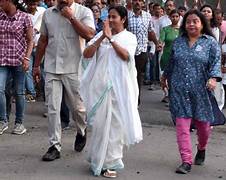
The dominant view in West Bengal politics still treats Mamata Banerjee and her All India Trinamool Congress as virtually unassailable. But that assumption rests more on legacy perception than on a close reading of the numbers. Beneath the surface, the electoral landscape is shifting in ways that make a Bharatiya Janata Party breakthrough in 2026 far less far-fetched than it appears.
Start with the voter rolls. The recent Special Intensive Revision (SIR) led to the deletion of roughly 91 lakh names. In a state where many seats are decided by razor-thin margins, such a large-scale revision isn’t administrative trivia—it has the potential to reorder outcomes across dozens of constituencies. When the underlying voter base changes, past voting patterns stop being reliable predictors.
Then comes the more structural issue: vote distribution. The Trinamool’s strength is real, but it is unevenly concentrated. A significant portion of its statewide lead is piled up in a limited number of constituencies—particularly minority-dominated seats—where victory margins are far larger than necessary. These surplus votes don’t translate into additional seats; they simply inflate margins where the party is already dominant.
By contrast, the BJP’s support is thinner but more geographically spread. In a first-past-the-post system, that difference matters. Elections are not won by aggregate vote share alone, but by how efficiently those votes are converted into seats. A party with tighter, more evenly distributed contests often benefits disproportionately from even small swings.
The numbers underline this asymmetry. The Trinamool holds far more “safe” seats with double-digit margins, but it also carries a much larger pool of excess votes—votes that don’t help expand its seat tally. The BJP, with fewer such cushions, operates closer to the threshold in many constituencies. That makes it more sensitive to shifts—but also better positioned to convert modest swings into seat gains.
And the swing required may not be dramatic. Based on recent electoral baselines, a relatively small shift—spread across a cluster of closely fought seats—could be enough to alter the balance of power. In electoral terms, this is the difference between a dominant narrative and a competitive reality.
Layer onto this the political mood. There are visible signs of fatigue with incumbency—ranging from allegations of corruption and entrenched local patronage networks to concerns over law and order and employment. Whether these translate into votes is always uncertain, but they add to the volatility already introduced by changes in the voter rolls.
None of this guarantees an upset. Conventional factors still favour Banerjee: a consolidated minority vote, a strong party organisation, and a perception of political invincibility that can influence voter behaviour. But elections are not static. When the arithmetic begins to shift—quietly but persistently—it can eventually overwhelm conventional wisdom.
West Bengal’s 2026 contest, therefore, may not be the foregone conclusion many assume. The numbers suggest a more competitive field—one where, if current trends hold, the BJP is not merely an opposition force, but a plausible contender for power.
Also Read: How Gujarat Model Of BJP Has Become A National Nigel And The Takeaways Of The Election Resultshttps://www.vibesofindia.com/how-gujarat-model-of-bjp-has-become-a-national-nigel-and-the-takeaways-of-the-election-results-2how-gujarat-model-of-bjp-has-become-a-national-nigel-and-the-takeaways-of-the-election-results/