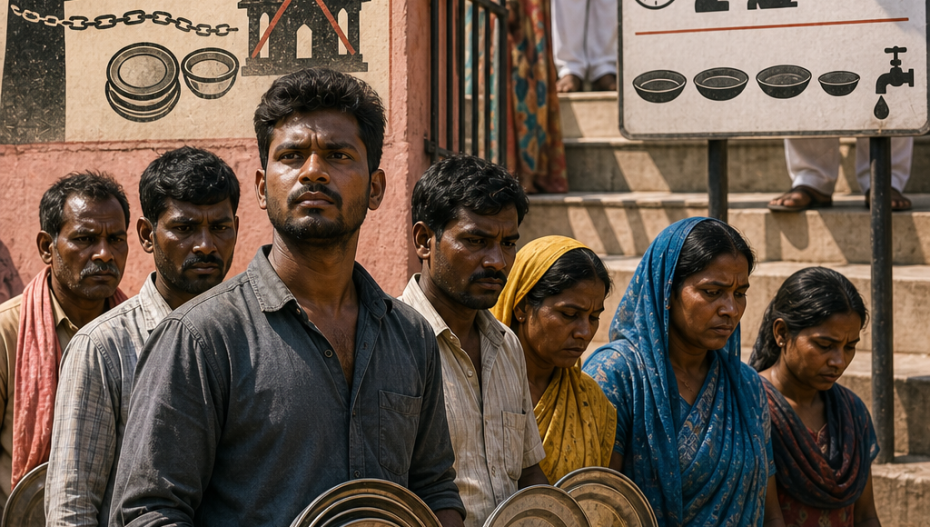
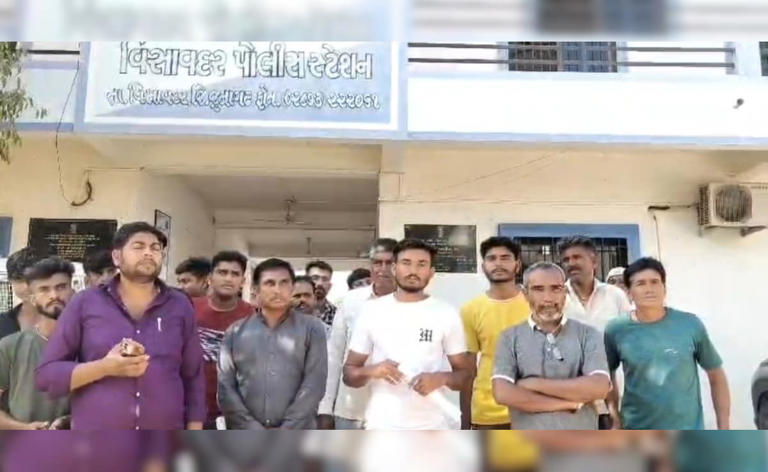
Above: Dalits of Bhutadi village in Gujarat. By Special Arrangement, Vibes of India.
Five men walked into the Dalit community’s lane in Bhutdi village, Junagadh district, on the evening of April 27. They had an invitation to deliver —to the consecration feast of a newly built Lord Ram temple scheduled for two days hence. But the Patostav invitation came with conditions. The Dalit residents were told to arrive only after the other castes had eaten. They were to bring their own plates and bowls. Their food and water would be kept separate. And they were to stay out of the temple itself.
Ajay Chatur Boricha, 25, filed a complaint at Visavadar police station the next morning. By the time the temple was consecrated on April 29, the community feast had been cancelled, five organisers were facing FIRs under the SC/ST (Prevention of Atrocities) Act, and the case had acquired the attention of DySP Ravirajsinh Parmar of the Junagadh SC/ST Cell, who confirmed that statements have been recorded and notices issued to all accused under BNSS 35(3). As we file this news report, investigators are also searching for digital evidence.
That a complaint was filed before any violence occurred — and that the Dalit community chose legal redress over participation on humiliating terms — marks a small but significant assertion of dignity. What happens to that complaint in the courts of Gujarat is another matter entirely.
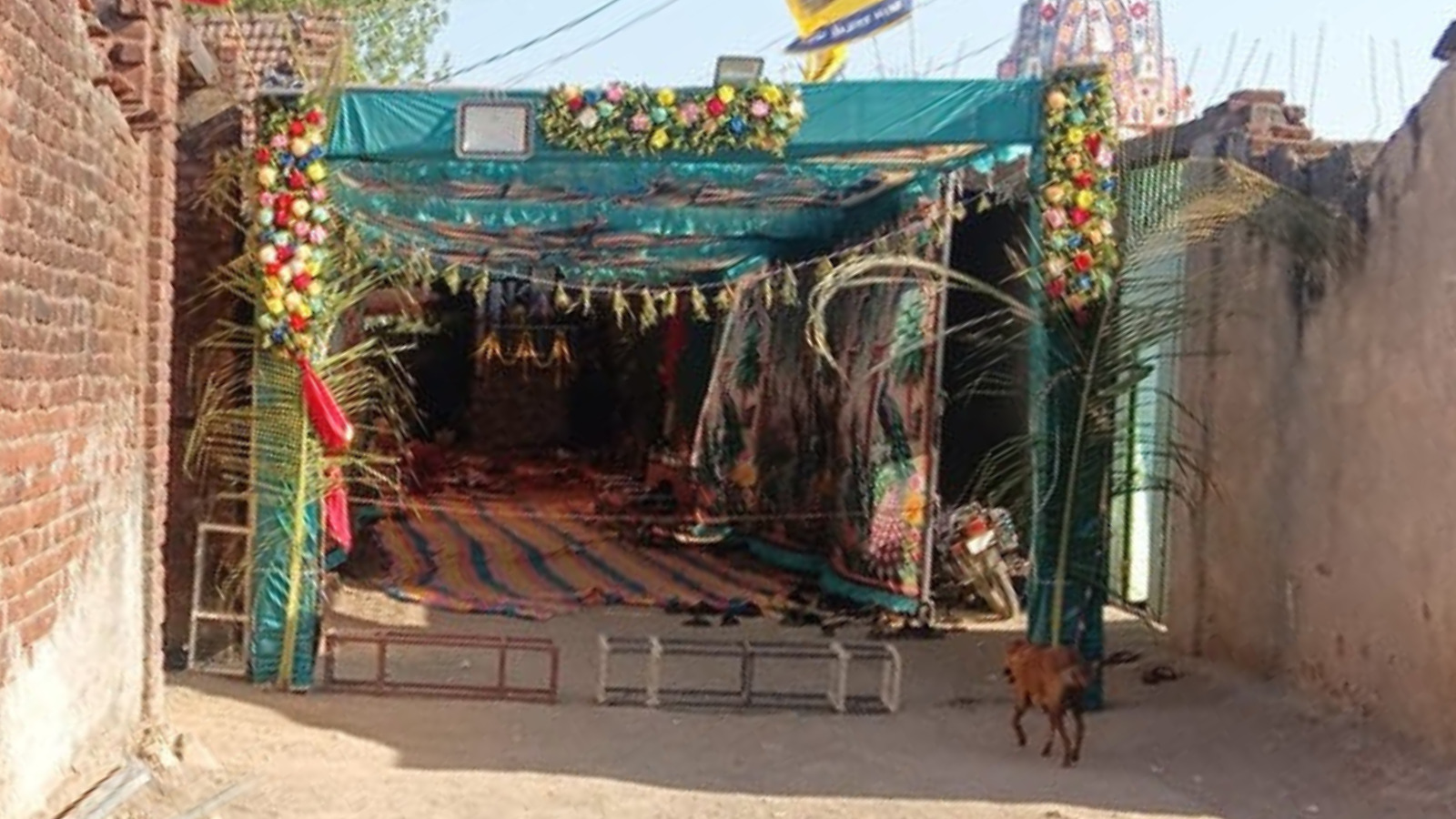
Above: The temple in Bhutdi village where Dalits were asked to bring their own plates. Picture via special arrangement by Vibes of India
THE GRAMMAR OF EXCLUSION
The conditions imposed on Dalits in Bhutdi — separate vessels, a later sitting, barred entry to the sanctum — are not inventions of rural backwardness. They are a grammar, fluent and consistent across the state. A Dalit manual scavenger from Ahmedabad district, whose testimony has been documented by civil society organisations, described the same logic at work in a city setting: separate tea tumblers at canteens, made to clean them yourself, barred from upper-caste water taps, sometimes forced to walk a kilometre for water. When he and his colleagues asked for their rights from the municipality, officials threatened to fire them. This sounds unbelievable but in most so called posh and high class and caste houses of Gujarat, there are two separate sets of vessels especially tea cups and drinking glasses which even the non Dalit domestic helps refuse to touch.
In March last year, a Dalit man in Vadol village in Sabarkantha district was beaten, stripped naked, and paraded through the streets by dominant-caste men — his offence, allegedly entering a temple. Two Dalit men in Mandal village were assaulted by cow vigilantes for refusing to dispose of a dead animal, a task that caste hierarchy has historically pressed their community into. During Navratri, a young Dalit girl was dragged out by her hair from a garba event amid casteist abuse. A 38-year-old Dalit labourer named Shailesh Solanki was assaulted and abused with casteist slurs at a crossroads in Sabarkantha simply for declaring his intent to visit the Kal Bhairav temple in Himatnagar.
As recently as February 2026, a Dalit groom’s wedding procession in Patan district was stopped at sword-point by upper-caste men who objected to his riding a horse — a ritual they considered their exclusive preserve. The video circulated widely. Elsewhere in Banaskantha, a Dalit lawyer named Mukesh Parecha wanted to arrive at his own wedding on horseback and requested police protection. A team of 145 policemen arrived in Gadalvada village to escort him. The wedding passed without incident. The spectacle of state force required for a man to exercise a social custom that others take for granted was, in itself, a statement about the distance between constitutional guarantee and ground reality.
THE CONVICTION RATE THAT EXPLAINS EVERYTHING
The Bhutdi FIR, once it travels the familiar path of Gujarat’s criminal justice machinery, will encounter a set of odds that are well documented. Between 2018 and 2021, the conviction rate in cases of atrocities against Scheduled Castes in Gujarat was 3.065 per cent. Of 5,369 cases registered during that period, only 32 were proven against the accused. In 1,012 cases — including cases of murder and rape registered under the SC/ST Act — the accused were acquitted. A further 1,044 cases were settled out of court.
Martin Macwan, veteran activist and founder of Navsarjan Trust, has observed that in the rare cases where conviction has been reached, it is typically because Dalit rights NGOs sustained the case — because the complainant and witnesses face social pressure and threats to withdraw. Ahmedabad city alone reported 189 cases of atrocities against Scheduled Caste persons in 2022, the highest of any district in the state, out of a state total of 1,425 registered cases. In March 2019, Gujarat’s then-minister for social justice told the assembly that crimes against Dalits had risen 32 per cent between 2013 and 2018.
The national conviction rate under the Atrocities Act stands at 3-4 per cent. Advocates working in the space have pointed to a structural explanation: a prejudiced or compromised police officer at the investigation stage, or a biased judge at trial, can ensure justice is never served while simultaneously encouraging the accused to file counter-complaints against the victim. The acquittal is, in this reading, not a failure of the law but of its gatekeepers.
THE PROSPERITY PARADOX
Gujarat’s governance record is frequently cited as evidence that development and social order can coexist. The state’s per capita income is among the highest in the country. Its industrial corridors, port infrastructure, and export numbers are points of pride in every Budget speech. The ‘Gujarat Model’ has been exported as a national template.
Against this backdrop, the persistence of caste atrocity is not incidental — it is, researchers and activists argue, structurally connected to the prosperity rather than standing apart from it. A 2014 research paper found that an increase in the consumption expenditure ratio of Scheduled Castes relative to upper castes is associated with an increase in crimes committed by the latter against the former. Dalit economic mobility, modest as it remains, appears to trigger a backlash in communities where subordination was the unspoken social contract underpinning local hierarchies.
Between 2015 and 2021, more than 9,000 incidents of violence against Dalits were documented in Gujarat — an average of four cases a day, according to National Crime Records Bureau data. The state also recorded the highest number of custodial deaths of any state or Union Territory for three consecutive years, with 24 deaths in 2022 alone. Gujarat’s ratio of complaints converted to FIRs is 0.8 per cent against a national ratio of 1.9 per cent — meaning the first filter, at the police station counter, already eliminates more than half the cases that are brought in.
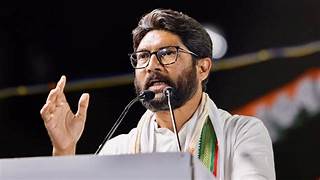
Above: Congress leader and party MLA Jignesh Mewani
The National Family Health Survey adds a further dimension. Gujarat has one of the lowest rates of inter-caste marriages in the country at 2.59 per cent, and the highest rate of consanguineous marriages at 28 per cent, against a national average of 11. Endogamy at that scale does not merely reflect social preference — it actively reproduces and entrenches the caste boundaries that produce the conditions for atrocity.
THE UNA DECADE AND ITS AFTERMATH
June 2016 remains the defining reference point. In Una, Gir Somnath district, cow vigilantes stripped, tied to a vehicle, and flogged four Dalit youth — Vashram and Ramesh Sarvaiya along with their cousins Ashok and Bechar — while they were skinning a dead cow in Mota Samadhiyala village. When their father Balu Sarvaiya, his wife Kunvar, and other relatives intervened, they were beaten too. The video, shot on a mobile phone, detonated across social media and triggered the most significant Dalit mobilisation Gujarat had seen in decades.
Ten years on, the flogging case has produced prosecutions but the underlying conditions that produced it remain structurally intact. Gau raksha vigilantism has, if anything, expanded its operational confidence. The deployment of OBC community members as the front-line enforcers of upper-caste social norms — while dominant castes maintain distance — has been documented by reporters who interviewed Dalit victims across Sabarkantha and Gandhinagar districts. It is a franchise model of atrocity: the moral authority rests higher up the hierarchy, the physical risk is outsourced down.
THE LAND THAT WASN’T GIVEN
State Congress working president and Vadgam MLA Jignesh Mevani, whose constituency has become a focal point for Dalit rights work, had recently drawn attention to the gap between land promises and land possession. According to Mevani, Dalits have not received 20,000 acres of land promised under the Gujarat Agriculture Land Ceiling Act — parcels that remain illegally encroached upon by non-Dalits. He has called on the government to register offences in such cases and to provide security to Dalit allottees who attempt to take possession, arguing that without state protection, the legal entitlement is functionally worthless.
Mevani’s Swabhiman Helpline, launched in 2023, had received 113 calls and helped secure the arrest of 150 accused as of last year’s count. He noted the figure also illustrated the scale of distrust in formal institutions: people are calling a political helpline rather than a police station because the police station has already failed
CONDITIONS OF DALITS IN GUJARAT IS PITIABLE: HITENDRA PITHADIYA
Seventy-seven years after Independence, the condition of Dalits in Gujarat remains pitiable. What happened in Bhutdi village of Junagadh — where Dalit residents were invited to a temple consecration feast on the condition that they arrive after others had eaten, bring their own plates, and stay out of the temple — is not an aberration. It is a routine. The state government speaks of social harmony, but only on paper says Congress leader and newly elected Ahmedabad Municipal Councilor Hitendra Pithadiya.
“In nearly 18,000 villages across Gujarat, after three unbroken decades of BJP rule, there is not a single village with a Dalit population where caste-based discrimination does not exist in some form. That is not an opposition charge. It is ground reality, and it reflects the state government’s sustained indifference toward its most marginalised citizens,” says Pithadiya.
The forms this discrimination takes are by now numbingly familiar. Dalits are barred from dining alongside other castes at community feasts. Wedding processions are stopped. Grooms are pulled off horses. DJ music at Dalit marriages is silenced. And then there are the assaults — for wearing goggles, for dressing well, for tucking in a shirt, for keeping a moustache, for using “Singh” after one’s name. Each beating carries the same message: dignity is not yours to claim.
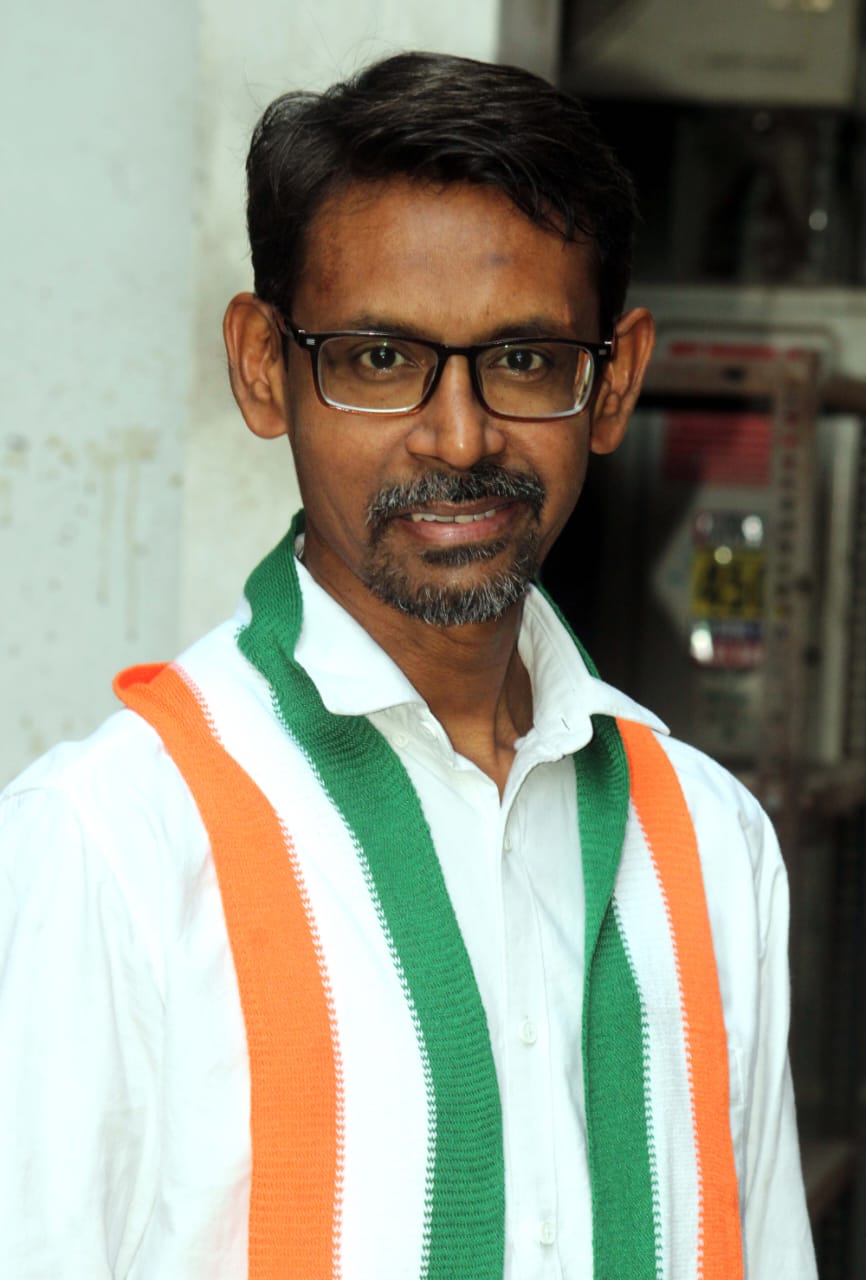
Above: Hitendra Pithadia of Congress
“We had hoped that Kishor Makwana — a Gujarati, and Chairman of the National Commission for Scheduled Castes — would bring sharper scrutiny to his home state. That hope has proven hollow. Whenever atrocities against Dalits surface in Gujarat, the Commission’s response has been silence. Makwana appears to look the other way.”, says Pithadiya.
WHAT THE LAW SAYS, AND WHAT IT DOES
Article 17 of the Constitution abolished untouchability in 1950. The SC/ST (Prevention of Atrocities) Act of 1989 — amended in 2016 to provide faster relief and stronger protections — created a legal architecture that, on paper, is among the most comprehensive anti-discrimination frameworks in the world. It covers social boycott, denial of temple access, enforced separate seating, casteist abuse — each of which is specifically alleged in the Bhutdi FIR.
The gap between the architecture and its application is where Dalits in Gujarat live. According to Jignesh Mevani the approximate seven per cent of Gujarat’s population that is Scheduled Caste has been the last of the state government’s concerns for the last two decades. There has been no government-led campaign to tackle atrocities. Senior officials no longer visit victims. The tehsildar, once a minimum threshold of state acknowledgment, is now often absent.
The Bhutdi case is, viewed from one angle, an example of the system working: a complaint was filed, an FIR was registered, the SC/ST Cell is investigating, digital evidence is being sought. Viewed from another angle, it is five men who walked into a Dalit lane with a list of humiliating conditions for dinner and face odds of roughly 97 to 3 that they will walk away unaccountable. That is the Gujarat Model as it applies to caste.
Also Read: Dalits Don’t Matter in Vibrant Gujarat: Youth Beaten for Wearing Turban https://www.vibesofindia.com/dalits-dont-matter-in-vibrant-gujarat-youth-beaten-for-wearing-turban/