


As BJP Sweeps Gujarat Local Body Polls, Congress Loses Opposition Tag In Half Its Cities
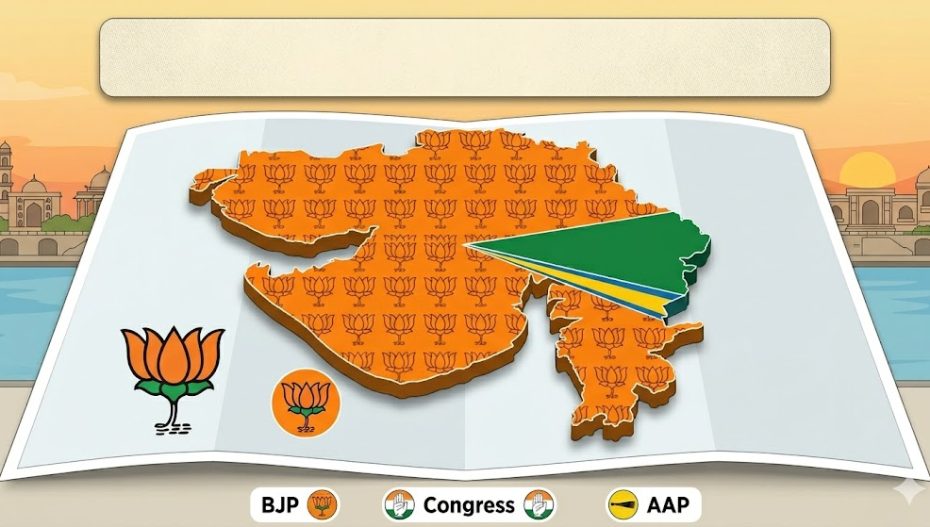
The BJP has expectedly blown the victory bugle in Gujarat’s 2026 local body elections, dominating urban areas in particular. In municipal corporations, the party pulled in nearly 60 per cent of all votes cast — a commanding lead over the Congress, which managed 26 per cent, and the Aam Aadmi Party at just over 10 per cent.
Zoom out to all local bodies combined, and the BJP’s average vote share sits at around 54 per cent. Even in rural areas — taluka and district panchayats — it held firm between 51 per cent and 52.5 per cent, comfortably ahead of both rivals.
The elections, held on April 26 across 15 municipal corporations, 84 municipalities, 34 district panchayats and 260 taluka panchayats, were one of the largest grassroots democratic exercises in Gujarat’s history, with more than 4.18 crore voters eligible to vote and around 9,200 seats in play. A total of 25,537 candidates contested the polling seats; 736 others had already won uncontested.
Across other tiers of governance, the pattern held. In taluka panchayats, the BJP took 51 per cent of the vote against Congress’s 33 per cent and AAP’s 13 per cent. In district panchayats — 34 of them went to polls — it was 52 per cent for BJP, 34 per cent for Congress and 12 per cent for AAP. In municipalities, the BJP secured 52.5 per cent, with Congress at 31 per cent and AAP trailing at under 5 per cent.
One of the standout stories of these elections was the nine new municipal corporations — Anand, Karamsad, Gandhidham, Mehsana, Morbi, Nadiad, Navsari, Porbandar-Chhaya, and Surendranagar-Wadhwan — upgraded by the Gujarat Cabinet in January 2025 to reflect rapid urbanisation. The BJP won all nine. In Morbi, holding its first election as a corporation, it swept all 52 seats. In Nadiad and Mehsana, the Congress failed to open its account. The new urban geography of Gujarat, it turns out, belongs entirely to the BJP.
Meanwhile, Congress performed relatively consistently across taluka panchayats, district panchayats and municipalities, with its vote share generally holding between 30 per cent and 34 per cent — though it dropped noticeably in municipal corporations, where it managed only 26 per cent.
THE CORPORATION NUMBERS
The seat-level results in the established corporations tell the story in the plainest terms. In Ahmedabad Municipal Corporation, the BJP won 160 of 192 seats; Congress won 32. In Surat, it was BJP 115, Congress 1, AAP 4 — a near-collapse from the AAP’s 27-seat performance in 2021 and a Congress presence so thin as to be almost invisible in Gujarat’s commercial capital. In Rajkot, the BJP took 65 of 72 seats and Congress seven. In Vadodara, BJP won 69 of 76 and Congress six, with one going to an independent. In Mehsana, BJP won 47 of 52 seats and Congress five.
The turnout numbers add a further dimension. Municipal corporations polled 55.1 per cent — the lowest of any tier. Gandhidham recorded the lowest turnout among all corporations at 46.03 per cent. Municipalities came in at 65.53 per cent, district panchayats at 66.64 per cent and taluka panchayats at 67.26 per cent. The pattern is consistent with what is seen across India: rural voters turn out more reliably, while in the cities that shape political narratives, roughly 45 per cent of registered voters stayed home.
HARSH TRUTHS
Yet for the Congress, behind the vote share numbers lies a more uncomfortable story. In several municipal corporations, the party has failed to cross the minimum threshold required to officially claim the post of Leader of Opposition — a position that, under democratic convention and Lok Sabha-style rules, generally requires a party to hold at least 10 per cent of total seats in the house.
The precedent goes back to former Lok Sabha Speaker G V Mavalankar, who established the principle that the largest opposition party needs 10 per cent of seats for formal recognition. In the Lok Sabha’s case of 543 seats, it translates to a minimum of 55. The same logic applies at the municipal level.
This matters more than it might seem. In municipal corporations, beyond the Mayor, Deputy Mayor and Standing Committee Chairman, the Leader of Opposition is a constitutionally recognised political office. It comes with a separate chamber, staff support, an official vehicle, administrative facilities and a formal role in meetings, debates and scrutiny of the ruling party’s decisions. Losing it is not merely symbolic. It means losing institutional visibility and political relevance in the day-to-day functioning of civic governance.
Congress can secure the post of Leader of Opposition in only five corporations: Ahmedabad, Vadodara, Rajkot, and a small number of others where its seat count crosses the threshold. In Surat — where the 10 per cent mark requires 12 of 120 seats and Congress won one — it does not have the numbers. In Morbi, Nadiad and Porbandar-Chhaya, it won nothing at all. The Samajwadi Party and AIMIM, both of which contested in pockets, managed a handful of seats between them — small enough to be statistically irrelevant but significant as a signal that even the margins of Gujarat’s opposition space are becoming contested.
Political experts have drawn comparisons with the past. In Rajkot’s municipal politics in 1988, the BJP held power while Congress, with 17 of 60 seats, was recognised as the official opposition. By 2021, its numbers had fallen sharply enough that it lost even that standing. What is playing out now across multiple corporations is a continuation — and deepening — of that trend.
AAP’s RISE
AAP was expected to do much better. In Surat, in fact, it had an impressive debut of 27 seats in 2021 which went down to 4 this time . However, AAP cannot be completely written off. While the BJP dominated overall, AAP’s growing footprint in rural areas was hard to ignore. In taluka panchayat elections, AAP added 17 lakh votes compared to 2021, bringing its total to 21.48 lakh votes across 260 taluka panchayats. Narmada district alone contributed 1.18 lakh of those, spread across its six taluka panchayats. The vote share tells the same story: from a marginal 2.6 per cent in 2021 to nearly 13 per cent in 2026 is a fivefold jump in five years.
The district panchayat numbers are equally telling. AAP pulled in 17.1 lakh votes across 34 districts, averaging nearly 62,645 votes per district. Narmada stood apart: the party not only won the district panchayat there but polled 1.29 lakh votes — nearly double what it managed on average elsewhere. The party also won one seat each in the Amreli district panchayat and registered early wins in taluka panchayats across Gir Somnath, Junagadh and Amreli. In Junagadh district, AAP won three seats in the Amrapur taluka panchayat in Maliyahatina, with candidate Dayaben Bharad winning by 265 votes.
AAP won one district panchayat and 13 taluka panchayats overall — a sharp contrast to the 72 seats it held across all local bodies heading into these elections. Political observers noted the party is clearly trying to establish itself as a credible third force in rural Gujarat. By these numbers, it is making a case, even as its urban project collapsed entirely. Its General Secretary Manoj Sorathia, the party’s mayoral face in Surat, lost his own seat.
WHAT EACH PARTY SAID
Unsurprisingly, all three parties found something to celebrate. BJP spokesperson Prashant Vala pointed to the results as proof of ‘pro-incumbency’ — a deliberate inversion of the conventional wisdom that ruling parties face friction in local body elections, where voters typically hold them accountable for roads, water and waste. Prime Minister Narendra Modi said the bond between Gujarat and the BJP had become ‘even deeper and unbreakable.’ Chief Minister Bhupendra Patel, who campaigned extensively across corporations, called it a mandate for good governance.
Congress’s Manish Doshi acknowledged seat gains in specific bodies but alleged that the BJP and AAP were working in tandem to split the anti-BJP vote — a charge that has a logic in some constituencies but places responsibility for Congress’s structural decline entirely outside the party. He said the party was already looking ahead to 2027.
AAP’s Gopal Italia called the results ‘historic.’ Given where the party started — a handful of seats in 2021 — it is hard to argue entirely with that framing. But as a claim about political momentum heading into 2027, it is complicated by the loss of Surat, which had been the proof-of-concept for AAP’s Gujarat project.
THE LONGER STORY
Taken together, these results tell a story that goes beyond a single bad election for Congress. What is emerging in Gujarat’s cities is a longer, slower erosion — one building for years. Congress was once the BJP’s most formidable rival in the state.
That rivalry now feels increasingly one-sided. The cadre base has thinned out, the urban vote share has slid, and there is no obvious leader stepping up to reverse either. In Vadodara, city Congress president Amiben Rawat and senior leader Dr. Nikul Patel both suffered crushing defeats in their own wards. The party’s organisational presence in cities — where elections are ultimately won and lost — is a shadow of what it once was.
Cities are politically critical. They shape middle-class voting behaviour, media narratives, fundraising networks, youth leadership pipelines and governance reputation. When a party disappears from municipal corporations, it tends to weaken further in the assembly and parliamentary contests that follow. The 2021 corporation results, which produced similarly large BJP majorities, preceded the party’s record-breaking 156-seat performance in the 2022 state assembly elections.
The underlying message of these results is blunt. In half of Gujarat’s municipal corporations, Congress lacks even the minimum numerical strength to be the official opposition. In politics, when a party cannot hold ground in city councils, it signals not temporary defeat but deep organisational crisis. It is no longer fighting for power in these cities — it is fighting for recognition. That is a dramatic fall for a party that once governed the state and dominated Indian politics.
(The image used in this article is purely representative and AI generated).
Also Read: BJP Sweeps Gujarat Local Body Elections, Reinforces Political Dominance https://www.vibesofindia.com/bjp-sweeps-gujarat-local-body-elections-reinforces-political-dominance/