


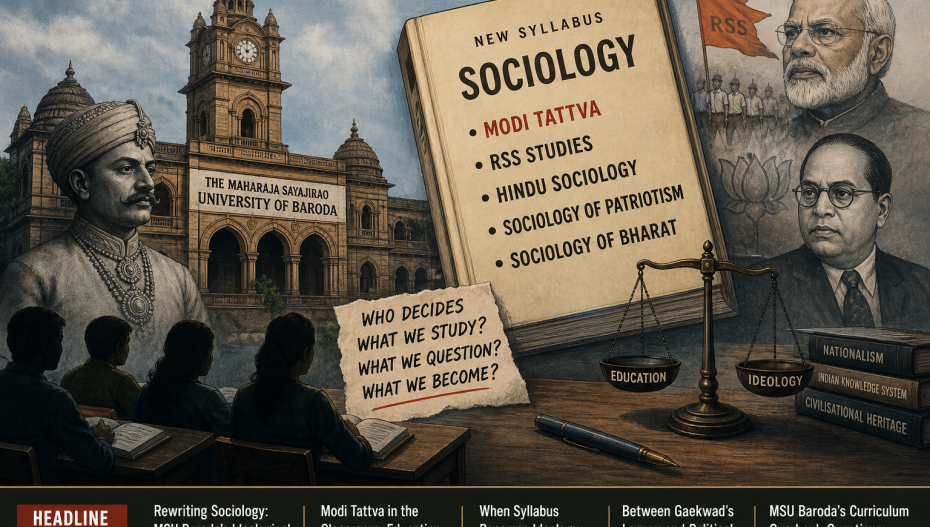
The decision to include ‘Modi Tattva’, RSS studies and Hindu Sociology raises fundamental questions about the purpose of university education — and who gets to answer them. An examination of the arguments, the precedents and a university with a complicated relationship with political power.
When Maharaja Sayajirao University of Baroda recently announced that its sociology students would henceforth study Prime Minister Narendra Modi’s leadership philosophy, the RSS, Hindu Sociology and the Sociology of Patriotism, the reaction was swift and predictable — praise from one corner, alarm from another. The revision, crafted by Dr Virendra Singh, head of MSU’s sociology department and chair of its Board of Studies, is framed as an effort to ground sociology teaching in Indian civilisational knowledge and contemporary governance realities. Critics see it as the latest instance of a systematic ideological remoulding of Indian higher education. Both sides have a case worth hearing carefully.
MSU Baroda is no ordinary institution. Founded in 1949 under the patronage of Maharaja Sayajirao Gaekwad III’s grandson Sir Pratapsinghrao Gaekwad, it is one of western India’s oldest public universities — the only English-medium state university in Gujarat — with 35,000 students, 1,200 faculty, and alumni that include Nobel laureate Venkatraman Ramakrishnan. The maharaja after whom it is named introduced compulsory education for girls in Baroda state, fined families who withheld daughters from school, funded B.R. Ambedkar’s higher education at Columbia University and was a patron of Sri Aurobindo Ghosh. That the university bearing his name is now at the centre of a curriculum controversy over ideological direction carries its own historical irony — even as the revision explicitly honours Gaekwad as a model of welfare-oriented leadership.
The controversy, however, is not really about Gaekwad. It is about what happens when a sitting prime minister’s leadership philosophy — labelled ‘Modi Tattva’, or the essence of Modi — becomes coursework in a public university while he is still in power, and whether the accompanying ideological architecture of the modules around it constitutes education or endorsement.
What Has Changed
From the upcoming academic session beginning in June, three new four-credit modules will enter the BA Sociology fourth-year programme and the MA Sociology first year: Sociology of Bharat, Hindu Sociology, and Sociology of Patriotism. Together, they represent a significant restructuring of how the discipline is taught at MSU — not fringe electives but mandatory core coursework.
The most immediately striking addition is ‘Modi Tattva’, a component within the Sociology of Patriotism module. Dr Virendra Singh, who designed the curriculum and is also associated with NITI Aayog and the Vadodara 2047 district plan, has been explicit about his rationale. ‘Whether you like it or not, you will have to discuss PM Modi in a political field and a leadership role. He is an element that will remain there for a long time,’ he has been quoted. The module will use Max Weber’s concept of charismatic authority — which Weber developed to describe leaders whose power derives from perceived extraordinary personal qualities rather than tradition or legal-rational structures — to examine Modi’s leadership style, poll performance, public perception, and policies. Singh argues that the same charismatic quality that sociologists identify in Gandhi and Martin Luther King is visible in Modi, making him a legitimate contemporary case study.
Alongside Modi Tattva, students will study the RSS — its history and through structured fieldwork. Singh explained that this inclusion was prompted by student observations during fieldwork in remote Gujarat villages, where RSS-affiliated volunteers were found active in grassroots implementation. The course, he said, will examine the RSS not merely as an ideological entity but as a model of social mobilisation and network-building, highlighting its internal principle that one can have matbhed (difference of opinion) but should not have manbhed (distance of minds). The Sociology of Bharat module draws on the Bharatiya Knowledge System framework, covering traditional Indian knowledge in medicine, technology, and social organisation. Shivaji Maharaj is described in course materials as ‘the first person to talk about Hindu Swaraj’.
The full suite of modules also includes a unit on nationalism, the nation-state, and cultural nationalism with a global perspective, alongside figures such as Sardar Patel, B.R. Ambedkar, and Sayajirao Gaekwad III. Critics have noted the conspicuous framing: Ambedkar, a ferocious critic of the RSS in his lifetime, is placed in a curriculum that simultaneously treats the RSS as a model of inclusion and dialogue — a juxtaposition that raises serious questions about intellectual honesty.
A University with a Complicated History
Understanding this curriculum revision requires understanding what MSU Baroda has been through before. The university has a proud liberal tradition — Gulammohammed Sheikh, Bhupen Khakkar, Dhruva Mistry, Nagji Patel, and other luminaries of the Baroda School of Art emerged from its Faculty of Fine Arts. For decades it was one of India’s more cosmopolitan campuses.
That tradition was badly strained in 2007, when a graduating Fine Arts student, Srilamanthula Chandramohan, exhibited works that a BJP leader and VHP-affiliated groups found offensive. Niraj Jain, then associated with the VHP and later the Hindu Jagran Manch, led supporters onto campus, clashed with students and faculty, and demanded the exhibition be shut. Rather than defend academic freedom, the university’s then Vice-Chancellor Manoj Soni suspended Fine Arts Dean Shivaji Panikkar for refusing to comply with the agitators’ demands. Chandramohan was arrested under IPC sections 295A and 153B and spent time in Vadodara Central Jail. No FIR was filed by the university against those who stormed the campus. The episode revealed, starkly, which way the institutional wind was blowing.
That same Vice-Chancellor, Manoj Soni, went on to become Chairman of the Union Public Service Commission under the Modi government. His trajectory from compliance with VHP pressure on campus to the chairmanship of India’s premier civil services body encapsulates the intimate connections between Gujarat’s institutional life and the ruling political dispensation.
Saffronisation pressures at MSU date even further back. The Baroda University Teachers Association was documenting efforts to place BJP-aligned candidates in university bodies as early as the mid-2000s, following over a decade of BJP rule in Gujarat. The pattern — external pressure, institutional compliance — was established well before the current curriculum revision. One research scholar at MSU wrote at the time that state government interference in the university had become systematic, and that without Gandhinagar’s approval, a Vice-Chancellor could not act in such an authoritarian manner.
A sitting prime minister’s leadership philosophy becoming examinable coursework in a public university while he is still in office is without precedent in India’s post-independence academic history.
Is MSU Alone? The National Picture
MSU Baroda is not operating in a vacuum. Its curriculum revision sits within a decade-long national project of reorienting Indian higher education — a project that has accelerated sharply since 2014 and intensified further after the BJP’s 2019 majority.
At the school level, the pattern is well-documented. References to the 2002 Gujarat violence were removed from sociology textbooks; the chapter on Mughal history was substantially curtailed in NCERT history syllabi; Darwin’s theory of evolution was dropped from Class 10 science; the section on Gandhi’s assassination and the RSS ban was removed from political science books. These were not isolated editorial decisions. Taken together, they form what critics have described as a coherent project of reshaping the official narrative of India’s past and present.
At the university level, the UGC issued new Curriculum and Credit Framework guidelines under the National Education Policy 2020 that opened space for ideological revision. UGC-drafted syllabi for mathematics incorporated astrology and Vedic Mathematics as components — drawing a public letter of protest from over 900 mathematics professors who described the content as unscientific and regressive. The NEP itself, passed without parliamentary debate during the COVID-19 pandemic, gave the BJP-RSS considerable scope to reshape the institutional architecture of higher education.
RSS pracharaks have become increasingly visible at government-sponsored events on campuses. Appointments of vice-chancellors aligned with the Sangh Parivar at central universities — JNU, BHU, Hyderabad University — have been documented repeatedly and have triggered sustained student protests. The BJP-RSS has used gubernatorial channels for VC appointments in states without BJP governments, triggering confrontations in Kerala, West Bengal, and Rajasthan.
As for curriculum elevating a living national leader: there is no direct Indian precedent. No university gave Jawaharlal Nehru, Indira Gandhi, Rajiv Gandhi or Atal Behari Vajpayee their own named leadership modules while they were in power, despite their overwhelming dominance of the political landscape. The closest parallels are in certain authoritarian states. That comparison is one that MSU officials would firmly reject, and one that should be applied with care — but the fact that it is being made at all, in reputable academic commentary, indicates the severity of the concern.
Closer to home, the trend of university renaming has proceeded steadily. North Maharashtra University became Kavayitri Bahinabai Chaudhari North Maharashtra University in Maharashtra; Chhindwara University became Raja Shankar Shah University in Madhya Pradesh; Allahabad State University was renamed after Rajju Bhaiya, a former RSS sarsanghchalak and professor. The pattern of institutional rebranding, combined with curricular revision, gives the MSU development a context that cannot be ignored.
The Case For: What the Defenders Argue
Decolonising sociology is a legitimate intellectual project
The most intellectually serious argument in favour of the revision is one that cuts across ideological lines: that sociology as taught in Indian universities has remained overwhelmingly dependent on Western theoretical frameworks — Durkheim, Weber, Marx, Parsons — applied to Indian social realities without adequate engagement with indigenous knowledge systems. This critique is not new, and it is not a BJP invention. Scholars have argued for decades that Indian sociology needs its own conceptual vocabulary. The demand to decolonise the curriculum is heard in British, South African, and American universities as well. Whether a module called ‘Hindu Sociology’ achieves this rigorously, or merely substitutes one orthodoxy for another, is a separate and crucial question. But the underlying concern is legitimate.
Weber’s framework is academically defensible
Singh’s choice of Max Weber’s charismatic authority as the analytical lens for Modi Tattva is not arbitrary — it is a real sociological concept that Weber used to describe leaders whose authority derives from perceived extraordinary personal qualities rather than tradition or legal-rational structures. Gandhi is a textbook example. Martin Luther King is another. The argument that Modi’s mass mobilisation and electoral dominance make him a legitimate case study for charismatic leadership theory is one that even Modi’s critics would find difficult to reject entirely on academic grounds. The issue is not the framework but whether the institutional conditions exist for the framework to be applied critically.
Contemporary figures can be studied in real time
Singh’s argument that it is better to study a leader’s impact while that impact is unfolding — rather than waiting 50 years for hindsight — has a certain logic. Live political sociology is a legitimate academic enterprise. American political science departments routinely study Trump’s electoral sociology; British universities examined Thatcherism while Thatcher governed. The precedent of studying living leaders academically is well established internationally. The objection is not that Modi is a living leader, but that the institutional context of this particular study makes critical analysis structurally improbable.
The RSS as a sociological object is understudied
Whatever one’s political views of the RSS, it is one of the largest civil society organisations in the world by membership, with a presence in virtually every district of India and a network extending into education, health, and disaster relief. As a sociological object — a case study in grassroots mobilisation, volunteer culture, and ideological transmission — it is remarkably understudied in Indian academia, partly because the academic community has historically treated it as too politically charged to examine neutrally. The argument that students encountering the RSS organically in rural fieldwork warranted structured academic examination is, on its face, a reasonable basis for inclusion.
The Case Against: What the Critics Argue
Power imbalance makes critical inquiry impossible
The most fundamental objection to Modi Tattva is structural, not intellectual. Sociology only works when the objects of study can be examined critically — when evidence that contradicts a hypothesis is as welcome as evidence that supports it. A module on a sitting prime minister’s leadership philosophy, developed by a department head who is simultaneously associated with NITI Aayog, in a state university in a BJP-governed state, within a module called ‘Sociology of Patriotism’ — all of these contextual factors create enormous institutional pressure against critical analysis. The question is not whether students are formally permitted to critique Modi in examination answers. The question is whether they will. Students in a state university with an eye on government jobs, scholarships, and placements will read institutional signals clearly.
The naming problem: ‘patriotism’ as a coercive frame
The module in which Modi Tattva sits is called the Sociology of Patriotism. This framing is ideologically loaded in ways that ‘Sociology of Nationalism’ — a well-established academic field — is not. Nationalism can be examined critically: its construction, its myths, its exclusions, its violence. Patriotism, as framed in current Indian political discourse, is not a phenomenon to be interrogated but a virtue to be inculcated. Placing a module on a prime minister within a paper on patriotism rather than political sociology or sociology of leadership pre-emptively frames dissent as unpatriotic. That is a pedagogical problem with consequences that extend beyond politics.
Ambedkar in a pro-RSS frame is a distortion
The inclusion of B.R. Ambedkar alongside the RSS as models of inclusion and dialogue is historically incoherent to the point of serious distortion. Ambedkar spent much of his intellectual and political life in direct, documented opposition to the ideological foundations of the RSS. He converted to Buddhism, in part, as a rejection of the caste hierarchy that Hindu nationalism has historically defended or elided. The curriculum’s claim that the RSS has ’embraced Sardar Patel as its own, making the stalwart Congress leader an influential name within the BJP today’ — offered as evidence of RSS inclusivity — is a political talking point, not sociological analysis. Placing Ambedkar in this company, without acknowledging or engaging with his actual views on Hindutva, is an act of historical revision, not education.
‘Hindu Sociology’ raises unanswered questions
A module called ‘Hindu Sociology’ raises questions the university has not publicly answered. Is this the sociology of Hindu communities and practices — a legitimate academic topic? Or is it a sociology derived from Hindu philosophical frameworks, meaning a sociology whose analytical premises are drawn from one religious tradition? If the latter, it represents a departure from the premise of social science: that its methods and frameworks must be applicable to all social phenomena regardless of the analyst’s religious position. The history of ‘Christian sociology’ in 19th-century Europe, or the incorporation of Islamic jurisprudence into social science in certain Gulf state universities, offer cautionary precedents for what happens when religious frameworks are institutionalised as sociological method.
The broader pattern makes context unavoidable
MSU’s revision does not exist in isolation. It follows the removal of Gujarat 2002 references from sociology textbooks. It follows the curtailment of Mughal history in NCERT. It follows the incorporation of astrology into UGC mathematics syllabi. It follows a decade of ideologically aligned VC appointments at central universities. Taken individually, each decision can be explained as administrative preference. Taken together, they form a pattern that India’s academic community — and several international bodies monitoring academic freedom — have documented with increasing concern. Times Higher Education noted in 2024 that the sense of the BJP seeing universities as cultural opponents is supported by the political interference and curbs on academic freedom experienced under the Modi administration. MSU’s curriculum revision is the latest data point in that pattern.
Placing Ambedkar — who spent his life in direct opposition to the ideological foundations of the RSS — in a curriculum that treats the RSS as a model of inclusion is not sociology. It is political mythology dressed in academic clothing.
The Gaekwad Paradox
There is an uncomfortable irony at the heart of this curriculum that its architects appear not to have registered. Maharaja Sayajirao Gaekwad III, after whom the university is named and who features prominently in the new modules as a model of progressive leadership, funded B.R. Ambedkar’s education at Columbia University and his subsequent employment — enabling the rise of the man who became the chief architect of the Indian Constitution and one of the most devastating intellectual critics of caste Hinduism in Indian history.
Gaekwad also famously caused a diplomatic incident in 1911 when he turned his back on King George V at the Delhi Durbar — a quiet act of defiance that spoke of his independence of mind. He was a ruler who patronised Muslim artists including Ustad Inayat Khan and Ustad Faiyyaz Khan, founded a comprehensive public library system, and ran Baroda state with a social reform orientation that was notably ahead of its time. He was a patron of Sri Aurobindo Ghosh, the revolutionary who later became a spiritual leader.
The university he inspired now places Ambedkar and the RSS side by side as exemplars of a tradition he built — a tradition that Ambedkar himself would have found unrecognisable in that company. Whether the curriculum designers have thought through these contradictions, or have deliberately elided them, is a question worth putting directly to Dr Virendra Singh.
What to Watch
Several questions will determine whether this revision is sociology or political performance. First: will the syllabi — the actual reading lists, examination questions, and assessment rubrics — be made public? The credibility of the academic framing depends entirely on what is being taught, not on what the department head says in press statements.
Second: who will teach these modules, and what is their academic background in the relevant fields? A module on charismatic leadership taught by a political scientist with peer-reviewed work in the field is a very different proposition from the same module taught by a faculty member with no independent research record.
Third: what will the examination questions look like? If students are asked to ‘analyse the charismatic leadership of PM Modi with reference to Weber’s theory’, that is an academic question that admits of critical engagement. If they are asked to ‘discuss the transformative impact of Modi Tattva on India’s socio-economic landscape’, that is a loyalty test.
Fourth: will faculty members who express reservations about the curriculum face institutional consequences? The 2007 Chandramohan episode — when Dean Shivaji Panikkar was suspended for defending a student’s artwork against political agitators — established a precedent for how MSU handles internal dissent under pressure. Whether that pattern repeats will be watched.
And fifth: will other Gujarat universities follow, and will the model spread to BJP-governed states? The signals from the current political environment suggest it might. If it does, the implications for Indian social science education are significant.
Conclusion: Education or Endorsement?
The distinction between studying a leader and celebrating a leader is real, but fragile — and it depends almost entirely on institutional conditions that MSU Baroda, given its history, has not consistently maintained. The intellectual case for decolonising Indian sociology is genuine. The case for studying charismatic political leadership as a sociological phenomenon is genuine. The case for examining the RSS as a social organisation is genuine. None of these cases require a module called ‘Modi Tattva’ in a paper called ‘Sociology of Patriotism’, developed by a department head with simultaneous government advisory roles, in a university in a state governed by the party whose leader is the subject of study.
What they require is intellectual rigour, institutional independence, transparent syllabi, diverse reading lists that include critics as well as defenders, and examination systems that reward critical analysis rather than ideological conformity. Whether MSU’s revision delivers any of those things is a question the university has yet to answer publicly.
Sayajirao Gaekwad III built Baroda’s educational institutions on the premise that knowledge liberates — that education, especially for the marginalised, is the route to a more equitable society. Ambedkar, the most consequential beneficiary of that premise, spent his life proving it. That premise is worth defending, whatever one thinks of the prime minister whose philosophy is now on the syllabus.
Also Read: From Khaki To Saffron: Gujarat’s IPS-Politics Journey as a Template https://www.vibesofindia.com/gujarat-khaki-to-kesari-ips-politics-pipeline/