

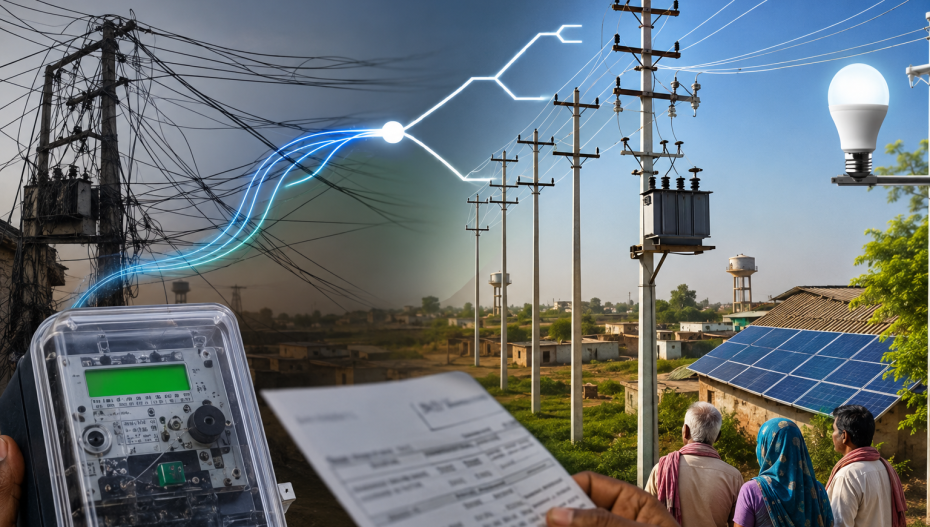
Uttar Gujarat Vij Company Limited is ring-fencing agricultural power from household supply across its network. Where it has worked, billing accuracy has improved. Where it has not, consumers are still paying for farm load they never used.
UGVCL (Uttar Gujarat Vij Company Limited) distributes electricity to over 75 lakh consumers across north Gujarat, covering districts including Mehsana, Gandhinagar, Patan, Banaskantha, Sabarkantha, and Arvalli. The utility has been running a feeder separation programme for several years, with the goal of ring-fencing agricultural power supply from domestic and commercial supply across its rural network. Where that separation is complete, it has measurably improved billing accuracy for households near farmland. Where it is still in progress, the old problem persists; farm power load finding its way onto household bills.
For consumers who want to pay their bill online without visiting a collection centre, one option available across Gujarat is Bajaj Pay, the BBPS-powered payment service. It fetches your current UGVCL outstanding by consumer number and issues a confirmed receipt on payment. But the more useful thing to understand first is how the feeder separation programme works and where it is in your area.
What feeder separation means
A feeder is a power line that carries electricity from a substation to a group of consumers. In rural Gujarat, many villages historically had a single feeder supplying both homes and agricultural connections like pump sets and borewells. This meant farm power use and household power use shared the same infrastructure.
The problem with shared feeders is twofold. First, farm power in Gujarat is subsidised – farmers pay a lower tariff. For that subsidy to work correctly, farm usage must be tracked separately. Second, when metering cannot cleanly separate farm load from household load on a shared feeder, some farm consumption ends up recorded against household meters. The household gets a higher unit count and a higher bill, for power they never used.
Feeder separation solves both problems at once. A dedicated agricultural feeder carries only farm connections. A dedicated domestic feeder carries only homes. Billing on each is clean, independent, and accurate. UGVCL’s programme has been implementing this across its network district by district, with Mehsana and Gandhinagar further ahead than more rural districts like Banaskantha and Patan.
How to check whether your area has been separated
UGVCL publishes feeder separation progress updates on its portal at ugvcl.com. You can also call the UGVCL customer care helpline at 1800-233-155335 and ask whether your village’s agricultural feeder has been separated. This one question determines which situation you are in and what your options are if your bill looks wrong.
If your area has been separated and you are still seeing unexplained unit spikes during irrigation season, that is a disputable billing error. If your area has not yet been separated, the spike is consistent with the known shared-feeder problem and the fix requires a formal complaint requesting meter inspection — not just a general query.
What your bill is telling you
Here is how to read the situation based on what appears on your bill and what the feeder status is in your area:
| What your bill shows | What it means | What to do |
| Feeder separation working — no dispute needed | ||
| Bill is higher but units are similar to last month | FAC (Fuel Adjustment Charge) has increased. Seasonal demand across north Gujarat has raised procurement costs. This is a legitimate statewide charge set by GERC. | Check the FAC line against last month. The difference explains the jump. No action needed. |
| Feeder separation incomplete — worth checking | ||
| Units spike in irrigation seasonNothing changed at home. | Your village may be on a shared feeder that has not yet been ring-fenced under UGVCL’s separation programme. Farm load is bleeding into household meter readings. | Check feeder status Call 1800-233-155335 and ask whether your area’s agricultural feeder has been separated. If not, log a complaint and request a meter inspection. |
| Bill marked Estimated for 2+ cycles | Meter reading has not been completed in your area. In villages where feeder separation work is ongoing, physical access for meter reading is sometimes disrupted during the works. | Submit a self-reading Log in to ugvcl.com and submit your meter reading with a photograph. This breaks the estimated billing cycle. |
| Raise a formal complaint | ||
| Actual reading, units spikedAgriculture is running nearby. Feeder separation confirmed in your area. | If UGVCL has confirmed feeder separation in your area but you are still seeing unit spikes consistent with farm load, the separation may be incomplete or the meter is faulty. | Escalate to GERC File at https://gercin.org/ with your complaint history and the confirmation that separation was done. GERC can order a technical inspection. |
UGVCL tariff rates and FAC charges are set by GERC and are subject to periodic revision.
How to raise a complaint with UGVCL
- Log in to ugvcl.com with your consumer number. Review your consumption history for the last three to six months. A unit spike that coincides with irrigation season and does not match any change at home is the pattern to look for.
- Call UGVCL customer care at 1800-233-155335 or 19121 (toll-free) or visit your nearest sub-division office. Log a formal complaint and ask for a meter inspection. Note the complaint reference number.
- If the complaint is not resolved within 30 days, escalate to the Gujarat Electricity Regulatory Commission at https://gercin.org/.
Keep paying your bill during the dispute. Stopping payment risks disconnection even with an active complaint. Confirmed adjustments are credited in the next billing cycle.
Paying your UGVCL bill without the queue
UGVCL’s collection centres in smaller towns and villages can mean long waits, especially around due dates. A missed due date adds a surcharge to a bill that may already be inflated by a billing error — the two problems compound each other.
You can complete your UGVCL bill payment online through Bajaj Finance website or app from your phone or computer at any hour. The outstanding amount fetches automatically by consumer number, so you pay what UGVCL has billed — no manual entry, no risk of an error. A timestamped receipt is issued on every payment, and your month-by-month payment history is available in the app. That record is useful if a billing dispute runs across multiple cycles and you need to show consistent on-time payment. Payments go through via UPI, debit card, credit card, e-wallet, or net banking.
How to pay your UGVCL electricity bill on Bajaj Finance
- Same process on the website and the app (Google Play and App Store):
- Open the Bajaj Finance website or app (Google Play / App Store) and go to Bajaj Pay.
- Select Electricity and choose UGVCL as your provider.
- Enter your consumer number and tap Fetch Your Bill.
- Confirm the amount and tap Proceed to Pay.
- Pay via UPI, debit card, credit card, net banking, or e-wallet. Confirmation arrives immediately.
Feeder separation is the right fix for the shared-feeder billing problem. Where it is complete, it works. Where it is still in progress, the old problem is still live — and knowing where your area stands is the first step to knowing whether your bill is accurate or disputable.