


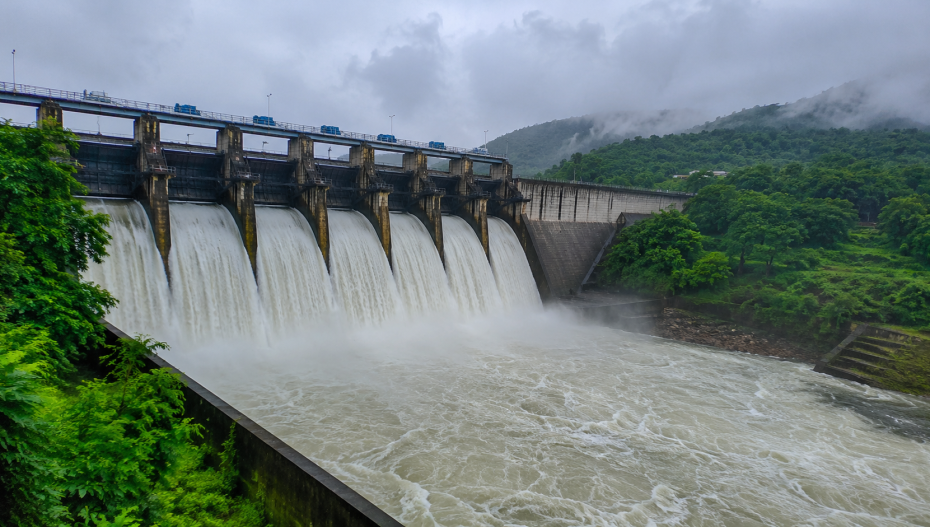
Gujarat has moved from worrying about a delayed monsoon to facing a serious flood watch after heavy rainfall pushed water levels sharply higher across the state.
As many as 14 dams have reached 100% of their storage capacity, while 21 reservoirs are on high alert. More than 750 million cubic metres (MCM) of water entered Gujarat’s reservoirs within just 120 hours, raising concerns about flooding in several areas.
However, despite the sudden rise in water levels, Gujarat’s overall water storage remains below the level recorded during the same period last year.
South Gujarat Sees Major Rise in Reservoir Levels
Of the 14 reservoirs that are now completely full, eight are located in South Gujarat.
The Damanganga reservoir is currently being managed carefully as large volumes of water continue to flow into it. The dam received an inflow of more than 55,300 cusecs, while around 53,000 cusecs was released directly into river channels.
In Navsari, both the Jhuj and Kelia dams have reached 100% capacity. Controlled water releases are being made downstream to manage the excess water.
The situation highlights how quickly reservoir levels have changed after the delayed monsoon began bringing significant rainfall to different parts of Gujarat.
Saurashtra Water Storage Rises Sharply
Saurashtra has also recorded a major improvement in its water storage levels.
In just 120 hours since July 20, the region’s reservoir storage increased from 39.14% to 46.39% of total capacity.
The Machchhu-II dam in Morbi has reached its Full Reservoir Level, with the reservoir now 100% full. More than 18,500 cusecs of excess water is being released downstream.
The Shetrunji reservoir in Bhavnagar, one of the major reservoirs in the region, is also completely full. It is releasing its entire inflow of around 15,340 cusecs downstream.
Other reservoirs, including Wanakbori in Mahisagar and Lakhigram in Surat, have also reached 100% capacity.
Meanwhile, the water level at Aji-2 Dam near Rajkot Taluka has shown some improvement in the situation. One of its three open gates was closed on Saturday afternoon after the inflow of water reduced.
Sardar Sarovar Maintains Controlled Storage
The Sardar Sarovar Dam in Narmada, Gujarat’s key water reservoir, continues to maintain a steady storage level.
On Saturday, the reservoir stood at 128.25 metres, with 6,521 MCM of water, equal to around 68.93% of its gross storage capacity.
The dam is receiving an average inflow of around 25,739 cusecs. At the same time, more than 3,500 cusecs is being released through the Canal Head Powerhouse.
The controlled inflow and outflow are helping maintain the reservoir’s storage while managing the large amount of water entering the system.
Gujarat Still Has Less Water Than This Time Last Year
Despite the recent surge in water levels, Gujarat’s overall reservoir storage remains lower than it was on July 25, 2025.
Across the state’s 206 water storage schemes, the current storage stands at 7,080.42 MCM, compared with 9,650.28 MCM during the same period last year.
This means the state currently has a deficit of 2,569.86 MCM compared with last year’s storage level.
The figures show the sharp contrast in Gujarat’s water situation. While heavy rainfall has filled several reservoirs and triggered a flood watch in some areas, the state as a whole still has less stored water than it had at the same point last year.
All Regions Still Below Last Year’s Storage Levels
South Gujarat, despite experiencing heavy rainfall and rising reservoir levels, is also facing a storage deficit compared with last year.
Thirteen schemes in the region have a combined deficit of around 1,268 MCM compared with July 25, 2025.
Saurashtra’s storage is about 492.85 MCM lower than last year’s level. Central Gujarat has a deficit of 373.76 MCM, while North Gujarat is behind by 331.20 MCM.
Kutch is also holding around 103.52 MCM less water than it did on the same date last year.
From Water Shortage Concern to Flood Watch
Gujarat’s water situation has changed dramatically within a matter of days. The state had been dealing with concerns over a delayed monsoon and lower reservoir storage. But the arrival of heavy rainfall has rapidly increased inflows into dams across several regions.
With 14 dams already full, 21 on high alert and more than 750 MCM of water added to reservoirs in 120 hours, authorities now face the challenge of managing excess water and controlling releases downstream.
At the same time, the overall storage figures show that Gujarat’s water reserves have not yet recovered to last year’s levels. The coming days will therefore be crucial, as authorities balance the need to store water for the future with the immediate risk of flooding in areas receiving heavy rainfall.
Also Read: Ahmedabad Reels Under 294.6 mm Rain, 4th-Highest In 100 Years https://www.vibesofindia.com/ahmedabad-294-mm-rainfall-fourth-highest-rain-event-100-years/