


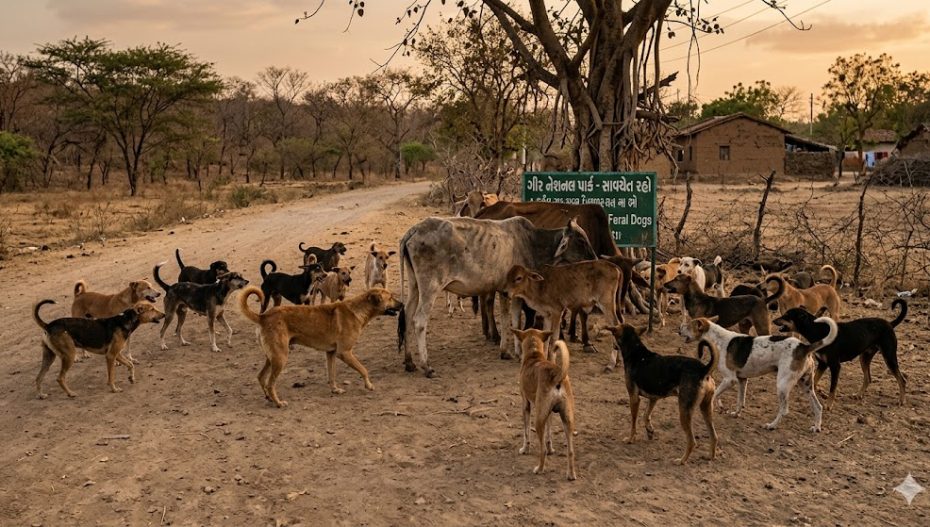
Fresh concerns are growing over the health of Asiatic lions in Gujarat’s Gir landscape after recent lion deaths and reports of illness among several lions. At the same time, a government livestock survey has highlighted another serious challenge, the large number of feral dogs and stray cattle living around lion habitats, increasing fears of disease spread.
According to the animal husbandry department’s livestock survey, the four Saurashtra districts that support nearly 95% of Gujarat’s Asiatic lion population, Amreli, Junagadh, Gir Somnath and Bhavnagar, are home to nearly 1.08 lakh feral dogs. This number is higher than the 80,050 stray cattle recorded in the same lion landscape.
Wildlife experts say this is worrying because free-ranging dogs are known carriers of Canine Distemper Virus (CDV), a disease that can spread to lions and other wildlife. The concern comes from past experience as Gir witnessed a CDV outbreak in 2018, which affected lion health. Research carried out after the outbreak found that canine distemper is common among dogs in India and that roaming dog populations can become a source of infection for wildlife.
Recent developments in Gir have raised fresh alarm. More than eight lions are suspected to have been affected by a viral infection, prompting forest authorities to step up surveillance and treatment efforts. Officials have quarantined 17 lions for close monitoring and medical care, while a team of 12 veterinary doctors and forest staff remains engaged in treatment and observation.
Forest officials say the situation is being closely watched. Senior officers and the Gujarat Forest Minister visited Gir to review the condition of the lions and assess the response measures.
While CDV remains a major concern, officials and experts are also examining whether another virus may be involved in the recent illnesses. The exact reason behind the lion deaths has not yet been confirmed. Samples and medical findings are under examination, and authorities say the actual cause will become clear only after expert and laboratory analysis is completed.
Experts say the disease risk is not limited to feral dogs alone.
Former National Board for Wildlife member H.S. Singh said government data shows that, apart from 1.08 lakh feral dogs, the lion landscape also has nearly 22.9 lakh domestic cattle and around 84,460 ungulates outside protected forests. Although Gir Sanctuary itself does not have feral dogs or stray cattle, these animals are common in surrounding lion habitats where lions frequently move.
Stray and abandoned cattle pose another danger because many carry ticks that spread babesiosis, another disease considered harmful to lions. Experts fear that the combined risk from viral infections and tick-borne diseases could make wildlife health management more difficult.
Officials have clarified that the current situation has not been declared a major epidemic, but monitoring has been intensified as a precaution. Wildlife experts also point out that lions are increasingly moving beyond traditional forest boundaries as their habitat expands, creating additional challenges for disease surveillance and conservation efforts.
Experts estimate that nearly 1.9 lakh feral animals are present across the wider lion landscape, making stronger disease control and better management of feral animal populations essential for protecting Gujarat’s iconic Asiatic lions.
For now, veterinary teams continue treatment and surveillance across Gir as authorities work to determine the exact cause behind the recent lion illnesses and deaths.