



Gujarat’s farmers are fighting on more than one front right now. Their biggest complaint is about electricity poles and high-tension power lines being put up on their farmland. On top of that, the Congress says the state has kept Gujarat out of the central government’s crop insurance scheme for years. Both issues have now pulled in the state Cabinet, farmer groups, and opposition leaders — and the anger on the ground is growing.
Though the ongoing farmers’ protests have received relatively limited attention in the mainstream media, the Gujarat government appears to be taking the agitation seriously, with the issue reaching the Cabinet and officials discussing various options to address farmers’ concerns through a revised compensation policy.
It Started With Poles on Farmland
Power companies have been putting up electricity poles and high-tension transmission lines across farms in many districts. The transmission corridors are being built to carry electricity generated from Gujarat’s expanding solar and wind energy projects, particularly in Kutch, Saurashtra and North Gujarat. Farmers say once a pole goes up, that patch of land is gone for good. Power lines running overhead also stop them from farming freely, make it difficult to operate tractors and harvesters, and bring down the value of their land.
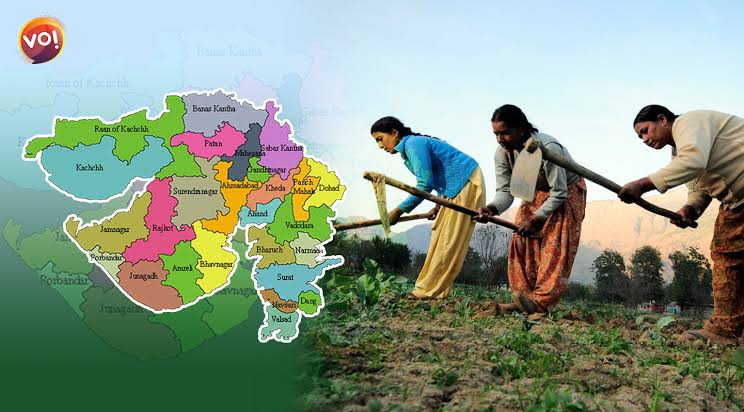
Farmers do get paid for this — but they say it’s a one-time, small amount that doesn’t come close to covering what they lose year after year. Meanwhile, the power companies keep earning from those very lines for decades. Farmer leaders argue that while they continue paying land revenue on their land, companies continue to earn from infrastructure built on it for years after making only a one-time payment. Farmer groups say that’s unfair, and they want the compensation rules rewritten.
Protests Spread Across the State
The anger first became visible in Jetpur and Moti Marad, led by farmer leader Bharatsinh Zala along with Vijaybhai Ugreja, Naresh Patel and others. Sarpanches from 22 villages boycotted a meeting called by the district collector, and local BJP leaders faced pushback from villagers on the ground.
But this isn’t a one-district issue. Gujarat is currently laying nearly 100 high-voltage power corridors stretching about 500 km across roughly 20 districts, as part of a plan to evacuate 135 GW of electricity. Farmer organisations estimate this could affect close to 5.5 lakh farming families and eat into nearly 3,800 hectares of farmland. Notices have already gone out to farmers in 14 districts, and construction work has begun in six.
On June 15, 2026, farmers under the joint banner of Kisan Congress and Kisan Sangharsh Samiti took out a large tractor rally from Shantipura Circle to Gandhinagar, with more than 1,000 tractors joining from Surat, Morbi, Rajkot, Surendranagar, Bhavnagar, Kutch and North Gujarat. Farmer leaders at the rally accused companies — including Adani — of forcibly putting up poles, and alleged that farmers who protest are sometimes roughed up by police.
More recently, Kisan Congress leaders announced a foot march starting from Vrajvani village in Kutch and ending at a large gathering in Dwarka. Farmer organisations say the issue is no longer just about increasing compensation but about rewriting the entire policy governing transmission corridors through private farmland. Their demands are specific: four times the market price for land under the 2013 Land Acquisition Act, a monthly rent of ₹50,000 for every pole standing on their land, and a one-time settlement of ₹2 crore per pole. The Aam Aadmi Party has also held its own farmer convention on the same issue and has warned of separate protests.
The Issue Reaches the Gujarat Cabinet
With protests growing, the matter reached the Gujarat Cabinet meeting in Gandhinagar, chaired by Chief Minister Bhupendra Patel. Ministers reportedly agreed, with unusual unanimity, that farmers deserve far more compensation than they currently get.
But no final number has been announced yet. Instead, the Cabinet decided to first hold talks with farmer organisations and representatives before drafting a new policy. Officials are now studying the legal side of the issue. Once that’s done, the proposal will go to the Chief Minister for final approval.
It’s worth noting this isn’t the government’s first move on this front — in 2022, Gujarat had already doubled the compensation rate for land falling under transmission corridors, from 7.5% to 15% of land value. Farmers say even that isn’t enough given how much value and usability their land loses.
Farmers Write to PM Modi
With no immediate breakthrough, farmer leaders decided to take their demands directly to Prime Minister Narendra Modi.
On June 22, 2026, farmer leader Bharatsinh Zala sent a detailed memorandum to Prime Minister Narendra Modi. His main ask: change the central government’s rules so that official notices about transmission lines list the names of affected farmers and their exact land survey numbers — not just village names. Right now, he says, this gap lets authorities and power companies start digging and installing poles without real consent from farmers, sometimes with police backup.
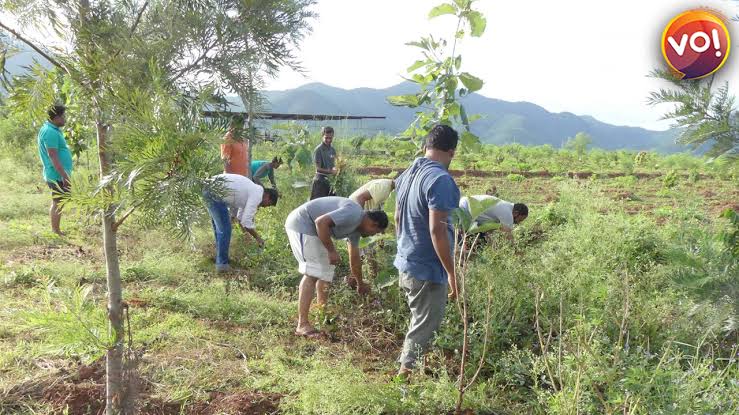
The letter also asks for monthly rent instead of one-time payment, a share in the profits power companies earn from these lines, a freeze on all pole-related work until stronger farmer-protection laws are in place, loan waivers, crop prices based on actual cultivation cost, a separate Agriculture Policy and Agriculture Commission, and more of the national budget going toward rural development. It also calls for setting up ginning and oil mills at the taluka level, controlling farm imports, doubling MSP, and creating a proper government procurement system. Zala’s letter points out that farmers affected by the Tata Nano and Bullet Train projects got compensated — and asks why pole-affected farmers should be treated any differently.
Congress Says Gujarat Skipped Crop Insurance
While the pole issue was building up, the Congress raised a separate complaint. Senior Congress leader and AICC spokesperson Shaktisinh Gohil says Gujarat is the only state in India that hasn’t implemented the central government’s crop insurance scheme, the Pradhan Mantri Fasal Bima Yojana (PMFBY), since 2019-20 — leaving farmers without cover that’s available almost everywhere else in the country.
To back his claim, Gohil released a letter written by Union Agriculture Minister Shivraj Singh Chouhan to Chief Minister Bhupendra Patel on November 25, 2025, urging Gujarat to adopt the scheme. The letter reportedly noted that PMFBY has helped farmers in other states hit by floods, drought and unseasonal rain, and that it also covers vegetables and horticulture crops.
Gohil had first raised this in the Rajya Sabha on December 5, 2025, after Gujarat farmers suffered heavy losses from unseasonal rain around Diwali. At the time, the state government announced ₹10,000 crore in relief — but Gohil called it inadequate, and warned that without proper insurance, farmers pushed into debt could be driven to take extreme steps. He now says that if PMFBY had been in place, farmers who lost crops worth crores last year would have got full insurance payouts instead of limited state relief.
With rains delayed this year and experts warning of a possible El Niño effect, the Congress is demanding that Gujarat adopt PMFBY immediately, explain why it opted out for six years running, and fully compensate last year’s crop losses.
What’s Next
Two separate fights — over land and over insurance — have now merged into one larger question: how much financial security does Gujarat actually give its farmers? What began as separate issues involving transmission corridors and crop insurance has evolved into a broader debate over how Gujarat balances infrastructure expansion with the financial security of its farming community.
The state government has agreed in principle that pole compensation needs to go up, but the real number is still being worked out through talks with farmer groups. On crop insurance, the government hasn’t yet responded publicly to the Congress’s charge.
For now, farmers across Kutch, Surat, Morbi, Jamnagar, Rajkot and several other districts are watching closely — and more protests, marches and conventions look likely in the coming weeks as both sides wait for the government’s next move.
Also Read: Gujarat Firms Outperform Sensex, Nifty; Gain Up To 58% In H1 2026 https://www.vibesofindia.com/gujarat-stocks-outperform-market-adani-group-h1-2026/