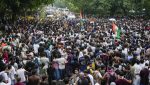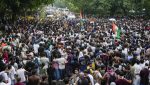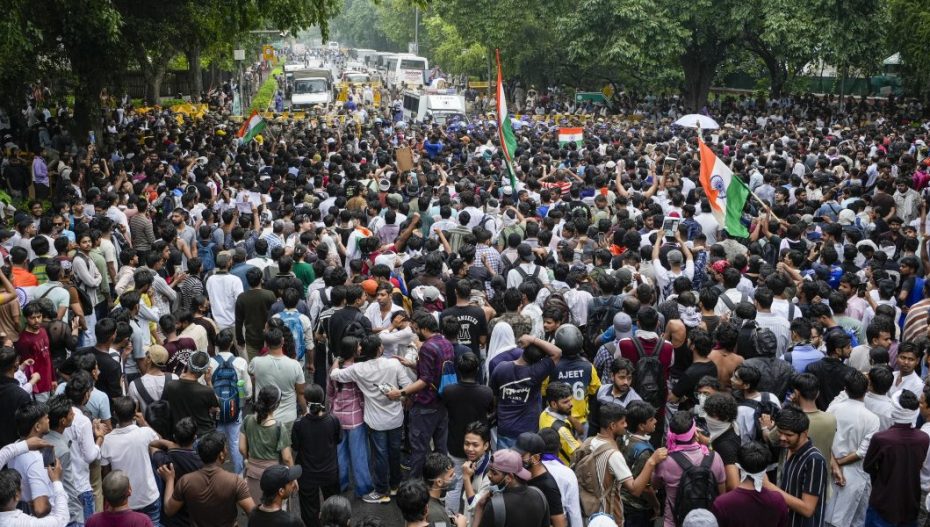
Tear gas hung over Sansad Marg on Monday afternoon as thousands of students, many of them still in their teens, ran for cover with wet cloths pressed to their faces. Barricades lay overturned. Somewhere in the chaos, a boy was being carried on two shoulders, blood running down the side of his head.
This was July 20, 2026 — the opening day of Parliament’s Monsoon Session — and Delhi had just watched the “Chalo Sansad” march, called by the Cockroach Janta Party (CJP), collapse into one of the most violent student crackdowns the capital has seen in years.
By evening, the numbers told their own story. More than 100 people were injured, including at least 10 police personnel, with several protesters landing in the ICU. Ram Manohar Lohia Hospital’s emergency ward was overwhelmed and had to divert incoming patients to Lady Hardinge.
Delhi Police say more than 118 of their own personnel were hurt too, and that the force was used only after protesters pelted stones, broke through barricades, and attacked security lines. Five FIRs have already been registered. Whichever version is closer to the truth, one thing isn’t in dispute: what began as a satirical Instagram page two months ago has now grown large enough to bring central Delhi to a standstill.
What happened on July 20
The plan was straightforward — a march from the protest camp at Jantar Mantar to Parliament, timed to coincide with the first day of the Monsoon Session, demanding the resignation of Union Education Minister Dharmendra Pradhan over the NEET-UG paper leak scandal. Delhi Police had already declared the gathering unlawful and slapped prohibitory orders on the route. It didn’t stop anyone from showing up.
Thousands did — students, parents, retired professionals, even Bollywood faces like Prakash Raj and Shabana Azmi, who joined the march in solidarity. As the crowd pushed toward Sansad Marg, they ran into layers of police barricading. When protesters tried to break through, the police responded with lathi-charges and tear gas at multiple points across the city. Internet services were suspended around the high-security zone near Parliament.
Delhi Police, for their part, have publicly denied that any lathi-charge or excessive force took place, calling reports of violence “rumours” and insisting the protest was handled “professionally.” That statement sits awkwardly next to the hospital admission numbers and the photographs of bandaged students that have since flooded social media and front pages alike. By evening, police had cleared the Jantar Mantar site entirely — only for protesters to rebuild the camp the very next day.
The man who wouldn’t eat
At the centre of the last fortnight’s coverage is 59-year-old education reformist and Ladakh climate activist Sonam Wangchuk, who has now been on hunger strike for 25 days in support of the protesting students. He was forcibly removed from the Jantar Mantar site on July 18 — an incident that protesters say was handled roughly, with police reportedly holding up sheets to block onlookers as he was carried away — and hospitalised.
As of this week, Wangchuk remains in the ICU at Gurugram’s Medanta Hospital. The hospital says his condition is now stable, though he will stay under observation “until further notice.” In a letter to Union Ministers J.P. Nadda and Jitendra Singh this week, Wangchuk laid out a new condition for ending his fast: he wants a written assurance from the Centre that no legal cases, harassment, or “vindictive action” will be taken against the protesters who marched on July 20 — a march he described, in the same letter, as having stayed peaceful “despite the atrocities and disproportionate use of force by the police.”
Where things stand right now
The camp at Jantar Mantar is back up, rebuilt within a day of being torn down, and by all accounts the mood among those who returned is defiant rather than deflated. “We will stand here with pride,” one protester who was at Monday’s rally told international media this week, describing having watched fellow demonstrators get struck by police. For most of the people camped out there, the anger traces back to one number: 152 alleged paper leaks and roughly 7.5 crore students affected by repeated entrance-exam irregularities over the past few years, NEET chief among them.
Politically, the standoff has widened well beyond the students themselves. Opposition leaders have piled pressure on the government over its handling of the crackdown and its prolonged silence on the protest itself. Leader of the Opposition Rahul Gandhi called the police action “disgusting” and used it to renew his broader charge that the government has failed India’s youth on jobs and exam accountability. Samajwadi Party MP Dimple Yadav and several other opposition MPs walked from Parliament to Jantar Mantar in a show of solidarity with the students. The government, meanwhile, has sent J.P. Nadda to hold talks with CJP leaders, even as the standoff over Wangchuk’s condition remains unresolved.
A protest about more than an exam
Strip away the satire and the viral costumes, and what’s playing out on Delhi’s streets right now is a familiar story with an unfamiliar face. It’s the story of a generation that did everything it was told to — studied hard, queued for entrance exams, believed the system would reward merit — and is now watching that same system get accused of leaking the very papers it was supposed to protect. It’s also, increasingly, a story about how far the state is willing to go to keep young people from being heard.
The images from July 20 — teenagers being tear-gassed on a road they were legally allowed to be denied access to, a 59-year-old activist carried out of a protest site while on hunger strike, internet shutdowns near Parliament during a democratically elected session — have reopened a debate that goes well beyond one exam scandal. Civil liberties groups and several commentators have pointed out that prohibitory orders, mass detentions, and force used against unarmed student marchers raise uncomfortable questions about the space for peaceful dissent in the country today. When students marching on Parliament to petition their own elected representatives are met with barricades and tear gas rather than a hearing, the question stops being about NEET alone — it becomes a question about whether the basic right to protest, guaranteed under the Constitution, is being allowed to function as it should.
That tension — between a state’s right to maintain public order and a citizen’s right to be heard — is precisely what’s animating so much of the coverage and commentary around this movement right now. It’s why opposition parties, retired judges, film personalities and ordinary parents have all found themselves, however briefly, standing on the same side of a barricade as teenagers holding hand-painted placards.
How a courtroom remark became a party
It’s worth remembering, if only briefly, where all of this started — because the origin says almost as much about India’s political mood as the protest itself does. On May 15, 2026, during a Supreme Court hearing on a contempt petition involving senior advocate designations, Chief Justice of India Surya Kant made an off-the-cuff remark from the bench, describing certain unemployed young people who turn to social media, journalism and RTI activism as being “like cockroaches” and “parasites of society” who “attack the system.”
Within a day, Abhijeet Dipke — a political communications strategist who had earlier worked with the Aam Aadmi Party — launched a satirical page inviting India’s “cockroaches” to unite, tongue firmly in cheek. The Cockroach Janta Party was born on May 16, openly parodying the ruling BJP’s name and structure. It picked up 350,000 sign-ups and crossed 20 million Instagram followers within days, spawned a student wing, the Cockroach Students’ Union of India, and spread from Delhi to West Bengal, Bihar and beyond. The CJI later clarified that his remarks were aimed at those using fake degrees to enter professions like law, not at India’s youth as a whole — but by then the moment had already outgrown the courtroom it was born in, and the movement had found a cause far bigger than the joke that started it: examination accountability, youth unemployment, and now, the right to protest itself.
What comes next
For now, all eyes are on two things: whether the government offers Wangchuk the written assurance he’s asking for, and whether the talks between J.P. Nadda and CJP leaders produce anything beyond another round of statements.
The Monsoon Session is still underway, the camp at Jantar Mantar is still standing, and a movement that started as a joke about cockroaches has, in the space of two months, forced a sitting Chief Justice into a public clarification and brought the national capital to a standstill.
Whether it ends in resignations, reforms, or just another cycle of detentions and denials is still an open question.
Also Read: Ahmedabad Joins CJP Protest: 150+ Detained In Solidarity March https://www.vibesofindia.com/ahmedabad-sonam-wangchuk-solidarity-protest-police-detentions/