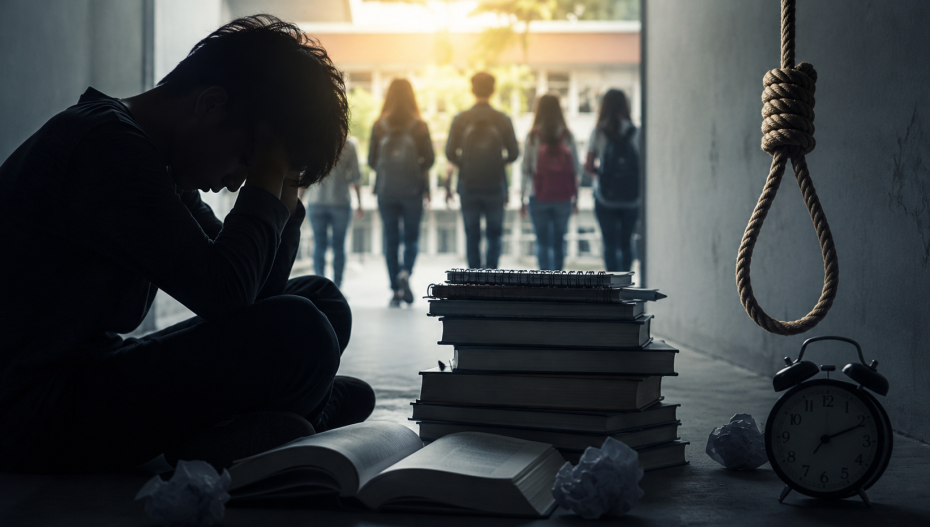
A worrying picture has emerged from Gujarat, where 1,888 students died by suicide over the last three years, highlighting the growing mental health crisis among young people. The figures have sparked fresh concerns about the increasing pressure created by the education system, competitive exams, and uncertainty surrounding careers.
Experts say the issue is no longer limited to academic stress alone. The commercialization of education, repeated paper leaks, delayed recruitment exams, and lack of mental health support have created an environment where many students feel hopeless about their future.
Year-Wise Student Suicide Data
According to the data presented in the report, the number of student suicides in Gujarat over the last three years is:
According to the data presented in the report, 1,888 students died by suicide in Gujarat between 2022 and 2024. In 2022, the state recorded 337 male student suicides and 304 female student suicides, taking the total for the year to 641. In 2023, 288 male students and 322 female students died by suicide, bringing the annual total to 610.
The trend continued in 2024, when 240 male students and 378 female students lost their lives, making the year’s total 618. Over the three-year period, 865 male students and 1,004 female students died by suicide, taking the overall number to 1,888.
The figures highlight the growing concern over student mental health and the increasing pressures faced by young people across the state.
In total, 1,888 students lost their lives during this period. The figures indicate that student suicides continue to be a major concern across the state.
Education Becoming a Costly Business
The report argues that education is increasingly turning into a business worth crores of rupees rather than remaining a public service. Rising education costs place a heavy financial burden on ordinary families, while students face constant pressure to perform well in examinations.
The report suggests that this combination of financial stress and academic expectations creates severe psychological pressure, especially among young people preparing for competitive exams.
Paper Leaks and Recruitment Delays Deepening Frustration
The situation has become even more difficult because of repeated incidents of paper leaks and delays in recruitment examinations.
Across India, more than 1,024 paper leak cases have reportedly been recorded in various competitive examinations. Gujarat has also witnessed several such incidents, weakening students’ confidence in the examination system.
Many recruitment processes take years to complete, leaving candidates waiting without certainty about their future. Students spend years preparing for exams only to face cancellations, delays, or irregularities, increasing stress and disappointment.
Experts say this uncertainty has become one of the biggest reasons behind frustration among the youth.
Demand for Transparent Examination System
The report emphasizes that young people are now demanding major reforms in the education and recruitment process. Among the key demands are:
A completely transparent examination system.
Fair and corruption-free admission procedures.
Transparent government recruitment examinations.
Timely completion of recruitment processes without unnecessary delays.
Strong action to prevent paper leaks and examination fraud.
According to experts, restoring trust in the examination system is essential to protect students’ confidence and future.
Students Under Constant Pressure
Every year, more than 20 lakh students in Gujarat appear for board examinations and various competitive entrance tests.
The pressure to secure high marks, gain admission into good colleges, and obtain stable employment continues to increase. For many students, these expectations become overwhelming, especially when combined with uncertainty in the examination and recruitment system.
Experts believe that repeated failures caused by system-related problems—not just academic performance—can severely affect students’ mental well-being.
Mental Health Support Needed at Every Educational Institution
Mental health professionals say that solving this crisis requires more than stricter laws or isolated reforms.
Dr. Manish Doshi, who has raised concerns over the issue, believes that a broader, systemic approach is necessary. He has suggested that:
Every school, college, and university should establish mental health counselling centres.
Students should have easy access to professional counselling services.
Emotional support systems should be made available before problems become severe.
Educational institutions should actively identify students experiencing stress, anxiety, or depression and provide timely assistance.
Experts stress that mental health should become an essential part of the education system rather than an afterthought.
Need for Long-Term Reforms
The report concludes that Gujarat’s rising student suicide numbers should be treated as a serious social issue rather than just a statistical concern.
Improving transparency in admissions, competitive examinations, and government recruitment can reduce uncertainty among students. At the same time, affordable education, better counselling facilities, and stronger mental health support can help young people cope with academic and career-related pressures.
Experts believe that unless meaningful reforms are introduced in both the education system and student support services, many young people will continue to struggle under immense pressure, putting their futures—and in some cases, their lives—at risk.
Also Read: ‘If Paper Leaks Need Resignations, Who Answers When Ahmedabad Leaks?’ Congress Questions https://www.vibesofindia.com/ahmedabad-waterlogging-amc-congress-accountability-debate/