


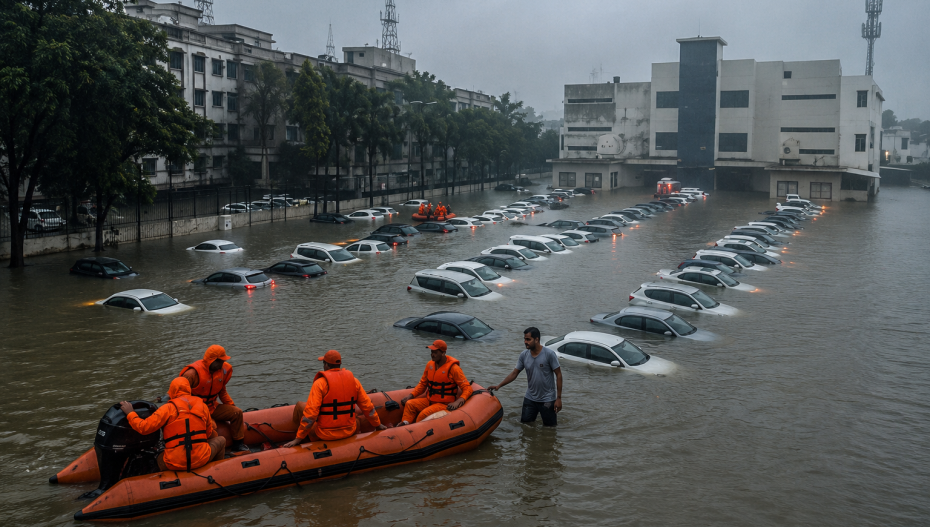
The issue of recurring waterlogging in Ahmedabad triggered a heated debate during the Ahmedabad Municipal Corporation’s (AMC) General Board meeting, with Congress councillors questioning the civic body’s accountability for repeated flooding despite spending crores of rupees on drainage and infrastructure projects.
Using the recent NEET paper leak controversy as an example, Congress councillor Shehzad Khan Pathan asked a sharp question that drew attention across the meeting.
“When an exam paper leaks, the Education Minister is forced to resign. If Ahmedabad ‘leaks’ every monsoon, then who should be held responsible?”
His remark set off an intense exchange between the opposition and the ruling side over the city’s preparedness for the monsoon season.
Congress Demands Accountability
Pathan argued that every year residents face severe waterlogging despite the AMC claiming to have invested huge amounts in stormwater drainage projects.
He said responsibility must be fixed for the recurring flooding and action should be taken against those responsible. According to him, if public money is being spent year after year, citizens deserve answers when the same problems continue to return every monsoon.
He also pointed to what he described as major weaknesses in Ahmedabad’s stormwater drainage network.
Areas Cited as Examples
While raising the issue, Pathan referred to several locations where waterlogging has repeatedly affected residents, including:
Madhumalti Apartments in Kathwada
Shrinandnagar in Vejalpur
Mahila Talav in Bodakdev
According to him, these locations continue to face flooding during heavy rains despite repeated civic works.
AMC Committee Chairperson Defends Civic Work
Responding to the criticism, Dharamshi Desai, Chairperson of the AMC Water and Sewage Committee, rejected the opposition’s claims.
Desai maintained that waterlogging had not occurred across the entire city and insisted that wherever flooding did take place, the water receded quickly.
He further stated that the situation has improved over the years because of the work carried out by AMC officials and elected councillors.
According to Desai, both civic officials and councillors deserve appreciation for the improvements made to Ahmedabad’s drainage system.
Heated Exchange Inside the House
Desai’s remarks were strongly challenged by Pathan, who accused him of ignoring the problems faced by ordinary residents.
Pathan went as far as saying that if the committee chairperson’s statement claiming that waterlogging had reduced was broadcast live on television, angry citizens would reject it because, according to him, the ground reality was very different.
He alleged that the chairperson was refusing to acknowledge the hardships faced by people living in flood-prone areas.
The disagreement soon escalated into a heated verbal exchange between the two leaders during the meeting.
Debate Shifts to Road Cave-ins
The discussion later moved beyond waterlogging and focused on the growing number of road cave-ins reported during the monsoon.
Desai informed the General Board that 15 road cave-ins had been reported so far this monsoon season. He described the number as relatively low and suggested that the situation remained under control.
However, Pathan expressed concern over the figure, pointing out that the monsoon had only just begun.
He reminded the House that more than 100 road cave-ins were reported during the previous monsoon season and warned that if the current trend continued, the city could once again record a “century” of cave-ins before the rains end.
Questions Raised Over Quality of Civic Works
Congress councillor Nirav Bakshi, representing the Dariapur ward, also criticised the quality of civic infrastructure projects.
He claimed potholes have appeared across several parts of Ahmedabad and blamed poor-quality construction and corruption for the recurring problems.
Bakshi alleged that despite spending crores of rupees on development projects, waterlogging continues because corruption affects the quality of public works.
According to him, unless construction standards improve and accountability is ensured, Ahmedabad will continue to struggle with flooded roads, potholes and infrastructure failures every monsoon.
Monsoon Preparedness Under Scrutiny
The discussion highlighted the growing political debate over Ahmedabad’s monsoon preparedness. While the ruling side maintained that the city’s drainage system has improved and flooding is limited and short-lived, the opposition argued that residents continue to suffer from recurring waterlogging, road cave-ins and poor-quality civic works.
With heavy monsoon rains continuing, the General Board meeting turned into a wider discussion on accountability, infrastructure quality and whether the city’s long-standing flooding issues are being effectively addressed or simply repeated year after year.
Also Read: Could Ahmedabad Lose Its World Heritage Status? UNESCO Warns Over Heritage Lapses https://www.vibesofindia.com/unesco-warns-ahmedabad-world-heritage-status-over-conservation-lapses/