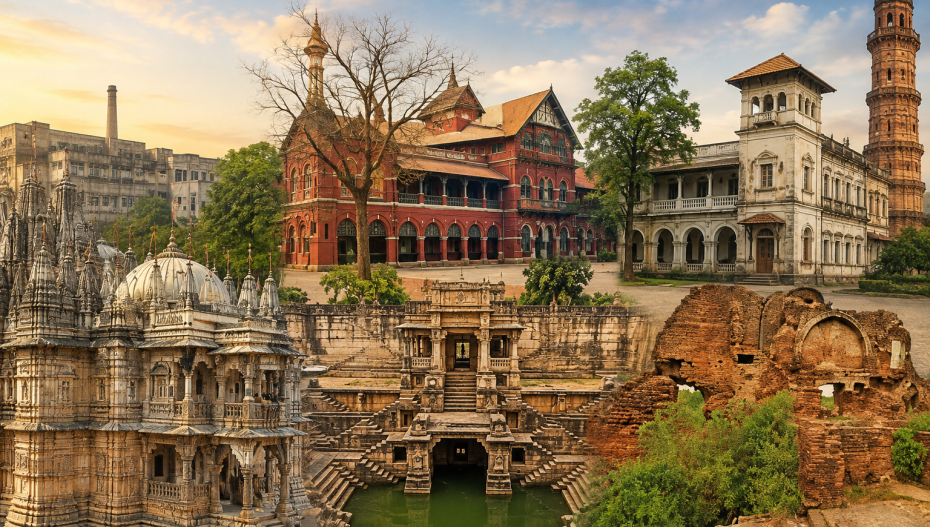
Ahmedabad is set to take another major step towards protecting its architectural and cultural heritage. After a delay of nearly 12 years, the Ahmedabad Municipal Corporation (AMC) is preparing to grant heritage status to 382 historically important structures located outside the Old City area.
The proposed list includes well-known landmarks such as Hutheesing Jain Temple, Fateh Baug Palace, Gujarat Vidyapith, Gujarat College, Circuit House and Vad stepwell, along with several old mills, stepwells, mosques, dargahs and other historic buildings.
The move is aimed at protecting these structures from demolition, neglect and unplanned redevelopment while helping owners maintain them.
382 Structures Shortlisted for Heritage Protection
The proposal to give heritage status to the 382 structures will be placed before the Heritage and Recreation Committee on August 24.
If the proposal is approved, the AMC’s heritage conservation committee will invite objections and suggestions from the public before sending the final list to the state government.
The process follows a detailed heritage survey conducted by the Indian National Trust for Art and Cultural Heritage (INTACH).
In December 2014, the AMC commissioned INTACH to conduct a comprehensive survey of historically significant buildings and structures outside Ahmedabad’s Old City.
The survey identified 861 historic structures, of which 382 were shortlisted and graded as having sufficient architectural or historical importance to be considered for heritage protection.
The heritage tag would mean that these structures cannot simply be demolished or altered without following the required conservation rules.
Many Structures Are Already Showing Signs of Decay
The survey also examined the physical condition of the 382 shortlisted structures.
The structures were divided into different heritage grades based on their architectural and historical importance:
Grade 1: 52 structures
Grade 2A: 38 structures
Grade 2B: 49 structures
Grade 3: 243 structures
The physical condition of the buildings also raised concerns.
According to the assessment:
18% were in good condition
37% were in fair condition
25% showed signs of deterioration
15% were under serious deterioration
5% were considered in danger of disappearing
This means that a significant number of historic structures require attention before further damage makes restoration difficult or impossible.
Why the Heritage Tag Matters
The conservation plan is not only about putting buildings on a protected list. The AMC also plans to support property owners with conservation-related benefits.
One of the proposed measures is the use of Transferable Development Rights (TDR) to help owners manage their properties while preserving the historic structures.
The heritage conservation committee will also review objections and suggestions received from the public before the proposal moves to the state government.
The long delay has become more significant because Ahmedabad received UNESCO World Heritage City status in 2017, but several heritage structures outside the Old City continued to face neglect and deterioration.
The latest proposal is therefore being seen as an attempt to extend heritage protection beyond the traditional historic core of the city.
Historic Sites Facing the Risk of Disappearing
The survey has identified several structures that are considered particularly vulnerable. Among the sites listed are:
Syed Hazrat Jalaluddin’s stepwell, Girdharnagar
Bhadaj stepwell, Gota
Sarkhej Roza complex
Fateh Baug Palace, Fatehwadi
Gram Panchayat lake, Vatva
Saptarishi well, Behrampura
Nanikram Shobharaj Mill, Rakhial
Mahisasurmardini Temple, Behrampura
Kalandarshah Dargah, Behrampura
Gebanshah Baba’s Dargah, Dudheshwar
Balapir’s Dargah, Dudheshwar
Surmabapa ni Khadki, Gota
Mochi ni Wadi’s platform, Kankaria
Gujarat Ginning Mill, Madhupura
Motilal Hirabhai Mill, Madhupura
Suprabhat Mill Compound, Madhupura
House of Kavi Shree, Navrangpura
Chimney near Chartola cemetery, Rakhial
Rani ka Roza, Rakhial
The list reflects the variety of Ahmedabad’s heritage, ranging from religious structures and stepwells to old industrial buildings and residential landmarks.
Fateh Baug: A Mughal-Era Landmark
One of the most historically significant structures on the proposed list is Fateh Baug Palace.
The complex dates back to the Mughal period. In 1582 CE, Mughal subahdar Abdul Rahim Khan-i-Khanan, also known as Mirza Khan, is said to have constructed Fateh Baug after his victory over Muzaffar Shah, the last Sultan of Gujarat.
Spread over around 50 acres along the banks of the Sabarmati River, the site was enclosed by massive walls on three sides.
Mughal engineers developed a system to bring river water directly into the gardens, making the complex an important example of the engineering and garden planning of the period.
The site also has a connection with Mughal emperor Jahangir. During his visit to Gujarat in 1618 CE, Jahangir visited the gardens. He was reportedly impressed by Fateh Baug and recorded the visit in his memoirs, Tuzuk-i-Jahangiri.
Ahmedabad’s Heritage Has Grown Through Many Eras
The proposed heritage list also reflects how Ahmedabad developed over several centuries.
The city entered a new phase in 1817, when it came under British rule after Kaira collector John Duncan Dunlop took charge.
In 1831, the Town Wall Fund Committee was formed to repair the city’s boundary walls, laying the foundation for the municipal system.
The Gujarat Vernacular Society was founded in 1848. It later became Gujarat Vidyasabha and played an important role in the development of education, including the city’s first library, newspaper and periodical.
Ahmedabad’s industrial transformation began to take shape in the 19th century. In 1861, industrialist Ranchhodlal Chhotalal established the Ahmedabad Spinning and Weaving Company Ltd, marking the beginning of the city’s major textile industry.
The company became associated with Ahmedabad’s emergence as an industrial centre and earned the city the reputation of being the “Manchester of the East.”
Gandhi Road and the City’s Changing Infrastructure
In 1884, Richie Road, now known as Gandhi Road, was developed as the city’s first major thoroughfare for traffic.
Ahmedabad’s infrastructure also underwent major changes around the same period.
Water connections were introduced in 1891 with the establishment of waterworks at Dudheshwar. By 1903, a sewage network had been laid in the Walled City.
Another important milestone came in 1915, when the faces of the clock on Bhadra Fort were electrified. It became the first building to receive an electricity connection and the first customer of the Ahmedabad Electricity Company.
These milestones show how Ahmedabad’s built heritage is connected not only to palaces and religious monuments but also to its development as an administrative, educational, industrial and modern city.
A Chance to Save Ahmedabad’s Architectural Memory
The proposed heritage protection for 382 structures comes at a crucial time. Many of these buildings are already showing signs of deterioration, while some have been identified as being at risk of disappearing completely.
The AMC’s next step will be to place the proposal before the Heritage and Recreation Committee on August 24. If approved, public objections and suggestions will be invited before the final proposal is sent to the state government.
After years of delay, the process could provide stronger protection to Ahmedabad’s lesser-known historic buildings and help preserve the city’s architectural story for future generations.
For a city recognised internationally for its heritage, protecting these structures is not simply about saving old buildings. It is about preserving the layers of history that tell the story of how Ahmedabad grew from a historic settlement into a modern city.
Also Read: Could Ahmedabad Lose Its World Heritage Status? UNESCO Warns Over Heritage Lapses https://www.vibesofindia.com/unesco-warns-ahmedabad-world-heritage-status-over-conservation-lapses/