


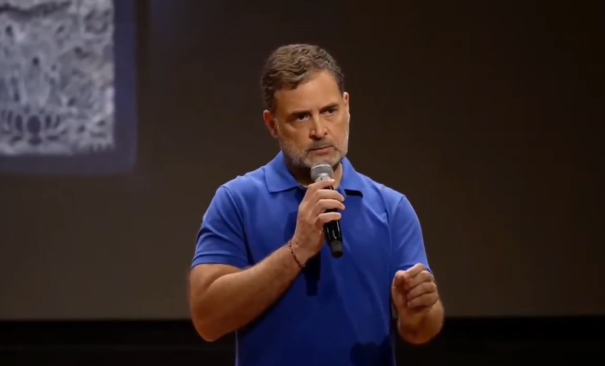
Congress leader and Leader of Opposition in the Lok Sabha Rahul Gandhi has sharply criticised the recent “purification” ritual carried out at a venue in Uttarakhand after Congress president Mallikarjun Kharge addressed a rally there. Gandhi described the practice as “another name for untouchability” and alleged that it goes against the principles of the Indian Constitution.
Speaking at a press conference in Delhi on Saturday, Gandhi said the incident reflected a larger political and ideological battle in the country between the values of the Constitution and the ideology represented by the BJP and RSS.
Gandhi attacks ‘purification’ ritual
Gandhi referred to an August 8 Congress rally at Ramlila Maidan in Haldwani, Uttarakhand, where Kharge had delivered a speech ahead of the 2027 Assembly elections.
According to Gandhi, a purification ritual was later performed at the venue by people associated with the BJP and RSS.
Gandhi questioned the practice and said that such an act suggests that Dalits are considered “unclean” and should not be touched. He argued that untouchability was outlawed by the Constitution and claimed that openly practising such discrimination amounts to a criminal act.
He said the incident was particularly significant because Kharge has spent his life working for the country and the Constitution.
‘Two ideologies are fighting’
Gandhi placed the controversy within what he described as a wider political struggle between two competing visions of India.
He said one side represents the Constitution and the ideas associated with Dr B R Ambedkar, Mahatma Gandhi, Jawaharlal Nehru and Sardar Patel, while the other represents the ideology of the BJP and RSS.
According to Gandhi, this ideological contest is shaping much of the political debate in India today.
Gandhi raises concerns over caste discrimination
Gandhi also spoke about what he described as continuing caste-based discrimination against Dalits despite constitutional protections.
He said Dalits have faced discrimination and violence for generations and argued that some forms of caste discrimination continue to appear in everyday life.
He cited examples involving children in schools, claiming that Dalit students are sometimes made to clean toilets, sweep and mop floors while other students do not have to perform such tasks.
Gandhi said such experiences can have a lasting impact on young minds because children grow up seeing differences in how their classmates are treated.
Claims of discrimination over access to water and tea cups
Gandhi further alleged that caste discrimination can also be seen in access to common resources.
He claimed that in some villages, Dalits have been prevented from using common village wells and have had to arrange separate sources of water.
He also referred to practices at tea stalls, alleging that separate cups are sometimes used for Dalits while reusable glass cups are used for others.
Calling these examples a reflection of social realities in parts of India, Gandhi said such discrimination can be seen in both villages and cities.
Kharge had earlier raised the issue
Kharge had also spoken about the Haldwani incident, linking the purification ritual to his identity as a Dalit leader.
He said he had not mentioned any community or religion during his speech at the venue. According to Kharge, however, people associated with the BJP later carried out the ritual at the same stage.
Kharge questioned whether such an incident was appropriate in a democracy and asked how the Constitution could be protected if such practices were allowed.
He later called for strict legal action and said he did not want the issue to be politicised. He also demanded that a case be registered under the law dealing with untouchability against those responsible for conducting the ritual.
A controversy over caste, dignity and constitutional values
The Haldwani incident has therefore become a larger political dispute, with the Congress presenting the purification ritual as an example of caste discrimination and a challenge to constitutional values.
Gandhi argued that practices that suggest one group is “unclean” or should not be touched cannot be separated from the history of untouchability in India.
His remarks have once again brought questions of caste discrimination, social equality and the protection of constitutional rights to the centre of political debate.
Also Read: Ahmedabad Peaceful Reading Session Turns Violent: Bajrang Dal Attack Youth, Tear Books