


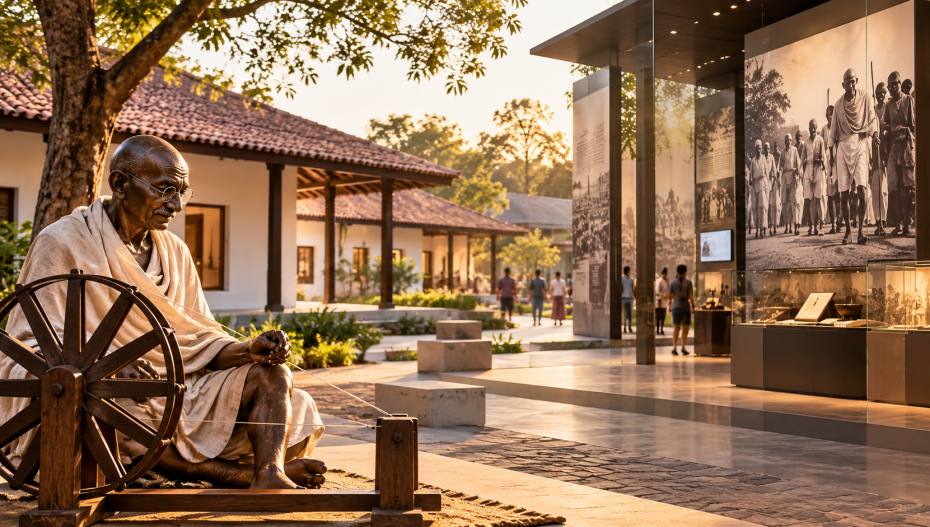
The historic Sabarmati Ashram in Ahmedabad is set to take a major step towards its redevelopment, with the design of 23 museums and exhibition spaces being taken up by Paris-headquartered Museum Studio.
Museum Studio, which specialises in turnkey projects for cultural institutions and has a presence in 46 countries, has been awarded the work in a consortium with Ecofirst Services Ltd, a wholly owned subsidiary of Tata Consulting Engineers.
The development is part of the larger plan to redevelop, conserve and expand the Sabarmati Ashram, with the redeveloped premises spread across 55 acres.
The project is being overseen by the Mahatma Gandhi Sabarmati Ashram Memorial Trust and is being carried out under the direct supervision of Prime Minister Narendra Modi. It has been described by sources as a “world-class” memorial and the largest dedicated to Gandhi in the world.
23 Buildings To Become Museums
The museum component will cover 23 buildings, with exhibitions planned to present different aspects of Gandhi’s life and his role in the independence movement. Ecofirst has been awarded a ₹113 crore contract for designing and developing the museums and exhibitions across these buildings.
The original Ashram complex had 28 buildings identified for restoration. These included a hostel, gaushala, school, spinning and weaving centre, paper-making centre and creche. The Ashram Gaushala museum is being restored by the National Dairy Development Board.
Nine-Member Panel To Shape Museum Content
While Museum Studio and Ecofirst are working on the museum development, the content is being reviewed by a nine-member Content Advisory Committee appointed by the Trust.
The committee was formed in March and has held three meetings so far. At its latest meeting in August, members vetted material covering Gandhi’s years in South Africa, along with people who influenced him and those whom he influenced.
The committee will provide inputs and approve the content, design and other aspects of the museums before the designs are finalised. The panel brings together political figures, philanthropists, museologists and academics.
The nine-member panel includes Rajya Sabha Deputy Chairman Harivansh and Rajashree Birla, a trustee of Gujarat Vidyapith and granddaughter-in-law of Gandhi’s close associate Ghanshyamdas Birla. Other members are Bihar Museum Director General Anjani Kumar Singh; National Commission for Scheduled Castes Chairperson and former Gujarat BJP spokesperson Kishor Makwana; Gujarat Vidyapith Vice Chancellor and former Gujarat BJP media convener Harshad Patel; Chhatrapati Shivaji Maharaj Vastu Sangrahalaya Director General Sabyasachi Mukherjee; historian Rizwan Kadri; IGNCA trustee Rajaram Yajnik; and Indian Institute of Heritage Pro-Vice Chancellor Manvi Seth.
Inputs From Gandhi’s Johannesburg Years
The committee’s work has also drawn on material connected to Gandhi’s time in South Africa. One committee member visited Satyagraha House in Johannesburg and submitted a 60-page input based on Gandhi’s writings preserved there.
Satyagraha House was designed by German architect Hermann Kallenbach, and Gandhi stayed there during 1908–09. Such inputs are being considered as the museum content is reviewed for authenticity.
NID To Review The Museum Story
The Content Advisory Committee is currently examining the first draft of a plan submitted by Ecofirst. Once the committee clears the content, it will move to the National Institute of Design (NID) for proof-checking, review and approval of the museum design submitted by Museum Studio.
NID will also decide how Gandhi’s story should be presented to the new generation, particularly as the source material notes that younger audiences are less inclined towards reading.
The communication and content formats will eventually be vetted by the Prime Minister’s Museum and Library Society and the Indian Institute of Heritage.
Bringing The Old Ashram Back To Life
The redevelopment is not limited to creating new museum spaces. Existing historic structures are also being revived using materials similar to those used more than a century ago.
The restoration work includes materials such as bricks, teak and lime plaster. A traditional binding paste made using urad, jaggery and fenugreek seeds is also being used. Once restored, the historic buildings will be given new roles as museums and exhibition spaces.
Gandhi’s Sabarmati Connection
The redevelopment is centred on the place where Gandhi spent an important part of his public life.
Gandhi had purchased a 60-acre plot along the Sabarmati River, situated between the central prison and a cremation ground. He moved into the Ashram in 1917, the same year he led his first major satyagraha in Champaran, Bihar.
A source connected with the project has claimed that more than 60% of Gandhi’s contributions to the country and the world, if quantified, came from this Ashram. The period referred to stretches from the Champaran Satyagraha to the British exit from India.
Digital Content Limited To 30%
The Trust has decided to cap the digital component at 30% of the content presentation inside the museums. Areas featuring electronic displays and similar installations will have air conditioning.
The approach keeps the focus on presenting Gandhi’s story through the museum spaces while allowing digital formats to form a limited part of the overall experience.
Central And Gujarat Governments Working Together
The redevelopment of the Sabarmati Ashram is being jointly implemented by the Central Government and the Gujarat Government.
Urban planner Bimal Patel’s firm HCP Design, Planning and Management Pvt Ltd prepared the masterplan and carried out the civil works.
The Trust’s Governing Council is headed by Gujarat Chief Minister Bhupendra Patel, while retired IAS officer I P Gautam heads its Executive Council.
With the museum design now being taken up by Museum Studio and Ecofirst, the redevelopment is moving towards creating a 23-museum complex within the historic Ashram premises in Ahmedabad.
The aim is to conserve the existing structures while creating spaces that present different chapters of Gandhi’s life, his influences and his leadership of the independence movement.
Also Read: ‘True Hero’: Gujarat Pilot Smit Machchhar Stabbed Mid-Air, Family Awaits His Recovery