



By Aparna Bhattacharya
Certain numbers – like how many Bengal voters were marked for ‘logical discrepancies’ – appear to be hard-coded into the dashboard, instead of using a dynamic code that would change with updates.
Some of the most important West Bengal numbers on the Election Commission’s portal appear to be typed straight into the portal’s code, rather than a dynamic figure that changes with the count.
That is the finding of an independent analysis of ECINet, the Commission’s online system for managing electoral rolls, which officers, observers and the Commission itself use to track the Special Intensive Revision (SIR) of voter rolls.
The Wire began looking into ECINet’s code after a tip-off. It then asked three senior computer scientists and a cybersecurity expert, each with decades of experience in the field, to examine the findings independently. All of them do not want to be named.
The code was publicly available until November 23 – when the code page started redirecting to an ECI log in page. This change occurred two days after The Wire reached out to the ECI with queries about the code.
What was examined
The analysis examined the code of the ECINet website itself, as last accessed on November 18. The server’s own records show that code was last changed on October 16, 2026.
A portal like ECINet works in two parts. The Commission’s database stores the real figures: how many voters were flagged, how many notices went out, how many hearings were held. Each time an official opens the dashboard, the screen asks the database for the latest figures and shows whatever comes back. When the data changes, the screen changes with it.
A number typed into the code skips that step. Instead of asking the database, the programmer writes the figure directly into the instructions for the screen, and the screen shows that figure every time, whatever the database holds. Programmers call this hard-coding. It is sometimes used while a system is being built or tested, but a live dashboard that officials rely on is expected to show the changing data, not a fixed number.
Think of a scoreboard at a cricket ground. It is fed by the scorers, and it is supposed to change with every run. Imagine one where, for one team only, the score has been painted on. The match goes on, runs are scored and wickets fall, but the board shows the same number. The players, the umpires and the crowd all look at it, and nothing on the board tells them it has stopped following the game.
ECINet is that scoreboard for the SIR. Its dashboards are meant to show what the Commission’s database holds, and the officers, observers and courts following the revision rely on them. The analysis found that for West Bengal, some of those figures are painted on. They are written into the portal’s code, so they stay the same whatever happens to the real count unless the portal’s developers change that code, and on the screen they look exactly like live figures.
A number that does not change
ECINet has a dashboard that shows how many voters in each state were flagged for “logical discrepancies”, the mismatches in names, ages and family details that sent voters to hearings during the SIR.
For every state, the dashboard shows the figure from the Commission’s database. Except one. When West Bengal is chosen, the code shows 94,49,132, whatever the database says.
The code that does this is public. It sits in a file the portal sends to every visitor’s browser, ecinet.eci.gov.in/static/js/9226.e7540559.chunk.js. The line reads: children: [“Electors with Discrepancies – “,(0,A.Cc)(“West Bengal”==Tl&&bo ? 9449132 : mo?.anomalyCount)]
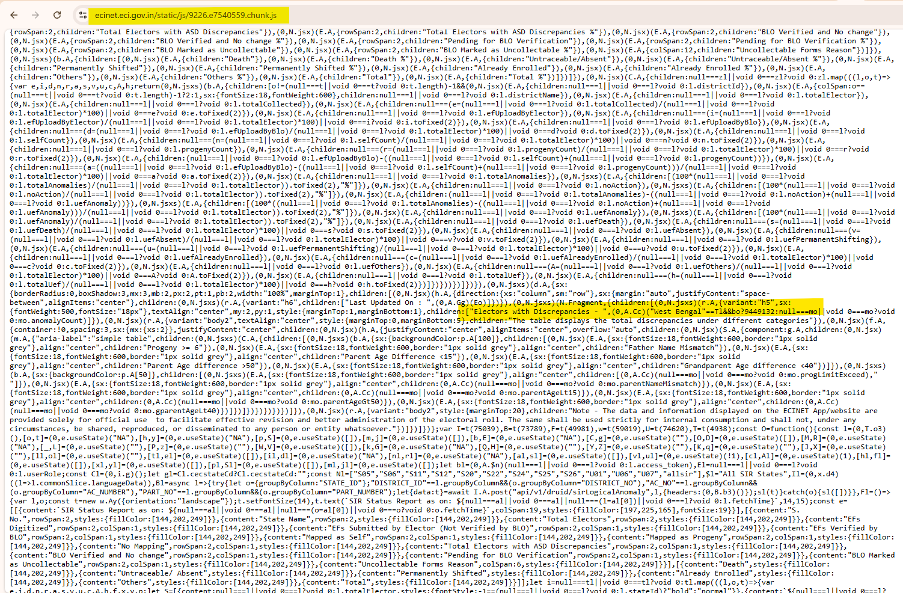
It is a simple either-or instruction.
If the state is West Bengal and the statewide view is selected, the screen shows the fixed number 94,49,132, written in the code as 9449132. Otherwise, it shows “anomalyCount”, the figure the portal receives from the Commission’s database. For all other states, the statewide total of electors with discrepancies comes from the data. For West Bengal, it comes from the code.
The number 94,49,132 is the official count of electors in West Bengal whose entries were flagged for logical discrepancies during the Election Commission’s verification drive, the voters who were then called to prove their place on the roll.
The code cannot say why. That count was published in February, so the code may hold a frozen copy of it. It may be a workaround for a problem with the server’s own count. Or it may be something else. The only way to know is to compare it with what the Commission’s database actually returns, which needs authorised access. What the code does show is that if the real number changed after February, as cases were reviewed, flagged again or sent to judges, anyone looking at the dashboard would not see the change.
Hearings counted from a fixed figure
A second dashboard tracks the notices sent to voters and the hearings held. For West Bengal, the code sets the number of notices to 1,51,92,735, and then works out the number of hearings from that fixed figure.
In other words, the screen’s count of hearings in Bengal depends partly on a number written into the code, not only on what the database records. West Bengal is the only state whose notices and hearings figures depend on a number in the code. In the drill-down views, district and below, Bengal’s figures come from the database too. The only other figure the code replaces on this dashboard is Tamil Nadu’s count of cases “found not OK”.
That figure is close to, but not identical to, the 1,51,92,634 hearing cases recorded in the Commission’s own ERONET status report from the deadline night of February 21. The hearing stage is where The Wire’s reporting has found the SIR’s official figures repeatedly failing to add up. On the Commission’s own records, electoral registration officers had decided 94% of hearing cases by the deadline, yet 60 lakh voters were still sent to judges a week later.
The rules that flagged voters, written into a screen
The West Bengal discrepancy dashboard also lists the rules used to flag voters. They are typed directly into it:
the voter’s parent is linked to six or more children on the roll (“Progeny >= 6”); the father’s name does not match; a parent and child are less than 15 years apart in age, or more than 50; a grandparent and grandchild are less than 40 years apart.
These are the “logical discrepancies” that sent millions of Bengal voters to hearings, and many of them on to judges. In one case The Wire has seen on the portal, a woman in Deganga was flagged because six other voters had named the same man as their father.
Rules that decide whether a citizen is called to prove their place on the roll would normally be set out in a published order, and kept in settings that officials control and auditors can check. Here the list appears in the code of a single screen, which only the portal’s developers can change, and which officials and auditors cannot easily see or review.
‘Backup’ turnout figures never updated
The analysis also found a backup screen for voter turnout. If the live turnout feed fails, it shows fixed figures for West Bengal – 2,84,19,840 votes out of 3,60,77,304 electors, a turnout of 78.77%, with a “last update” of April 11, 2026. The state assembly election was held in two phases – April 23 and April 29 (both after April 11, when the 78.77% backup number was put in).
The total electors figure on the screen is not a placeholder. It matches, to the last digit, the official number of electors eligible to vote in the first phase of polling. After scrutiny of the Phase 1 vote, the Commission put that number at 3,60,77,304
On April 20, the Commission had announced 3,60,77,171 Phase 1 electors. On the eve of polling, the SIR tribunals restored a further 139 voters, and eight names earlier added by judicial officers were removed. The final number was settled only around polling day on April 23. So the screen holds a figure from after the date it claims as its last update. The code was evidently changed after April 11, but the date in the code was not.
The turnout on the screen, 78.77%, or 2,84,19,840 votes, is not the final figure of 93.19%, or 3,36,20,168 votes.
However, turnout on the screen is not invented either. It is the turnout recorded at 3 pm on polling day. According to the Commission’s own hour-by-hour figures for April 23, seen by The Wire, Phase 1 turnout stood at 78.77% at 3 pm, the same figure fixed in the code. The screen also holds turnout percentages for the 16 districts that voted in the first phase, and these match the same 3 pm figures: 79.88% for Bankura, 80.22% for Birbhum and 77.53% for Alipurduar. Beside each, the code records zero voters – indicating that the code was not updated completely and only the turnout percentages were hard-coded in the backup.
Time stamps hidden in the code show when these snapshots were taken: 3:33 pm and 5:33 pm on April 23. They appear to have been copied from the live turnout feed on polling day and saved into the portal, where they were still sitting on October 16.
There is no evidence that this backup screen was ever shown to anyone. But it is still significant that the backup was never updated, as this is an important official historical record that may have been required at any moment. Instead, the ECI appears not to have ensured that these numbers were updated.
If the backup was used, the live screen would show the figures with their poll date and the note “As at 03:00 PM”, so the label itself is accurate. The problem is what it would show at any other time. If the live feed failed later that evening, the screen would present the 3 pm figures as the latest turnout, with nothing to tell officials that they were looking at saved numbers rather than live ones. If it failed on April 29, the second day of polling, the screen would show the first phase’s figures instead, marked only with the earlier poll date. The code holds no figures from April 29, which suggests the snapshots were taken once, on April 23, and not updated after that.
Why it matters
On a screen, a number typed into the code looks exactly like one drawn from live data. The officers, observers and courts relying on ECINET to follow the SIR in Bengal would have no way to tell the two apart.
That matters in a revision where the Commission’s public figures have repeatedly not matched its own records. When the roll was frozen in April, 22,163 cases were described publicly as decided and awaiting only an e-signature. The Commission’s own report records the same 22,163 as not decided before the assembly election. The office of the Chief Electoral Officer now says 5,819 cases remain pending across the state. The electoral rolls of just 11 Murshidabad constituencies record 29,347 voters still under adjudication.
Based on publicly available files
This analysis is based only on the files the portal sends to browsers, which are publicly available. It could not see what the Commission’s servers hold or return, and it does not show what was actually done with the portal. Why the fixed values are there, whether as test data left behind, a snapshot frozen in place or a deliberate substitution, cannot be told from the code.
The analysis found no fields for religion, caste or community anywhere in the files, and no feature that deletes voters automatically at this particular stage. Every removal needs an officer to act. Its authors withdrew or narrowed 12 of their own earlier claims after checking them against the code.
Questions for the Commission
The Wire has asked the Election Commission why these West Bengal figures are fixed in the portal’s code, what the true counts in its database are, which order sets out the rules used to flag voters, and why a backup turnout screen holds figures that weren’t updated. This report will be updated when the Commission responds.
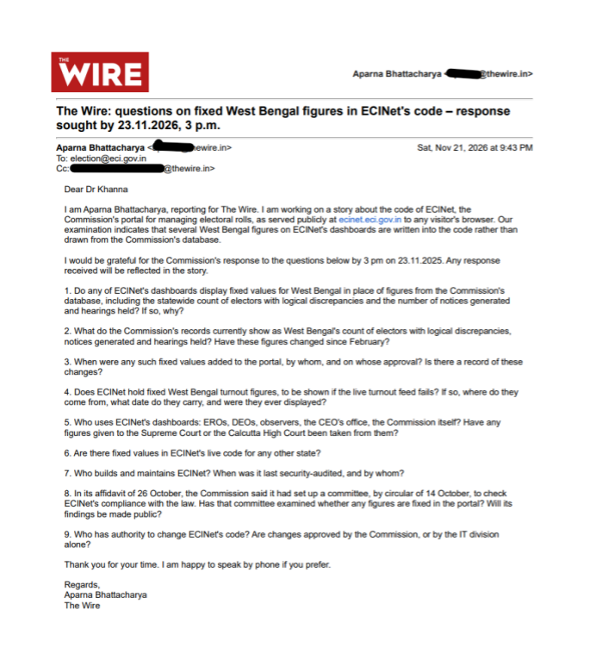
Two days after The Wire sent its questions to the Commission on Saturday, November 21, 2026, public access to ECINet’s code was restricted. Visitors trying to open the portal’s code files are now redirected to ECINet’s login page, which asks for a user ID, a captcha and a one-time password before anything can be seen. The Commission has not said whether the change was connected to The Wire’s questions.
ECINet was redeployed on November 23. The server records a new version of the site published at 7:35 pm IST that day. The portal now loads a new main file, and its list of files has changed.
The Wire has preserved a complete copy of the code as on November 18, with a digital fingerprint for each file.