Ahmedabad is preparing to think bigger.
A city that has hosted major sporting events is now looking ahead to the Commonwealth Games and aspiring to become part of the Olympic story. The ambition is to present Ahmedabad as a city capable of hosting events of global scale, with better infrastructure, connectivity and facilities.
But while the city looks towards the world stage, a very basic problem is sitting in plain sight — and it is growing every day.
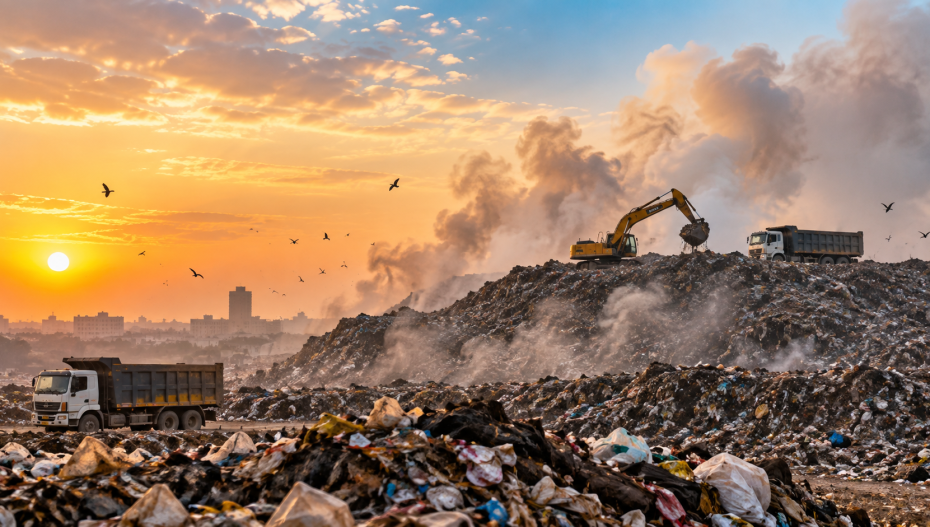
At Pirana, on Ahmedabad’s south-western edge, thousands of tonnes of garbage continue to pile up. Beneath that waste, organic material is breaking down without oxygen and producing methane, a greenhouse gas far more powerful than carbon dioxide over the short term.
A new study has now put a number to the problem: Pirana released an average of around 38,000 metric tonnes of methane a year between 2019 and 2024. In 2024 alone, the figure was about 42,000 tonnes.
For a city that wants to project itself as a global destination, the findings raise an uncomfortable question: Can Ahmedabad talk about international ambitions while the basic management of the waste it produces remains such a challenge?
A mountain of waste on Ahmedabad’s edge
Pirana is not a new problem.
The dump has been growing since the 1980s and is now around 22 metres high. Ahmedabad sends roughly 4,000 metric tonnes of garbage to the site every day.
That waste contains a significant amount of organic and food waste. As it gets compressed under layers of garbage, it decomposes without oxygen. Methane-producing bacteria then generate methane inside the dump.
The problem is that Pirana does not have the infrastructure normally used to control this gas.
There are no gas-collection wells, no engineered liner beneath the waste and no impermeable cap over the dump.
In simple terms, much of the methane produced inside the waste mass has no proper system to collect it before it escapes into the atmosphere.
And unlike a temporary pollution spike, the methane coming from Pirana appears to be a persistent problem.
The numbers tell a steady story
Researchers from the Centre for Atmospheric Sciences at IIT Delhi studied methane emissions from major Indian dumpsites using satellite-based measurements.
Their findings show that Pirana’s emissions have remained significant over several years.
Pirana’s methane emissions have remained high over the years. The dump released around 35,000 tonnes in 2019, rising to 46,000 tonnes in 2020. Emissions fell to 32,000 tonnes in both 2021 and 2022, before increasing again to 41,000 tonnes in 2023 and 42,000 tonnes in 2024. Over these six years, Pirana released an average of around 38,000 tonnes of methane annually.
The variation from year to year is relatively low compared with some other Indian landfills studied.
That matters because it suggests that Pirana is not producing methane only during occasional periods of unusually high emissions. The release is continuing year after year. The findings were also independently cross-checked using NASA’s EMIT instrument.
Methane is not just another gas
Methane is one of the major greenhouse gases driving global warming.
The study notes that methane is around 80 times more powerful than carbon dioxide over a 20-year period.
That makes a large, continuously emitting dumpsite more than just a local waste-management concern.
It becomes part of the larger climate problem.
For Ahmedabad, the issue is particularly difficult to ignore as the city deals with rising heat and increasingly intense urban weather conditions. While one dumpsite cannot by itself explain the city’s changing temperatures, methane emissions add to the wider greenhouse-gas burden.
And the irony is hard to miss: a city preparing itself for international events is also dealing with a waste site that is releasing tens of thousands of tonnes of methane into the atmosphere every year.
Pirana is not India’s biggest methane emitter
Pirana’s numbers are serious, but the study also shows how large the problem can become at other Indian dumpsites.
Delhi’s major dumpsites recorded considerably higher methane emissions in 2024.
Among the major dumpsites studied, Pirana receives around 4,000 tonnes of waste every day and emitted about 42,000 tonnes of methane in 2024, with a six-year average of 38,000 tonnes. In comparison, Ghazipur in East Delhi receives 2,000–2,200 tonnes of waste daily but released around 1.2 lakh tonnes of methane in 2024, averaging 87,000 tonnes over six years. Okhla emitted about 72,000 tonnes in 2024, with a six-year average of 52,000 tonnes, while Bhalswa recorded 33,000 tonnes in 2024 and averaged 24,000 tonnes over six years.
Together, Delhi’s three major dumpsites released around 2 lakh metric tonnes of methane in 2024, according to the study.
Ghazipur, which began operating in 1984, is now more than 60 metres high. It released about 1.2 lakh tonnes of methane in 2024.
Interestingly, Pirana receives nearly twice as much waste every day as Ghazipur. Yet its methane emissions are much lower. That does not necessarily mean Pirana is being managed better.
The difference can also be linked to factors such as the height of the waste, the composition of the garbage and the conditions under which it decomposes.
Why the waste inside matters
What goes into a dump matters almost as much as how much goes into it.
Indian dumpsites tend to receive a large amount of organic waste, including food waste. When this material is buried under layers of garbage and deprived of oxygen, it creates ideal conditions for methane production.
The IIT Delhi study points out that Indian dumpsites receive more organic waste than comparable landfills in the US and China.
That means the methane problem is closely tied to something as ordinary as what households and businesses throw away every day.
Food waste does not simply disappear when it reaches Pirana.
It keeps breaking down.
And while it does, it keeps producing methane.
Satellite data is changing the picture
One of the important aspects of the study is how the researchers measured the emissions.
Instead of relying only on estimates based on the quantity and type of waste entering a landfill, researchers used a satellite-based Cross-Sectional Flux method.
The method detects methane plumes downwind of a dumpsite and then works backwards to estimate how much methane is being released.
The results suggest that traditional bottom-up estimates can significantly underestimate actual emissions.
For Ghazipur, conventional estimates were found to be 70–90% lower than the measured emissions.
For Bhalswa, they were 30–70% lower.
That is important because if emissions are being underestimated, the scale of India’s landfill methane problem may also be larger than previously understood.
Ahmedabad is sending more waste. The question is what happens next.
The Pirana story is ultimately not just about methane.
It is about what happens when a city grows faster than its waste-management systems.
Ahmedabad generates thousands of tonnes of waste every day. Pirana has been absorbing it for decades. But the waste does not stop creating environmental problems once it reaches the dump.
It decomposes. It releases methane.
And without proper systems to collect that gas, much of it can go straight into the atmosphere.
The study’s six-year numbers show that this is not a problem that appeared suddenly. Pirana released about 35,000 tonnes of methane in 2019, 46,000 tonnes in 2020 and 42,000 tonnes in 2024.
The emissions have remained high.
Ahmedabad may be preparing for the world’s biggest sporting stages. But before the city can convincingly present itself as a global city, it also has to deal with what is happening beneath its own waste.
Also Read: Chasing The US Dream Via ‘Dunki’, 3 Gujarat Cousins Kidnapped In Ethiopia