


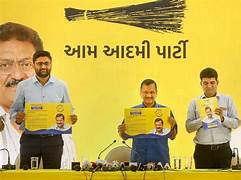
The Aam Aadmi Party has approached the Supreme Court of India challenging the blocking of the Facebook page and Instagram handle of its Gujarat unit, alleging that the action was taken without notice just days before local body elections in the state.
The matter came up before a Bench of Justices PS Narasimha and Alok Aradhe, which on Friday issued notices to the Central government, the Gujarat government and Meta Platforms, the parent company of Facebook and Instagram.
The court also directed that the plea be tagged with the pending case of Software Freedom Law Centre, India v. Union of India, a significant matter dealing with the scope of government blocking powers, intermediary liability and procedural safeguards in online censorship and content takedown cases.
What Triggered the Dispute
According to the petition filed by AAP and Gujarat unit secretary Sharma Anup, the party’s social media accounts suddenly became inaccessible in India shortly before local body elections, severely affecting its online campaign outreach.
The petition states that Meta informed the party that the restriction had been imposed following a communication from “Government of India / Law Enforcement” under Section 79(3)(b) of the Information Technology Act, 2000.
AAP has argued that Section 79(3)(b) does not itself provide an independent statutory power to block or suspend entire social media accounts. Instead, the provision primarily deals with intermediary liability and safe harbour protections available to digital platforms.
Senior Advocate Shadan Farasat, appearing for AAP, argued before the court that the government was improperly using a safe-harbour provision to justify large-scale blocking action.
“Here they are invoking Section 79(3)(b), which is a safe harbour provision for the intermediary to do blocking. My portal is gone,” Farasat submitted during the hearing.
He further pressed for interim relief, arguing that the Gujarat unit’s online political presence had effectively disappeared during an active electoral period.
“Today my portal is gone, so there’s something in the interim that I may need,” he told the Bench.
Government Response
Solicitor General Tushar Mehta, appearing for the Union government, submitted that similar legal questions were already under consideration before a Constitution Bench-led matter concerning online blocking and censorship powers.
He suggested that the present case could simply be tagged with the pending proceedings without separate notices being issued.
However, the court proceeded to issue formal notices while linking the matter to the broader constitutional challenge already pending before the Chief Justice-led Bench.
No Blocking Order, No Prior Notice: AAP
A central allegation in AAP’s petition is that neither the Ministry of Electronics and Information Technology (MeitY), the Gujarat government, Gujarat Police nor Meta supplied any formal blocking order, written reasons or prior notice before restricting access to the accounts.
The party has argued that the absence of transparency violates principles of natural justice and procedural fairness.
According to the plea, the trigger for the suspension may have been repeated copyright complaints related to the party’s use of clips from popular Gujarati films in online campaign content and political messaging.
However, AAP argues that even if copyright complaints existed, blocking the entire accounts of a recognised national political party amounts to a disproportionate and unconstitutional response.
The petition describes the action as a form of prior restraint on political speech during an election period.
Larger Constitutional Questions
The case is expected to raise broader questions about the power of governments and digital intermediaries to restrict political speech online, especially during elections.
AAP has relied on landmark Supreme Court judgments including Shreya Singhal v. Union of India and Anuradha Bhasin v. Union of India.
In Shreya Singhal, the Supreme Court struck down Section 66A of the IT Act and strongly emphasised safeguards for online free speech. In Anuradha Bhasin, the court held that restrictions on internet access and online expression must satisfy tests of proportionality, necessity and transparency.
AAP has argued that the blocking of its Gujarat unit’s pages has a “chilling effect” on opposition political speech and undermines democratic participation in a multi-party electoral system.
Political Context in Gujarat
The controversy assumes significance because Gujarat has emerged as an important expansion state for AAP outside Delhi and Punjab.
Since the 2022 Gujarat Assembly elections, where AAP secured nearly 13 per cent vote share and obtained national party status, the party has increasingly relied on aggressive digital campaigning, social media outreach and online volunteer networks to challenge the dominance of the Bharatiya Janata Party in the state.
AAP leaders argue that restricting social media access during an election cycle disproportionately harms smaller opposition parties that depend more heavily on digital communication compared to established parties with larger organisational machinery and mainstream media presence.
The case is now likely to become part of a larger constitutional debate over digital censorship, intermediary liability and the future of political speech on privately owned online platforms operating under government directives in India.
Also Read: AAP Alleges “Vote Theft” In Gujarat https://www.vibesofindia.com/aap-alleges-vote-theft-in-gujarat/