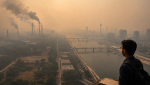



Imagine walking through a city where almost every road, neighbourhood and open space is covered in concrete, while trees, lakes and natural green areas become increasingly rare. According to a new satellite-based scientific study, this could become the reality for Ahmedabad by 2045 if the current pace of urbanisation continues without stronger environmental safeguards.
The study predicts that 77.1% of the Ahmedabad Metropolitan Region (AMR) could be covered by built-up concrete surfaces by 2045, transforming the city into one of India’s most densely urbanised metropolitan regions. Researchers also warn that natural vegetation could shrink by 85%, significantly increasing the risks of heatwaves, flooding, poor air quality and biodiversity loss.
77% of Ahmedabad Metropolitan Region Could Be Covered in Concrete
The study forecasts that by 2045, Ahmedabad’s artificial concrete footprint will expand to cover 77.1% of the metropolitan region, which includes areas under:
Ahmedabad Municipal Corporation (AMC)
Ahmedabad Urban Development Authority (AUDA)
Small portions of Guda
Gandhinagar Municipal Corporation (GMC)
Unchecked urban sprawl is expected to push the city’s built-up area to 310.2 square kilometres, drastically changing Ahmedabad’s landscape. This represents a massive jump from 40.2% built-up area recorded in 2000, indicating how rapidly construction has replaced natural landscapes over the past few decades.
Green Cover May Collapse by 85%
One of the study’s biggest concerns is the sharp decline in vegetation. Researchers estimate that Ahmedabad’s green cover will fall from 33.04 sq km in 2000 to just 5 sq km by 2045, amounting to an 85% reduction.
This means the city’s natural “green lungs” could almost disappear, leaving residents with very little tree cover to protect them from rising temperatures and extreme heatwaves. The report warns that such a dramatic loss of vegetation would severely weaken Ahmedabad’s ability to naturally regulate its climate.
Study Based on Satellite Data and AI
The warning comes from a research paper titled: “Integrating GEE, Machine Learning, and MOLUSCE for Predicting Urban LULC Dynamics of Ahmedabad Metropolitan Region, India.”
The study was conducted by Rupesh Gupta from Delhi University’s Department of Continuing Education and Extension and has been published in the International Journal of Engineering and Geosciences. For the research, Gupta analysed decades of satellite imagery using Google Earth Engine (GEE), a cloud-based geospatial computing platform. The study used:
USGS Landsat 7 satellite images from the year 2000
Landsat 8 satellite imagery from 2020
These images were processed through an AI-based land-use prediction model called the Cellular Automata-Artificial Neural Network (CA-ANN) to forecast Ahmedabad’s future urban growth.
Ahmedabad Already Showing Signs of Environmental Stress
According to Gupta, Ahmedabad is already experiencing the consequences of rapid urbanisation. He states: “This 85% loss of natural vegetation over 45 years would severely undermine the city’s ecological resilience, affecting carbon sequestration, microclimate regulation, air quality and biodiversity.”
The study says that major infrastructure and development projects are accelerating this transformation, including:
Delhi-Mumbai Industrial Corridor (DMIC)
Smart City initiatives
Expansion of Metro Rail
Rapid growth of expressway networks
These developments, while boosting infrastructure, are also driving what the researcher describes as heavily lopsided urbanisation.
Concrete Area Expanded Rapidly Between 2000 and 2020
The study highlights how quickly Ahmedabad has already urbanised over the past two decades. Between 2000 and 2020:
Built-up concrete area increased by 62 sq km
It expanded from 161.4 sq km to 223.4 sq km
Researchers found that nearly all this new construction came at the expense of open barren land.
Open Buffer Land Shrinking Fast
Barren land, which acts as a natural buffer for rainwater absorption and future urban planning, has already witnessed a steep decline. It reduced from 125.7 sq km in 2000 to 50.8 sq km in 2020.
The study warns that by 2045, this category of land could shrink by nearly another 100 sq km, leaving almost no unused or underutilised land within the metropolitan boundary. Gupta explains that barren land serves as an important spatial buffer and development reserve.
Its disappearance means nearly every available parcel of land will be converted into constructed or semi-constructed surfaces. The researcher warns this could:
Significantly worsen surface runoff
Increase urban flooding and waterlogging
Reduce long-term flexibility in city planning
Water Bodies Also Under Threat
The report raises serious concerns about Ahmedabad’s lakes and rivers. Due to pollution, ongoing construction and extensive concrete sealing of land, the city’s water bodies are projected to shrink from 8 sq km in 2020 to 4.5 sq km by 2045.
The study also warns that increasing concrete surfaces will prevent rainwater from naturally percolating into the soil. As a result, groundwater levels could continue to decline because there will be far less opportunity for rainwater recharge.
Farmland May Shrink Significantly
Agricultural land surrounding Ahmedabad is also expected to reduce considerably. Although improved irrigation helped farmland increase slightly between 2000 and 2020, the AI model predicts cropland will decline from 97.4 sq km to 57.4 sq km by 2045.
This represents a substantial loss of agricultural land in the city’s peri-urban areas.
Urban Heat Island Effect Expected to Intensify
The study says the disappearing vegetation will significantly worsen Ahmedabad’s Urban Heat Island effect. With fewer trees and more heat-absorbing concrete, neighbourhoods are expected to become:
Hotter during summer
More vulnerable to prolonged heatwaves
Less capable of naturally cooling surrounding areas
Researchers warn this could make daily life increasingly difficult for residents, especially during Gujarat’s already intense summer months.
Major Risks Identified in the Study
The report identifies several environmental consequences if current trends continue:
Concrete takeover: Built-up surfaces could occupy 77% of the metropolitan region by 2045.
Vanishing green cover: Natural vegetation may decline by 85%, from 33 sq km to around 5 sq km.
Shrinking water bodies: Lakes and rivers could reduce from 8 sq km to 4.5 sq km.
Loss of open buffer land: Nearly 100 sq km of barren land may disappear, reducing rainwater absorption and increasing flood risk.
Farmland reduction: Agricultural land could decline from 97.4 sq km to 57.4 sq km.
Researchers Suggest Immediate Action
To prevent these projections from becoming reality, Gupta recommends urgent policy interventions. The study calls for:
Establishing a Metropolitan Land Use Observatory to monitor land-use changes in real time.
Enforcing stronger laws to protect wetlands and ecologically sensitive areas.
Expanding urban forests across the metropolitan region.
Making rooftop gardens mandatory on suitable buildings.
Introducing stricter land-use planning to balance development with environmental conservation.
A Critical Choice for Ahmedabad’s Future
The research concludes that Ahmedabad stands at a crucial crossroads. While infrastructure development and urban expansion continue to drive economic growth, unchecked concrete expansion could come at a significant environmental cost. Without stronger planning measures, the city risks losing much of its natural vegetation, water bodies and open land over the next two decades, making it hotter, more flood-prone and less resilient to climate change.
The study serves as a warning that sustainable urban planning, green infrastructure and ecological conservation must become central to Ahmedabad’s future development if the city is to avoid becoming an overwhelmingly concrete landscape by 2045.
Also Read: Why More People in Gujarat Are Choosing Business Over Jobs https://www.vibesofindia.com/gujarat-self-employment-report-rajkot-surat-ahmedabad-mospi/