


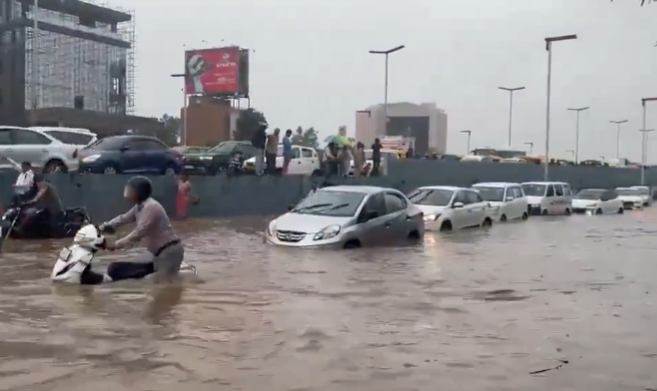
Ahmedabad was hit by a spell of torrential rain on Thursday, leaving large parts of the city waterlogged, traffic paralysed and thousands of residents struggling to move around. The intense downpour brought back memories of the devastating floods of July 14, 2000, when Ahmedabad recorded 325 mm of rainfall.
According to reports, the city received around 278 mm of rain by 10 pm, with several areas recording between 250 mm and 370 mm of rainfall. The rainfall was so intense that the city reportedly received nearly 45% of its seasonal rainfall in just one day.
More than 300 locations in western Ahmedabad were reported to be flooded, while over 150 residential societies faced waterlogging. Several major roads, underpasses and service roads were submerged, leaving commuters stranded and vehicles stuck in deep water.
With the India Meteorological Department (IMD) forecasting heavy to very heavy rainfall on Friday, the city remained at risk of further flooding.
Heavy Rain Brings Ahmedabad to a Standstill
The rain began around 8 am and continued for much of the day, with intense spells causing severe waterlogging across the western parts of Ahmedabad.
Several roads were covered with knee-deep to waist-deep water. Traffic slowed to a crawl, while many vehicles broke down after water entered their engines. Major roads and areas affected by severe waterlogging included:
Anandnagar Road in Jodhpur
Judge’s Bungalow Road in Bodakdev
Manekbaug-Dharanidhar Road
132-feet Ring Road
Drive-In Road
VIP Road in Shela
SG Highway service roads
Bopal
Thaltej
Sarkhej
Vejalpur
Service roads on both sides of SG Highway were also flooded in areas including Bodakdev, Thaltej, Jodhpur and Sarkhej.
The heavy rain also disrupted daily life, with commuters unable to reach their workplaces and residents struggling to access essential services.
One South Bopal resident, Manish Khatri, said he had to abandon his bike near Vakil Bridge after water entered the silencer. He said he tried to continue riding but had to stop when the water current became too strong.
More Than 300 Locations Flooded, 150 Societies Affected
The scale of waterlogging was particularly severe in western Ahmedabad. Reports said more than 300 locations in the western part of the city were inundated, while over 150 residential societies reported flooding.
In the North West Zone, water accumulation was reported in around 80 societies, while another 24 societies were affected in the South West Zone. Much of the water entered basement parking areas.
The intense rainfall put additional pressure on the city’s drainage system, which struggled to handle the large volume of water falling within a short period.
The Ahmedabad Municipal Corporation (AMC) temporarily shut 10 underpasses to prevent accidents and protect commuters. The closed underpasses included those at:
Shahibaug
Makarba
Akhbarnagar
Mithakhali
Usmanpura
Parimal
Some underpasses were reopened after the rain eased in the afternoon. However, another spell of rain in the evening forced authorities to close the Parimal and Kubernagar underpasses again.
By 7 pm, the AMC control room had received around 50 complaints about uprooted trees.
Vasna Barrage Becomes a Major Point of Concern
The flooding also raised questions about the management of water levels in the Sabarmati River.
According to sources, the water level at Vasna Barrage was 134 feet by 10 am, with only three gates open. By 11 am, the level had increased to 135.7 feet.
It was only at around 12.20 pm that 15 gates were opened to release water.
Following the opening of the gates, the water level dropped to around 129.5 feet and eventually fell to 124.5 feet by 3 pm. As the water level decreased, some flooded roads gradually began to clear.
Sources alleged that opening the gates earlier could have helped reduce the flooding in several western parts of the city.
Experts reportedly pointed out that when the water level at Vasna Barrage rises above 128 feet, rainwater from nearby western areas may not be able to drain properly into the Sabarmati. This can cause stormwater drains to back up, worsening waterlogging.
Questions Raised Over Desilting and River Capacity
The heavy flooding has also raised concerns about the condition and capacity of the Sabarmati river channel.
Sources said the riverbed was dredged as part of the riverfront project. However, they claimed that until 2011, the riverbed was cleaned and emptied regularly, while no similar large-scale desilting or deepening work had been carried out in the past five years.
According to these sources, the reduced capacity of the river channel could affect its ability to handle large amounts of water during heavy rainfall.
During the monsoon, water released from upstream areas can also carry sand and debris into the river, which may further reduce the depth of the riverbed.
Experts said that during intense rainfall, the water level at Vasna Barrage needs to be brought down quickly to allow stormwater from western Ahmedabad to drain into the Sabarmati.
Schools Struggle as Students Get Trapped in Flooded Roads
The heavy rain created a major challenge for schools, students and parents.
As roads became flooded, several schools announced early closure. However, many school buses were unable to operate because of waterlogged routes.
In Vejalpur, a bus carrying students of A-One School became stuck near Bakeri City. Rescue teams reached the spot and safely evacuated all the children.
At DAV International School, three buses had to turn back because of flooded roads. Many parents were also unable to reach the school.
Students remained inside classrooms until around 5 pm, where they were provided with poha and biscuits while staff arranged ways to get them home safely.
School principal Deepak Gautam said staff members worked to ensure the safety of the children and arranged transport wherever possible.
At Shanti Asiatic School in Shela, students also remained on campus for several hours until the water level fell and parents could reach the school.
A school van carrying around 15 students also broke down on a waterlogged road in Shela. Police personnel stepped in and helped take the children to their homes in South Bopal.
Police Help Stranded Students Reach Home
Emergency teams and police personnel were deployed at several locations to help people caught in the flooding.
Near Ajit Mill in Rakhial, a schoolgirl who was stranded because of waterlogging was taken home in a police vehicle. Senior police officers instructed personnel to ensure that the girl was safely handed over to her parents.
The situation also created difficulties for parents trying to collect their children.
South Bopal resident Pragya Joshi said she spent nearly four hours trying to pick up her two children because of the transport disruptions.
She said autorickshaws were charging around ₹200 for a journey of just 1 km. When the school asked parents to collect their children because buses were not operating, she had to leave her younger child with a neighbour, arrange transport to reach the school and then find another vehicle to return home.
Cab Services and Public Transport Hit
The flooding also disrupted cab and other transport services across the city.
Several cab drivers cancelled trips because major routes were under water. This left people arriving from outside Ahmedabad stranded, even when they were willing to pay higher fares.
Vehicles stalled on flooded roads, while commuters had to abandon two-wheelers and walk through waterlogged stretches.
The situation was particularly difficult in western Ahmedabad, where water levels remained high for several hours.
AMC Steps Up Emergency Response
AMC Municipal Commissioner Banchha Nidhi Pani said the city received nearly six inches of rain within three hours after the downpour began around 8 am.
Senior officials and technical teams were sent to areas that were badly affected. The civic chief also inspected parts of Bopal.
The AMC assigned additional responsibilities to senior officers and technical teams in areas that reported severe flooding.
As floodwater began to recede, the civic administration advised residents to drink boiled water as a precaution against waterborne diseases. Health teams also started distributing chlorine tablets.
Ahmedabad Gets a Flashback of 2000 Floods
For many residents, the scale of Thursday’s rainfall brought back memories of the catastrophic flooding of July 14, 2000, when Ahmedabad recorded 325 mm of rainfall.
The latest spell once again left roads, underpasses and residential areas submerged, creating a similar sense of fear and uncertainty among residents.
The city’s drainage systems were overwhelmed by the sheer volume of water falling within a short period. Basement parking areas in several housing societies were flooded, while residents faced difficulties getting in and out of their homes.
More Rain Could Worsen the Situation
The weather situation remains a concern as the IMD has forecast heavy to very heavy rain for Friday.
After receiving around 278 mm of rainfall by 10 pm, with some locations reporting rainfall between 250 mm and 370 mm, the city could face further problems if another intense spell hits already saturated areas.
Authorities will need to closely monitor water levels in the Sabarmati and Vasna Barrage, manage drainage systems and keep emergency teams ready in vulnerable areas.
For Ahmedabad, the immediate challenge is to clear the accumulated water, restore normal traffic movement and ensure that residents and students can travel safely. But with more heavy rain forecast, the city may not yet be out of danger.
Also Read: Ahmedabad Sees Ripple Effect Of Delhi Protests: Over 200 Detained, 7 Booked In Surat https://www.vibesofindia.com/ahmedabad-exam-irregularities-protests-over-200-detained-congress-students/