


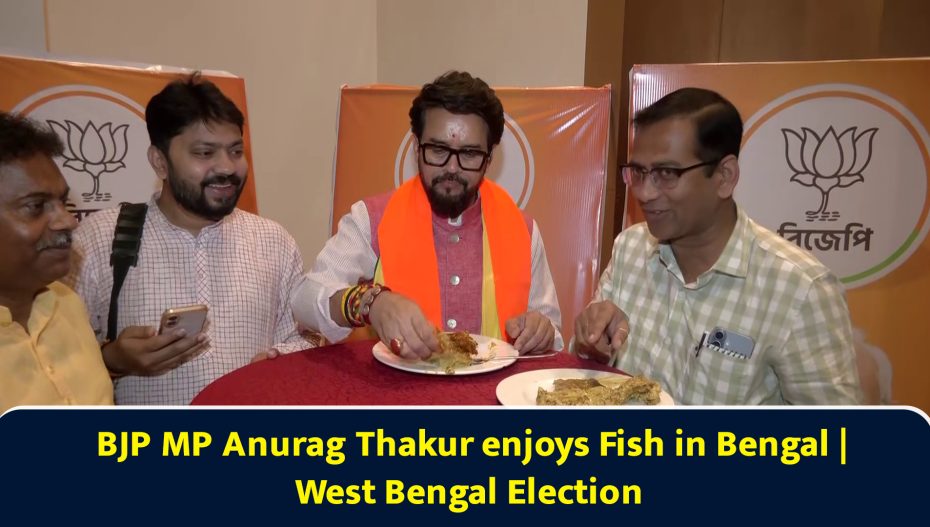
A large Katla fish. That was the campaign prop of choice for BJP in Bengal. The party sees nothing absurd about it, because in politics everything carries meaning.
They had a clear reason behind the fishy optics. Chief Minister Mamata Banerjee warned that the BJP would ban fish if it was voted to power in Bengal. The BJP had a ready rebuttal: show up at their doors holding one.
It worked in the way that only Bengali politics can. One man, one fish, and suddenly the nation was watching. The images had gone viral. Soon, other BJP leaders were spotted carrying fish on the campaign trail or eating it during TV interviews.
The Trinamool Congress was not amused. The ruling party doubled down on its allegations, pointing to meat sale restrictions in BJP-ruled Bihar and other states as evidence of what Bengal might expect.
To drive the point home, Trinamool launched a social media video series called Jodi Tara Ashe (“What If They Come?”).
As an editorial notes, the AI-generated clips depict life under a hypothetical BJP government in Bengal. One recent video showed men in saffron scarves stopping a fish truck, telling the driver he needed permission from “Gujarat and Delhi” to proceed.
Subtle, it was not. Effective, perhaps depending on who is watching.
Intellectuals believe the fear runs deeper in rural Bengal, where meat is not a luxury but a staple.
An example cited is that of Navratri when meat consumption is restricted in parts of north India. The general sentiment is that a similar restriction in West Bengal would hit rural households hard.
People there understand this which is why the fear sticks.
This month, Prime Minister Narendra Modi himself entered the debate at an election rally. He lamented that Bengal still imports fish from other states, blaming Banerjee’s 15-year tenure for the failure to boost local fish production.
PM Modi also stopped at a jhalmuri shop in Jhargram to buy the puffed rice snack, a gesture aimed squarely at signalling his appreciation for Bengali culture.
Another argument is whether ordinary Bengalis could even afford meat and eggs under Trinamool’s rule. Jobs are scarce and pockets empty.
Beyond the fish politics lies a deeper and more stubborn challenge for the BJP. Its image as a party of outsiders, or bohiragoto, as Bengalis call it.
Analysts agree the outsider problem is less acute than it was five years ago. The BJP has since built a local leadership base. The BJP has also turned the outsider charge around. It points to Trinamool’s own star campaigners (Gujarat-born cricketer Yusuf Pathan, Bihari actor Shatrughan Sinha, and Uttar Pradesh-origin retired police officer Rajeev Kumar), all of whom represent Trinamool in Parliament.
The BJP’s other strategy is religious mobilisation. By some accounts, it is gaining traction in urban Bengal in a way it did not before.
The business class and artists critiqued Hindutva politics ahead of the 2021 Assembly elections. They believe a similar collective effort was unthinkable today. The idea of Kolkata as a “mini-Pakistan” or “mini-Bangladesh” had entered the public imagination, and middle-class Bengalis had absorbed it.
Among ordinary workers, the mood is more cautious. Fish is not necessarily a concern, but beef is. There is apprehension that a beef ban is likely if the BJP won the state.
The editorial mentions that Bengali nativist group Bangla Pokkho claims it has helped shape this sentiment. The organisation has campaigned actively against what it sees as anti-Bengali actions by BJP-led governments at the Centre and in other states.
Across Bengal, people believe Trinamool is bad, but the BJP is against Bengalis. And that’s precisely why the BJP is now working so hard to appear Bengali. One fish at a time.
Also Read: Food, Faith and Fascism in New India https://www.vibesofindia.com/food-faith-and-fascism-in-new-india/