


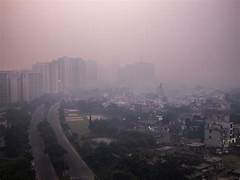
Normal breathing has unfortunately become a privilege in Delhi, which has earned an ignominious title of the world’s most polluted city. Emissions from factories, emissions from crops, vehicle smoke, and burns of crops have made Delhi’s air toxic. But even that is saying it mildly.
Pollution levels went up by 6% last year. It is reported that during winter, concentrations of PM2.5 and PM10 regularly soar past the levels recorded during Beijing’s notorious “airpocalypse” of 2013.
With crisis comes desperation to turn to innovation.
The Guardian has reported that the Delhi regional government has embarked on a cloud-seeding experiment to induce artificial rain to cleanse the foul air that chokes the world’s most polluted city.
Months of erratic weather over the Indian capital had stalled the Bharatiya Janata Party’s (BJP) ambitious plans, but with the city once again plunged into a hazardous haze after the Diwali festival, the government finally announced the long-delayed rollout.
Delhi’s environment minister, Manjinder Singh Sirsa, confirmed that the first trial flight—during which seeding flares were fired into the skies—had been successfully conducted.
If conditions remain favourable, Delhi will experience its first artificial rain on October 29, Chief Minister Rekha Gupta was quoted as saying.
The BJP has long turned to cloud seeding as a weapon to combat Delhi’s toxic air. The process involves deploying aircraft or drones to disperse silver iodide particles, whose crystalline structure mimics that of ice into clouds. Water droplets then cluster around these particles, altering the cloud’s composition and raising the likelihood of rainfall.
Yet experts remain sceptical. Specialists who have studied cloud seeding insist that it is no panacea. While it can prompt marginally heavier or more frequent rain than would naturally occur, the overall impact is often minimal. Moreover, the method requires the presence of clouds, an element frequently missing from Delhi’s winter skies, precisely when pollution levels soar.
Crucially, the approach does nothing to tackle the underlying sources of toxic emissions.
According to the report, two professors from Delhi’s Centre for Atmospheric Sciences, Shahzad Gani and Krishna AchutaRao, denounced the initiative as a “gimmick.”
They called it “a textbook case of science misapplied and ethics ignored.” Drawing parallels with the “smog towers” erected by the previous government, projects that devoured billions of rupees but yielded negligible improvement in air quality, they warned of repeating the same folly.
They believe research so far has been inadequate on the long-term consequences of using cloud-seeding agents such as silver iodide or sodium chloride.
There are dangers to agriculture and human health. They cautioned that snake-oil solutions will not clear the air in Delhi or the rest of North India.
Also Read: Rajkot Villages Hit By Pollution To Get Rs 25 L https://www.vibesofindia.com/rajkot-villages-hit-by-pollution-to-get-rs-25-l/