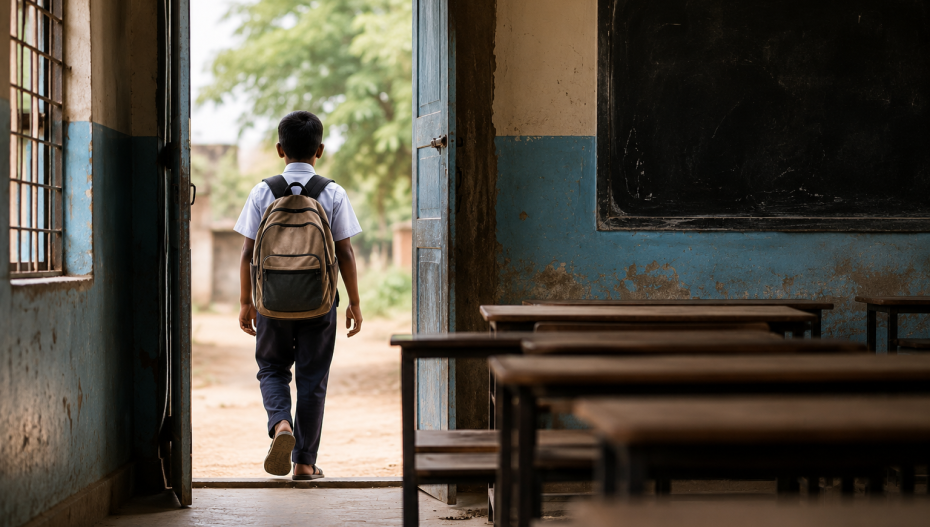
Gujarat has been placed in the ‘red zone’ for school dropouts, with more than 15% of students leaving school by the time they reach the secondary level, according to the latest education data.
The UDISE+ 2025-26 data shows that while Gujarat has managed to bring children into primary schools, the state is struggling to ensure that students continue their education through secondary and higher secondary classes.
The figures also point to a major gap in enrolment at the higher secondary level, with Gujarat performing well below the national average.
15.7% Students Drop Out at Secondary Level
According to the latest data, Gujarat’s overall secondary school dropout rate stands at 15.7%, compared with the national average of 9.5%.
The situation is worse among boys. About 17.6% of boys in Classes 9 and 10 drop out in Gujarat, compared with the national average of 10.9%. Among girls, the dropout rate stands at 13.3%, while the national average is 8%.
This means that while Gujarat has been successful in getting children into primary schools, a significant number of them do not continue their education once they reach the secondary stage.
Higher Secondary Enrolment Far Below National Average
The data also shows a worrying picture at the higher secondary level. Gujarat’s net enrolment rate for higher secondary education in 2025-26 stood at 29.1%. Among girls, the rate was slightly higher at 29.6%, but this was still far below the national average of 41.1%.
The state’s higher secondary enrolment rate has also fluctuated sharply in recent years.
It was above 40% in 2022-23, before falling to 34.7% in 2023-24 and then dropping further to 24% in 2024-25. The figure improved to around 29% in 2025-26, but it remains below the national average of 35.8%.
Secondary School Enrolment Also Falls
The enrolment situation is not limited to higher secondary schools.
According to the data, only 31.3% of Gujarat students eligible for secondary or higher secondary education were actually enrolled. This is significantly lower than the national averages of 51.3% and 52.5%, respectively.
Secondary school enrolment also saw a sharp decline in recent years. It stood at 49.5% in 2022-23, fell to 45.7% in 2023-24 and then dropped dramatically to 26.1% in 2024-25, before showing some improvement.
Why Are Students Leaving School?
Education officials say there is no single reason behind the high dropout rate.
In some cases, students leave school because they change schools or move to another area. Others drop out because of early marriage.
The problem is also linked to social and economic conditions in rural and tribal areas.
Some boys leave school to work and help support their families. For girls, social restrictions can make it difficult to travel to other villages or towns for higher education.
Another major reason is academic performance. Some students reportedly leave school after failing their examinations, particularly when they reach secondary classes.
These factors together make it difficult for many students to continue their education beyond the primary level.
Primary Schools Show a Positive Picture
The data also highlights an area where Gujarat has performed well.
The state has recorded a zero dropout rate at the primary school level. This suggests that the state has been relatively successful in bringing young children into the formal education system and keeping them in school during their early years.
However, the challenge begins when students move to Classes 9 and 10.
The sharp rise in dropouts at the secondary level shows that simply enrolling children in primary schools is not enough. Students also need support to continue their education as they grow older.
Fewer Schools Have Zero Students
There is also a small positive development in the latest data. Gujarat has 53,425 schools, and the number of schools reporting zero student enrolment fell slightly from 63 in 2024-25 to 58 in 2025-26.
The number of teachers working in these zero-enrolment schools also declined from 78 to 74 during the same period.
Although the change is small, the fall suggests that the number of completely empty schools is gradually reducing.
Government Tries to Bring Dropouts Back
The Gujarat government has been running Shala Praveshotsav, a school enrolment campaign, for more than two decades to encourage children to join school.
This year, the government also focused on bringing back around 6.4 lakh students who had reportedly dropped out in the previous year.
After a three-day enrolment campaign held in June, the number of children still out of school was brought down to around 50,000.
However, the latest UDISE+ figures suggest that bringing children back to school is only one part of the challenge. The bigger task will be ensuring that these students remain in school and continue their education through Classes 9 and 10 and beyond.
Keeping Students in School Is the Bigger Challenge
The latest figures present a mixed picture for Gujarat’s education system.
The state has made progress in getting children into primary schools and has a very low dropout rate at that level. But as students move into secondary and higher secondary education, the numbers begin to fall sharply.
The high dropout rate, low enrolment and social and economic barriers point to the need for stronger efforts to keep students in classrooms.
For Gujarat, the challenge now is not just getting children into school, but ensuring that they stay in school, complete their education and have the opportunity to continue into higher secondary classes.
Also Read: CJP March Turns Violent; Gujarat Joins Nationwide Protests https://www.vibesofindia.com/cjp-parliament-march-delhi-clashes-gujarat-protests/