


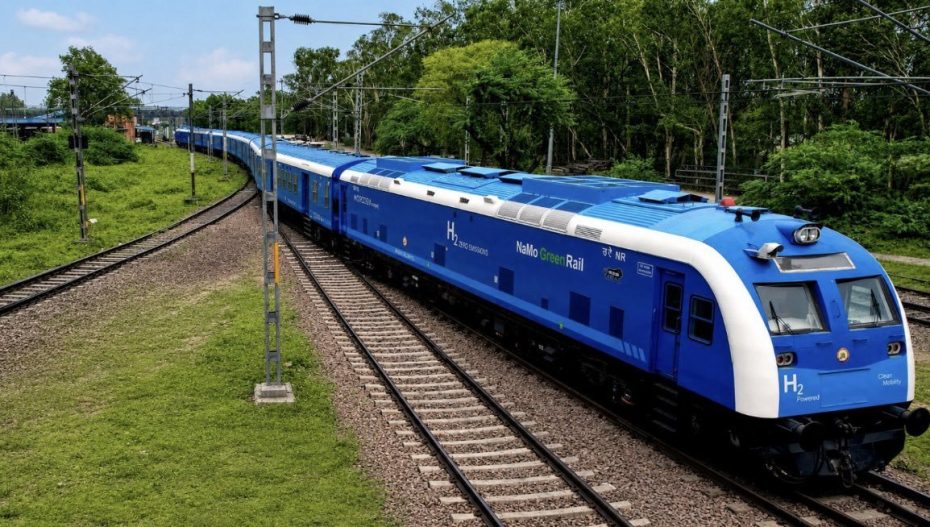
India has launched its first hydrogen-powered train, marking an important step in the country’s clean energy journey. The train was flagged off by Prime Minister Narendra Modi on the Jind-Sonipat route in Haryana, becoming the latest addition to India’s efforts to build greener transport systems.
At first, the project may seem surprising. After all, Indian Railways has already electrified more than 99% of its broad-gauge railway network, replacing diesel trains with electric ones over the past several years. This raises a simple question: If electric trains already exist, why does India need hydrogen trains?
The answer lies beyond railways. The hydrogen train is not just about transportation—it is part of India’s larger plan to build a green hydrogen economy and reduce dependence on imported fossil fuels.
How the Hydrogen Train Works
The hydrogen-powered train runs on an 89-kilometre route between Jind and Sonipat in Haryana. Instead of using diesel, it operates with hydrogen fuel cells. Inside these fuel cells, hydrogen combines with oxygen to produce electricity, which powers the train. The only by-product of this process is water vapour, making it an environmentally friendly alternative.
The train consists of two hydrogen-powered driving cars, eight passenger coaches, and is supported by a dedicated hydrogen refuelling facility at Jind.
Why Not Simply Use Electric Trains?
Although hydrogen trains are cleaner than diesel trains, they are generally less efficient than electric trains running on overhead power lines.
Electric trains receive electricity directly from the railway network. Hydrogen, however, goes through several stages before it can power a train. Electricity is first used to produce hydrogen through electrolysis. The hydrogen is then compressed, stored, transported, and finally converted back into electricity inside a fuel cell.
Each of these steps results in some energy loss.
Because of this, many countries mainly use hydrogen trains on non-electrified railway routes where diesel trains are still operating.
India also plans to use hydrogen trains on such routes. However, since almost the entire railway network is already electrified, the new hydrogen train is not intended to replace electric trains. Instead, it serves as a pilot project to develop expertise in hydrogen fuel cells, storage systems, safety technology, and refuelling infrastructure.
A Bigger Goal Beyond Railways
The hydrogen train is actually a symbol of India’s broader energy transition.
Hydrogen is not only useful for transportation. It also plays a major role in industries such as fertilizer manufacturing, steel production, petroleum refining, and chemicals.
Today, much of the hydrogen used by these industries is produced from natural gas, which creates significant carbon emissions.
India’s Green Hydrogen Mission aims to replace this conventional hydrogen with green hydrogen, produced using renewable electricity from solar and wind energy. This would help industries reduce emissions while making them less dependent on fossil fuels.
Why Hydrogen Matters for Fertilizer Production
One of the biggest uses of hydrogen is in fertilizer manufacturing.
Hydrogen is a key ingredient in producing ammonia, which is used to make urea and several other fertilizers. Unlike electricity, hydrogen cannot simply be replaced because it becomes part of the final chemical product.
Currently, fertilizer plants mostly use hydrogen produced from natural gas. Green hydrogen offers a cleaner alternative by using renewable electricity instead.
For a country like India, one of the world’s largest fertilizer consumers, this could become one of the most important long-term applications of hydrogen technology.
A Cleaner Future for Steel Manufacturing
Hydrogen could also transform India’s steel industry.
Traditional steel production depends heavily on coal, which produces large amounts of carbon dioxide. Hydrogen can perform a similar chemical role during steelmaking but produces water instead of carbon dioxide.
As one of the world’s largest steel producers, India sees hydrogen as both an environmental opportunity and a strategic industrial advantage.
Solving Renewable Energy Storage Challenges
Hydrogen could also help solve one of renewable energy’s biggest problems—energy storage.
Solar panels generate electricity only during daylight hours, while wind energy depends on weather conditions. This means renewable power is not always available when needed.
Hydrogen offers a way to store surplus renewable electricity. During periods of excess power generation, electricity can be used to produce hydrogen. That hydrogen can then be stored for weeks or even months before being used later for industry, power generation, or transport.
In this way, hydrogen acts as an energy carrier, allowing renewable energy produced today to be used in the future.
Reducing Dependence on Imported Fuel
India imports large quantities of crude oil, LNG, and other fossil fuels. Global events such as wars or supply disruptions often lead to higher fuel prices, increasing the country’s import bill.
Producing green hydrogen domestically using water and renewable electricity could reduce some of this dependence on imported fuels. It would also strengthen India’s energy security while creating new industries related to hydrogen production, storage, and infrastructure.
In the future, India also hopes to become a competitive exporter of green hydrogen and hydrogen-based fuels such as green ammonia.
Why the Hydrogen Train Still Matters
From a railway perspective, hydrogen trains may not replace electric trains anytime soon because direct electrification remains more efficient. However, the importance of the hydrogen train lies elsewhere.
The project gives Indian engineers and companies practical experience in hydrogen technologies, fuel cells, storage systems, and refuelling infrastructure. It also helps create a domestic ecosystem that could support industries such as fertilizers, steel, chemicals, shipping, trucking, and energy storage.
Rather than representing the future of Indian Railways alone, the Jind-Sonipat hydrogen train serves as a testing ground for India’s long-term ambition to become a major player in the global hydrogen economy.
While it remains uncertain how large hydrogen’s future role will be, the launch signals that India intends to be part of the global clean energy transition from the very beginning.
Also Read: Canada Pauses New Parent Sponsorship Applications; Indian Families Affected https://www.vibesofindia.com/canada-pauses-new-parent-grandparent-sponsorship-applications/