

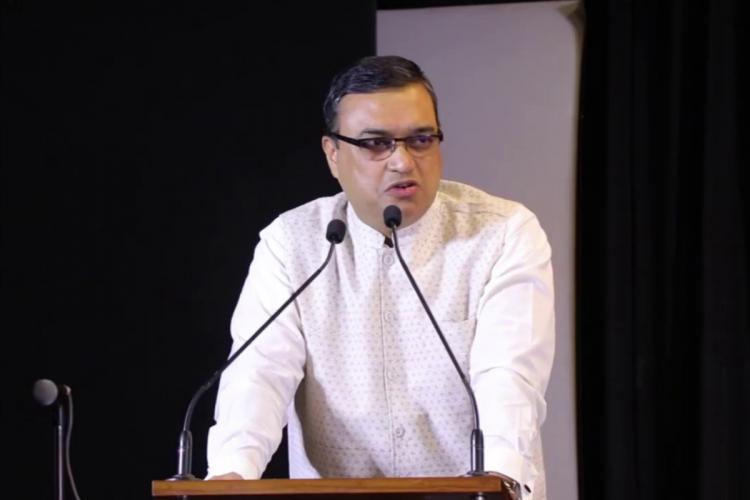
After disagreement, a two-judge Supreme Court bench on Wednesday (September 23) referred the petitions challenging the 2023 Act pertaining to the appointment of chief election commissioners and election commissioners to a constitution bench. Justice Dipankar Datta mentioned that the 2023 law, prima facie, confers a veto on the executive, since the appointment by a committee comprising the prime minister, Union minister and the leader of opposition, fails the “perception trust,” Live Law reported.
“Free and fair elections depend on a truly independent ECI [Election Commission of India]. It is not enough for the ECI to be independent; it must appear to be independent. The member nominated by the prime minister cannot be expected to defy the Prime Minister,” Justice Datta observed.
Further, Justice Datta questioned the rationale behind including a cabinet minister as the third member of the selection committee.
“Inclusion of cabinet ministers fails to provide an independent counterweight that a neutral selector would. It becomes largely ornamental,” he was quoted as saying by Live Law.
During the hearing, Justice Datta said that the Union government’s demand for a larger bench reference was unwarranted underlining that the constitutional principle that the ECI appointments must be free of executive influence is well settled by the five-judge bench in Anoop Baranwal (2023). Justice Satish Chandra Sharma, however, disagreed saying that the matter has to be authoritatively decided in terms of Article 145(3) of the constitution since a substantial question of interpretation of the constitution has arisen.
The bench then ruled that the matter be placed before the Chief Justice of India to constitute a constitution bench to avoid delaying the matter.
“A decision by a three-judge bench on which of the two opinions is correct would be of little worth and only delay the decision on the significant issues that are raised,” the order mentioned, as per Live Law.
The apex court bench passed the judgment while hearing a batch of petitions challenging the Chief Election Commissioner and Other Election Commissioners (Appointment, Conditions of Service and Term of Office) Act, 2023. The pleas particularly challenged Section 7 of the Act pertaining to the selection committee. The petitioners argued that the executive has a two-to-one majority in the selection committee which undermines the independence of the election commission.
Notably, at present all the three election commissioners including the chief election commissioner are appointees of the Modi government, and were put in place in accordance with the controversial 2023 Act brought in to exclude the presence of the CJI in the selection committee. The CJI’s presence was to ensure a non-partisan appointment in the poll body, which is a crucial constitutional office.
Commenting on today’s Supreme Court verdict, Congress Rajya Sabha MP and former Union minister Jairam Ramesh wrote on X, “Today has also seen the Supreme Court delivering a split verdict on the question of whether a selection committee to appoint election commissioners is valid. Justice Datta has, through pointed and straightforward questions, highlighted the degree of central government control over the committee. He has rightly asked, can a PM’s nominee go against the PM? The validity of the selection committee will now be examined by a larger bench, but Justice Datta’s judgment confirms that the CEC must be free from the government’s control if it is to be effective.”
“In March 2023, the Supreme Court, in Anoop Baranwal v. Union of India, directed that the CEC and ECs be appointed by the President on the recommendation of a committee comprising the Prime Minister, Leader of Opposition and Chief Justice of India. Later that year, the Modi government replaced the CJI with a Union Cabinet Minister through the Chief Election Commissioner and Other Election Commissioners Act, 2023, altering the Court-mandated selection mechanism and overriding the Court’s direction to keep the Election Commission independent of Executive control,” he added.
Also Read: Six Questions The Supreme Court Should Now Ask The Chief Election Commissioner