


The message from Gujarat today is blunt and unmistakable: investors receive incentives, owners receive protection, management receives compliance, and workers receive longer hours, weaker rights, and police batons when they protest. Industrial peace here is not built on justice or negotiation. It is enforced through exhaustion and fear.
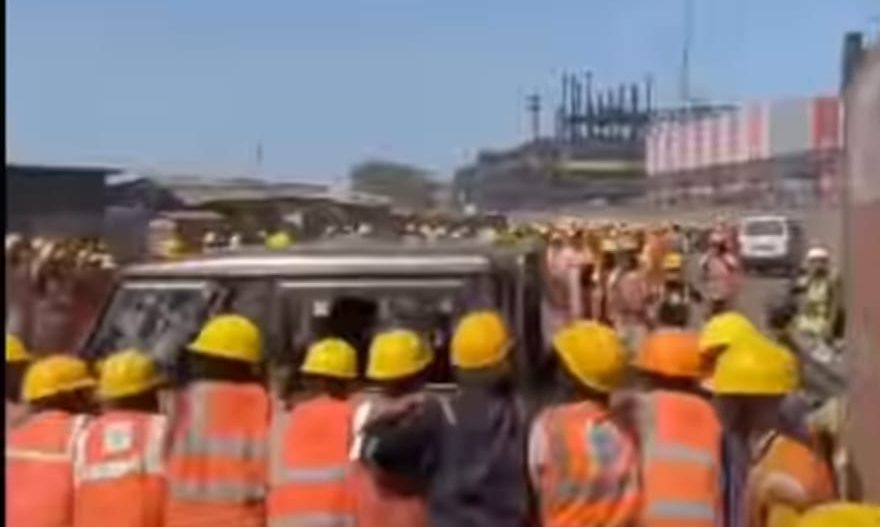
Over 20 workers at Larsen & Toubro’s ArcelorMittal Nippon Steel India plant at Hazira in Surat have been arrested for allegedly inciting violence. The police, who arrived very much on time to deal with the so-called “violent workers,” fired tear gas shells to disperse at least 2,000 workers who had gathered to protest. The protesting workers complained of being manhandled by private security personnel deployed at the plant, following which the police were called in. Many workers claim the police response was worse than the provocation.
According to police officials, the situation deteriorated after tensions flared between demonstrators and private security personnel at the plant. Some workers alleged that members of the security staff manhandled a few protesters during a procession, triggering anger among the crowd. As tempers rose, sections of the gathering reportedly began vandalising property. Law enforcement personnel initially attempted to calm the workers, but stone-pelting soon followed, prompting a stronger response.
Surat Zone VII Deputy Commissioner of Police Shaifali Barwal said officers used more than 35 tear gas shells to disperse the crowd. “We detained 20 individuals, and the process of registering an FIR is underway,” she told reporters, adding that additional police teams were deployed to prevent further disturbances. Visuals from the area showed large groups of workers moving along the highway that cuts through the coastal industrial town, even as authorities worked to restore order.
AM/NS India said a group of workers deployed by L&T at the project site had assembled to raise certain demands. The company maintained that L&T management was engaging with workers to address concerns and that local authorities were assisting in stabilising the situation. Officials familiar with the plant’s operations said production units were not significantly impacted, though security was tightened across the complex as a precaution.
Industrial relations experts note that large infrastructure and steel projects often depend heavily on contract labour, where disputes over wages and working conditions can escalate quickly if not addressed through structured dialogue. Hazira, a major industrial hub, has previously witnessed sporadic labour unrest, like other parts of Gujarat. The Surat police are now assessing damage to property allegedly caused during the protest.
While negotiations between management and worker representatives are expected to continue, this incident once again spotlights the fragile balance between industrial productivity and labour welfare in large-scale projects in Gujarat.
The workforce protesting at Hazira was overwhelmingly migrant—drawn from Uttar Pradesh, Bihar, West Bengal, and Odisha. That fact makes the state’s response even more revealing. Migrant labour in Gujarat is disposable labour: welcome when silent, expendable when assertive. Rising living costs, punishing shifts, and opaque overtime practices fester unchecked until confrontation becomes inevitable. Dialogue collapses because it never truly exists. Coercion steps in—efficiently, decisively, without remorse. For corporations, the state behaves like a partner; for labour, it behaves like an enforcer.
Gujarat loves to market itself as an investor’s paradise. It succeeds spectacularly at that. For workers, however, it increasingly resembles a labour camp with better branding. The protest by Larsen & Toubro contract workers at the ArcelorMittal Nippon Steel India plant at Hazira near Surat is the latest proof. More than 2,000 workers were protesting at the site after months of ignored demands and administrative indifference. In total, nearly 10,000 contract workers work here, most demanding nothing radical—just higher wages, transparent overtime calculation, and humane working hours. What they received instead was tear gas, detentions, and criminal cases. At least 20 workers are arrested for allegedly “inciting violence,” while the violence of chronic exploitation remains legally invisible.
That the police arrive swiftly—not to resolve the dispute, not to compel negotiation, and not to enforce labour laws, but to restore “order”—speaks volumes about which side the khaki chooses, or is routinely ordered, to stand with. In Gujarat’s industrial grammar, order means uninterrupted production, secured assets, and subdued labour. Lives, dignity, and rights rank lower.
Fixed-pay regimes dominate, unions remain discouraged or quietly crushed and the moment workers organise, management—often with the government firmly on its side—responds not with dialogue but with muscle. Labour law functions like a suggestion until workers protest, when it suddenly transforms into a criminal code.
There is no credible grievance redressal mechanism, no trusted forum for collective bargaining and no institutional patience for dissent. Silence becomes the default mode of governance. When silence breaks, policing begins. Gujarat does not manage labour disputes; it suppresses them.
Hazira is not an exception. Gujarat tells the same story repeatedly. Factory, textile, and diamond workers protest wage cuts, delayed payments, layoffs, and brutal work schedules. Each time, the script remains unchanged: police deployment, prohibitory orders and pressure to disperse. Employers escape scrutiny. Structural exploitation continues uninterrupted. Worker anger is treated not as evidence of policy failure, but as a public nuisance to be cleared from the streets.
This is not mismanagement. This is governance by design. That design became explicit with the Gujarat government’s recent amendment to the Factories Act. Daily working hours now stretch from nine to twelve. Overtime limits expand from seventy-five to one hundred and twenty-five hours per quarter. The government sells this as “flexibility.” In reality, it is legislative gaslighting. This is not reform. It is the formal legalisation of exploitation that already operates informally. In Gujarat, “ease of doing business” increasingly means the freedom to extract more labour from fewer workers without accountability.
The claim that these changes benefit employees insults basic intelligence. Longer shifts reduce employment opportunities, intensify fatigue, raise accident risks in hazardous industrial zones and inflict long-term health damage. Allowing women to work night shifts under the banner of empowerment—without credible enforcement of safety safeguards—is not progress. It is abdication masquerading as reform.
Trade unions rightly call this an attack on workers’ dignity. Forcing sweeping changes through ordinance, without consultation or legislative debate, exposes a government impatient with democracy whenever it inconveniences corporate comfort. International labour commitments are quietly ignored, while workers are instructed to sacrifice more hours, more health, and more security for a growth story whose rewards reliably bypass them.
The message from Gujarat today is blunt and unmistakable: investors receive incentives, owners receive protection, management receives compliance, and workers receive longer hours, weaker rights, and police batons when they protest. Industrial peace here is not built on justice or negotiation. It is enforced through exhaustion and fear.
Gujarat’s growth story is written in steel and profit, but footnoted in fatigue, FIRs, and forgotten workers. This is not governance. This is management consultancy—where the state acts as HR for capital and riot control for labour.
Also Read: Gujarat: Four Workers Dead in Fire Blaze at Hazira Steel Plant https://www.vibesofindia.com/gujarat-four-workers-dead-in-fire-blaze-at-hazira-steel-plant/