


By Sanjay K. Jha
The BJP, however, refused to hold a meaningful conversation and stuck to its favourite tactic of maligning the opponents.
The march from Parliament house to the Election Commission’s office would have taken barely 15 minutes. A few members of Parliament (MPs) led by Leader of Opposition in the Lok Sabha, Rahul Gandhi, could have met the Chief Election Commissioner (CEC) and handed over a memorandum. The situation could have involved no drama, no police crackdown, no security scare and no media spectacle.
But there is a problem. The CEC is Gyanesh Kumar who seemingly cannot muster the moral courage to meet the opposition leaders who have accused him of plotting the murder of democracy. The trust deficit is apparently so low that even systemic engagement is not possible. What’s bewildering is that the Union government failed to foresee the snowballing crisis because of the diminishing public faith in the Election Commission and has so far chosen to bulldoze the misgivings using the power of propaganda.
In a healthy democratic culture, the prime minister would have intervened to address the concerns of the opposition parties and the citizens but Narendra Modi committed the blunder of defending every indefensible transgression of Gyanesh Kumar, setting the stage for this unseemly conflict that is unfolding over past two days. When Rahul Gandhi analysed the voters’ list of two Karnataka constituencies and produced such credible evidence of wrongdoing, both the Union government and the Election Commission should have responded democratically and made institutional changes to erase doubts. But the government and the commission worked in tandem to discredit the opposition as “anti-national”, presuming that the storm would blow over with the passage of time.
But then came the implosion from the Election Commission itself, revealing how Gyanesh Kumar had flattened internal objections and violated rules and norms to take unilateral decisions. While only those decisions taken by consensus, or by majority among the three commissioners, are legal, the commission itself issued a statement, which looked like a public admission of guilt, promising to take corrective measures.
The Supreme Court was forced to issue notice to the commission and a sitting judge Ujjal Bhuyan said, “If any process results in disenfranchising millions and millions of Indian citizens, such a process is intrinsically arbitrary. No amount of whataboutery can justify it.”
Whataboutery, unfortunately, came from the BJP more than the commission. Even when the MPs were on the road today, BJP rained silly questions: how did the BJP win before the arrival of Gyanesh Kumar, what about Kerala, Tamil Nadu and Telangana, what about dead and duplicate voters, what about ineffective campaigns that led to Congress defeats… etc. Ironically, the BJP didn’t refer to critical concerns, about the arbitrary decisions, about fake voters, about targeted deletions, about immunity to Election Commissioners, about the change made in the appointment process. The BJP ignores the basic point that the commission doesn’t have the right to decide citizenship and the millions of voters excluded from the voters’ list are neither dead, nor duplicate. The Form 6 controversy is unforgivable as the commission can’t encroach upon Parliament’s powers to make laws and change the process. Illogic and sophistry offered by the BJP achieved little except providing fodder for the sycophantic media which mischievously projected today’s protest as political relaunch of Rahul Gandhi.
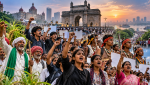
Amidst all this, public anger swelled. Students, activists, intellectuals, the Cockroach Janata Party and opposition parties mounted an unprecedented campaign for the removal of Gyanesh Kumar. Despite police action and refusal to allow protests at the designated site Jantar Mantar, people are regularly coming on the street since October 2, creating an impression of a nation in turmoil. The decision to stop MPs from taking out a small march indicated that the Modi Government had decided not to give an inch to the protesters. The Government manifestation of democratic paralysis, the main accusation against the Modi-Shah duopoly for the last 12 years.
It appears Modi has assured Gyanesh Kumar not only immunity from legal consequences but also from political wrath.
The first element of basic structure is supremacy of the Constitution, not the government. The Constitution guarantees the right to assemble peacefully and move across India’s territory. The Modi Government’s obstinate refusal of permission to hold protest protests is illegal but the Supreme Court has remained a mute spectator over the last decade. It is not only the right, but the duty of citizens to protect democracy and they will oppose any move of the Government, or any institution, which is not in conformity with the constitutional spirit. The very resolve of the people is to constitute India into a democratic republic. Justice is not only social and economic, but political as well. Disenfranchisement of genuine voters violates the principle of equality of status and opportunity. If the opposition parties and the civil society groups do not oppose the Government and the Election Commission despite their perception of democracy being hijacked would be seen as sinful.
The central theme of opposition MPs’ protest today was the hijacking of democracy. Congress president Mallikarjun Kharge said the Modi government was willing to trample down citizens’ rights to remain in power.
“A Hitler-like rule will come and the citizens will become slave,” Kharge predicted, summing up the fears of a large section of people.
Rahul Gandhi too said it was inexplicable that around 300 MPs were not allowed to walk 100 yards to reach the commission. He said, “Why can’t the Election Commissioners meet elected representatives? Election Commission’s job is to hold fair elections but they have hijacked the process through vote chori [theft]. Narendra Modi, Amit Shah, Mohan Bhagwat and Gyanesh Kumar, all of them will be punished for this crime. Nobody will be able to escape.”
The BJP, however, refused to hold a meaningful conversation and stuck to its favourite tactic of maligning the opponents. They said the Congress was spreading anarchy. What about the retired and sitting judges, lawyers, professors, students and journalists who saw the rote in the commission and warned against destruction of democracy? Hollow rhetoric about the opposition’s victory in Tamil Nadu or Kerala can’t obliterate the tell-tale signs of illegalities in Bengal, Haryana or Maharashtra.
To ask how the Congress would have won Karnataka if elections were rigged is childish. It’s like asking how a particular shop can be burgled when the whole market is safe. Or, how only one or two passengers could be targeted by the pick-pocket while others in the bus remained unaffected? Questions of legality and fraud cannot be dismissed by rhetorical flourish. What went wrong in Bengal is not hidden from anybody. What anomalies the Karnataka and Haryana voters’ list contained have to be dispassionately examined and rectified. If that remedy is not forthcoming, public protests are the natural outcome.
Also Read: In Maharashtra, Everybody Is Protesting – From ‘Cockroaches’ To Tribals To Women