


A poster saying “Village for Sale” has appeared in Tulshi, a village in Maharashtra’s Solapur district. For outsiders, it may look like a sarcastic protest message. For the villagers, it represents years of waiting for something they say should have reached them long ago — irrigation water.
Tulshi is only about 9 km from the Sina-Madha lift irrigation scheme, which became operational in 2000. Yet, according to villagers, the village has received none of its benefits.
The distance has become a painful reminder of the gap between an irrigation project meant to provide water and farmers who continue to depend on rainfall.
Sarpanch Sharad More said the villagers have been waiting for around 25 years. He said the “Village for Sale” poster reflects their anger and frustration after years of being promised a solution.
While the message may appear amusing to people outside the village, More said it is not a joke for those living there.
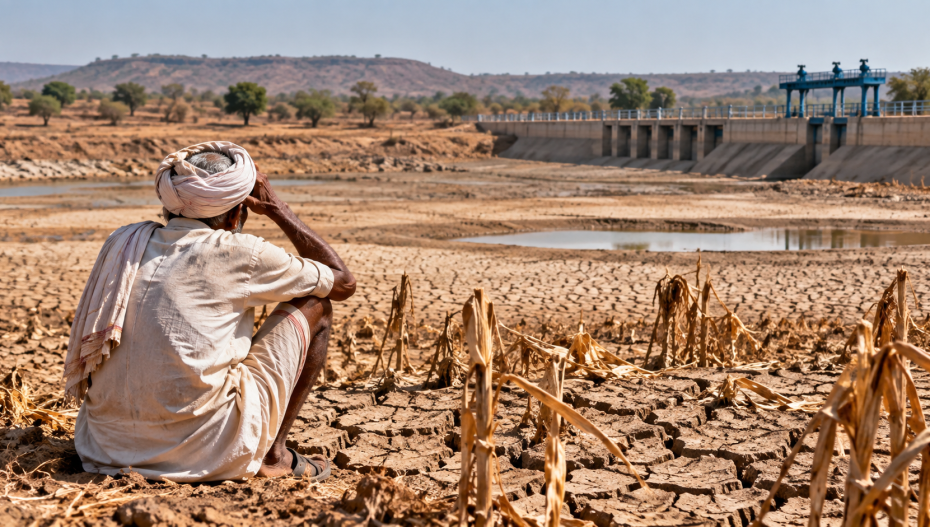
Farms wait for water as wells dry up
For Tulshi’s farmers, the problem is not limited to one failed crop season. Their farming continues to depend heavily on uncertain rainfall.
The situation has become more difficult as water sources in and around the village have dried up. The village’s water bodies have little or no water, while wells and percolation lakes have also dried. Villagers have been dependent on water tankers since July.
The contrast is particularly difficult for farmers in Tulshi because some neighbouring villages are able to grow water-intensive cash crops, while Tulshi continues to struggle for basic irrigation.
Records cited in the report also show that several villages in Madha had gone without rain for 45 days. If the situation continues after the monsoon, around 2,700 hectares of farmland in the area could turn barren, according to the report.
For farmers already watching their water sources disappear, the fear is that the coming months could make the situation even harder.
Protest after years of waiting
The worsening water shortage pushed villagers to intensify their protest.
On Ganesh Chaturthi, Tulshi residents began an indefinite fast and submitted a memorandum to the tehsildar, demanding action on the irrigation issue.
The protest also took a serious turn, with villagers warning of self-immolation if their demands were not addressed. They also threatened to boycott elections.
The protest was later called off on Friday after Maharashtra Water Resources Minister Radhakrishna Vikhe Patil spoke with the villagers.
Administration plans canal proposal
The administration has now said it is working on a possible solution.
S Karthikeyan, collector of Solapur district, said the irrigation department had conducted a hydrological survey of Tulshi.
Based on the survey, the administration plans to send a proposal to the state government for a canal network to address the village’s long-standing irrigation problem.
For Tulshi, however, the issue is about more than a new proposal.
A village located just 9 km from an irrigation project that has been operational since 2000 has spent decades waiting to see water reach its farms. Until that changes, the “Village for Sale” poster remains less a slogan than a sign of how deeply the water crisis has affected the people who live there.
Also Read: Questions May Be About Gyanesh, But The Question Mark Is On Modi’s Democratic Legitimacy