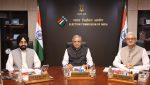



Modi’s democratic legitimacy relies heavily on projecting undisputed, overwhelming public backing which is severely undercut by the recent revelations about Gyanesh Kumar and the ECI.
The massive scandal engulfing Chief Election Commissioner (CEC) Gyanesh Kumar goes far beyond administrative dysfunction or his personal misconduct as documented internal dissents by fellow commissioners, opaque voter roll deletions under the Special Intensive Revision (SIR), control over a centralised voter database and an appointment process engineered for executive capture reveal a political capture of the Election Commission of India (ECI). Without an impartial poll body, electoral victories lose democratic meaning and imperil the future of Indian democracy.
- Why do the recent revelations about Gyanesh directly undermine Prime Minister Narendra Modi’s democratic legitimacy?
Democratic legitimacy depends on whether citizens could vote under rules administered by an independent referee, with equal access to the system of voting and meaningful capacity to challenge exclusion. Prime Minister Narendra Modi’s political power comes from democratic legitimacy secured by winning free and fair elections.
When the ECI’s own members have repeatedly objected to the handling of voter registration, deletions, restorations and database access – and the CEC refuses full disclosure – the credibility of the process producing Modi’s mandate is directly implicated and his electoral mandate cannot be considered an authentic expression of popular sovereignty.
Academic literature clarifies why leaders with autocratic tendencies continue to hold elections rather than abolishing them. Scholars such as Andreas Schedler and Adam Przeworski note that elections in such regimes are designed to co-opt elites, measure the strength of the opposition and project a necessary facade of democratic legitimacy to both domestic and international audiences.
When the electoral machinery is centralised and controlled, as witnessed in the current ECI controversy, elections cease to be a fair contest. They transform into un administrative exercise in power retention, weaponising the architecture of democracy to sustain non-democratic authority.
Moreover, the opposition’s warning that compromised voter lists yield illegitimate legislative majorities directly challenges the legality of every executive order, constitutional amendment and statute passed by this regime. The claims of vote chori (theft) by the leader of the opposition in Lok Sabha Rahul Gandhi were previously dismissed by the Bharatiya Janata Party (BJP) as a case of sour grapes but they stand validated by recent revelations.
A mandate may remain legally operative, but it loses democratic credibility when the public cannot trust the referee who certified it. To put it simply, when the referee is partisan, the winner’s trophy carries zero moral and constitutional authority, leaving Modi in control of executive power without democratic legitimacy.
- But haven’t numerous global democratic indices placed Modi in the same playbook of managed or electoral authoritarianism followed by Putin and Erdoğan?
Yes, the political capture of India’s poll panel aligns with the global playbook of electoral authoritarianism perfected by regimes like Vladimir Putin’s Russia, Recep Tayyip Erdoğan’s Turkey and Sheikh Hasina’s Bangladesh.
V-Dem classifies India under Modi as an electoral autocracy, placing it 106th of 179 countries on its Electoral Democracy Index in 2025, with a score of 0.38. Freedom House rates Modi’s India “Partly Free,” with 62 out of 100 points, including only 31 out of 60 for civil liberties. The Economist Intelligence Unit has labelled India a “flawed democracy“, with all three having documented a deliberate, state-led dismantling of democratic guardrails under the Modi regime. But so far, India’s electoral process had been seen a little differently from these states, these revelations change that.
Putin’s model was not to abolish voting but to hollow out the conditions of meaningful competition by capturing referees, punishing, censoring information and use law as a weapon of incumbent survival. Erdoğan followed a similar route where elections continued, but the state, courts, media and election environment was the handmaiden of the ruler.
Modi’s method now appears to follow the same playbook. Rather than banning opposition parties or cancelling polls outright, the government appears to have subverted the electoral machinery by controlling voter registration, centralising database software, and neutralising institutional referees. This strategy converts elections from uncertain democratic contests into administrative rituals where democratic forms are retained solely to mask non-democratic control.
When we look at international indices highlighting India’s democratic backsliding under Modi, they are in effect referencing the precise administrative realities now exposed within the ECI.
- Didn’t it start with the Modi government taking control of the appointment process for India’s election commissioners in 2023?
Yes. The 2023 law was the enabling move. In Anoop Baranwal vs Union of India, the Supreme Court had created an interim selection committee comprising the prime minister, the leader of the opposition and the chief justice of India (CJI). The purpose was to prevent the government of the day from controlling appointments to the Election Commission.
The Modi government overturned that safeguard through the Chief Election Commissioner and Other Election Commissioners Act, 2023. It removed the CJI and substituted a Union cabinet minister nominated by the prime minister. The selection panel now consists of the prime minister, a cabinet minister chosen by him and the leader of the opposition, which gives the executive a permanent two-to-one majority. Modi had legislated a structure that guarantees him full political control over the ECI, effectively reducing the leader of the opposition to a decorative bystander.
Gyanesh’s appointment showed why that change matters. A recently retired IAS office who had worked on crucial Modi-Shah ideological projects, he was elevated as the CEC in February 2025 under the new law.
- Is there something in Gyanesh Kumar’s career profile which raises eyebrows?
As a bureaucrat, Gyanesh’s career shows a troubling proximity with the Modi regime whose ideological projects he helped execute. He worked in the Home Ministry’s Kashmir division and played a key role in the preparation and implementation of the Modi government’s Article 370 abrogation and Jammu and Kashmir reorganisation in 2019. He subsequently handled work connected to another defining ideological project of the Modi government, the Ram Janmabhoomi Teerth Kshetra Trust and became its ex officio member. He subsequently served as Secretary in the Ministry of Cooperation, headed by Amit Shah, before retiring in January 2024 before being appointed the Election Commissioner (EC) two months later. In February 2025, he became CEC under the altered 2023 appointment framework.
- Why is the BJP defending Gyanesh so vehemently?
The BJP with its unabashed support and its West Bengal party chief calling for a Padma Bhushan for him are hurting the system and exposing the CEC much more.
The BJP should ideally be silent on a constitutional functionary but it is defending Gyanesh because it has no choice. By doubling down in his defence, it is further reinforcing the view that he is their man. The reason is simple. If Gyanesh’s conduct has compromised the integrity of voter rolls or subordinated the commission to political control, the damage reaches every election, by-election and roll revision won by the BJP and supervised under his authority. It raises questions about the credibility of the mandate from which Modi and the BJP derives their claim to rule in 21 states, besides the Centre.
BJP spokesperson Sambit Patra argued that internal differences prove democratic functioning, that final decisions were unanimous and that the Opposition is conducting a smear campaign against the ECI. But if the reported objections were ordinary technical discussion, Gyanesh should release all the documents.
The ECI can publish the objections, minutes, orders, legal advice, final decisions and state-level implementation data. If all his decisions were lawful, the CEC should publish the legal basis and let the public know. If voters were not wrongly excluded, the ECI can disclose the district-level data for the country to see.
This is not the first time the BJP has defended Gyanesh. Notices signed by 193 opposition MPs were rejected by the Lok Sabha speaker and Rajya Sabha chairman, both BJP leaders, before a formal inquiry could begin. The constitutional protection against removal is meant to shield an EC from government intimidation and is not meant to shield him from serious allegations made by the opposition. By utilising parliamentary majorities and presiding officers to block statutory scrutiny, Modi has protected Gyanesh from being held publicly accountable.
- Have Gyanesh and Modi fully destroyed the democratic inheritance built after the first general elections in 1951–52?
As historian Ornit Shani’s research demonstrates, India’s first general elections in 1951–52 were built on a radical, uncompromising commitment to universal adult franchise, executed by an independent bureaucracy that prioritised citizen inclusion. Decades later, T.N. Seshan institutionalised this constitutional mandate, fiercely enforcing the Model Code of Conduct, and establishing the ECI as an autonomous counterweight to executive power.
Under Modi and Gyanesh, this historical inheritance has been systematically inverted. Rather than defending universal franchise with an inclusive approach, the current commission oversees administrative voter exclusions on flimsy and opaque grounds. Rather than asserting independence, Gyanesh has aligned the ECI’s operational priorities with the Modi regime’s preferences. His role is central because he heads the body responsible for protecting the voter from the state. But Modi’s offence is greater because he changed the constitutional conditions under which that body is appointed and operates.
- Can the situation be salvaged by Gyanesh’s resignation, or do we need something more?
A CEC who has lost the confidence of fellow commissioners, opposition parties and a significant section of the public cannot continue to supervise a national electoral system. But Gyanesh’s resignation alone would not restore institutional independence of the ECI. It would require the stopping of SIR, disclosure of all internal ECI records relevant to the SIR; publication of constituency-level additions, deletions and restorations; independent judicial or parliamentary investigation; guaranteed individual notice and accessible appeals before any voter deletion; and restoration of a genuinely non-executive appointment mechanism where the incumbent government does not possess a built-in majority in appointing the body that validates its electoral legitimacy.
Without these corrections, India will simply have a system in which an autocrat chooses the referee, makes the rules and asks citizens to call the outcome democracy.