


By Aparna Bhattacharya
Justice (Retd) Indrajit Chatterjee, sitting as Appellate Tribunal No. 11 for the district of Murshidabad, passed an order in an appeal numbered APS2507E055••••••. It concerned a male elector of Part 52 in the Farakka assembly constituency (55).
The second line of the order reads, “This is an appeal filed by the Additional CEO as regards” the elector, who is then named in full.
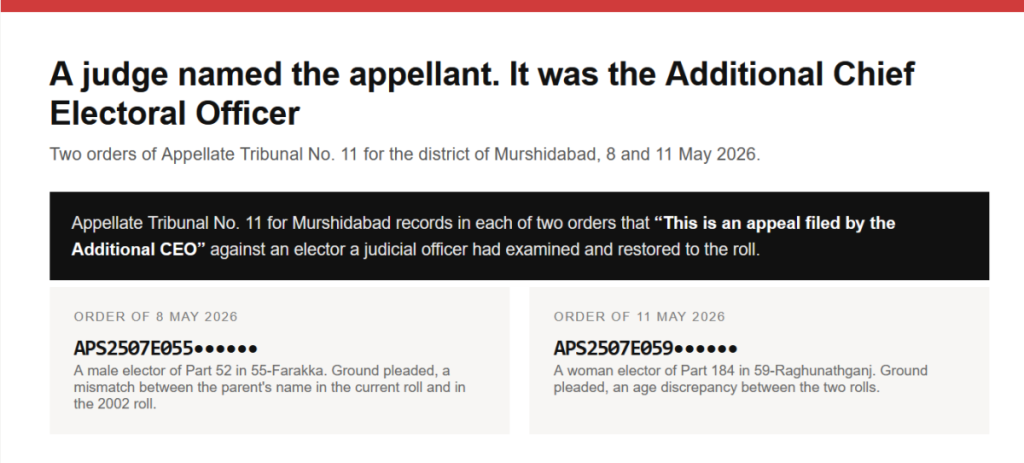
Three days later the same tribunal passed an order in an appeal numbered APS2507E059••••••, concerning a woman elector of Part 184 in 59-Raghunathganj. The order uses the identical formula, recording in terms that the appeal was filed by the Additional CEO.
Both electors had been examined by judicial officers during the Special Intensive Revision (SIR) and placed back on the electoral roll. In each case, an appeal was then filed to have them removed. And in each case, the tribunal records that the appellant was the Additional Chief Electoral Officer of West Bengal.
On August 12, according to the Indian Express, Election Commissioner Sukhbir Singh Sandhu wrote to Election Commission of India (ECI) officials asking who had been authorised to file appeals on the commission’s behalf before the West Bengal tribunals, and who had actually filed them.
He recorded that neither he, nor Election Commissioner Vivek Joshi, nor the serving Chief Electoral Officer of West Bengal had been informed of the basis or the process for filing these appeals.
Three months before that question was put, a retired high court judge had already written the answer into the record in two cases.
The appeals carry a serial number that gives them away
The commission’s appeals portal issues every appeal an identification number. Examined across a set of them, those numbers fall into two distinct formats, and the difference between the two is the difference between a person filing a form and a system generating one.
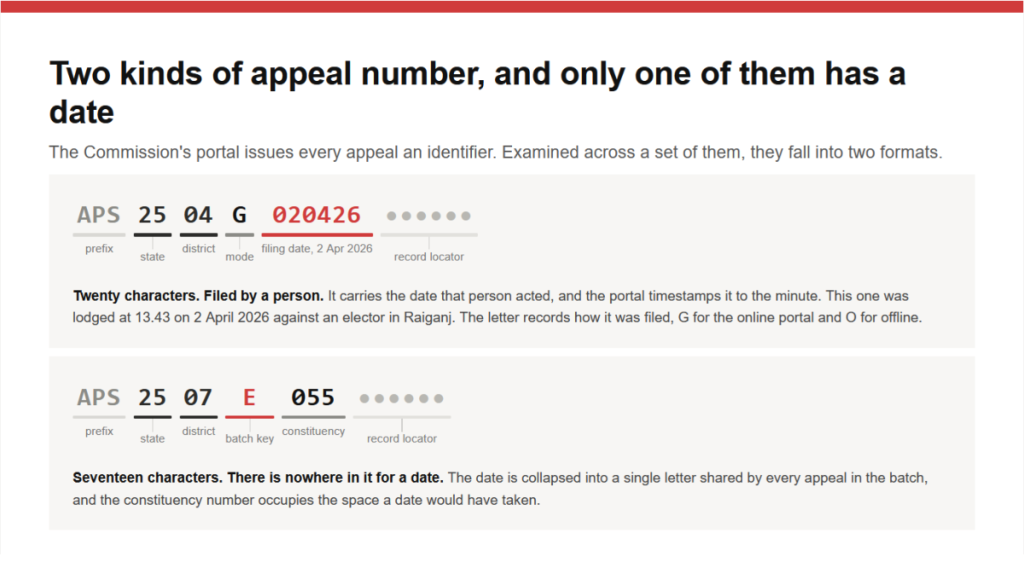
The first format spans twenty characters. Following the state prefix (APS25), it carries a two-digit district code, a single letter denoting submission mode (G for online portal filings and O for offline physical submissions), a six-digit calendar date in DDMMYY sequence, and a final six-digit identifier.
For example, appeal APS2504G020426151332 was lodged against an elector in Raiganj within District 04 (Uttar Dinajpur). The 020426 sequence records the filing date of April 2, with the portal timestamping the action at 13:43 pm.
The second format comprises 17 characters and contains no calendar date within its syntax. Following the state and district prefix, it features a single alphabetic batch key, a three-digit assembly constituency number and six final digits. In Farakka’s appeal APS2507E055101330, district code 07 represents Murshidabad, while 055 corresponds to the Farakka assembly constituency.
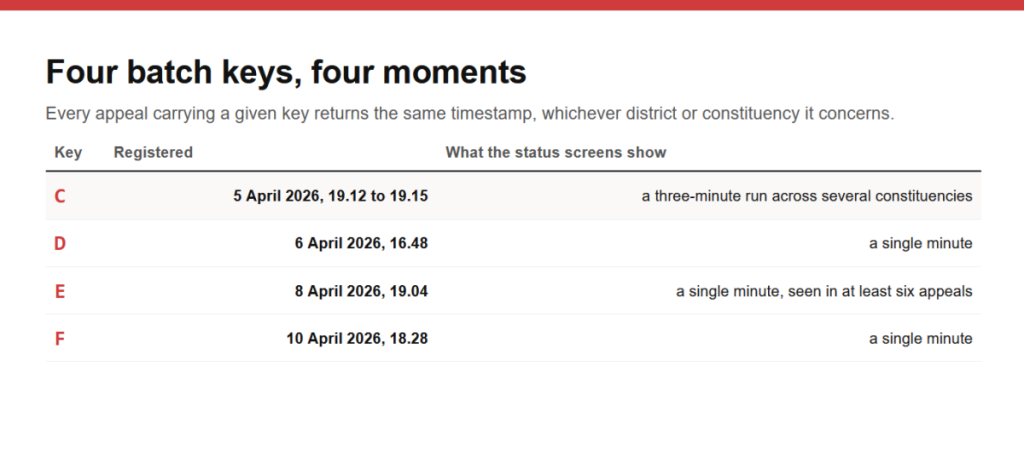
Rather than storing variable calendar dates, the filing date in this format is collapsed into the alphabetic batch key. System status logs reveal that every appeal sharing a given letter shares an exact, down-to-the-minute execution timestamp across different constituencies:
Four letters, four moments
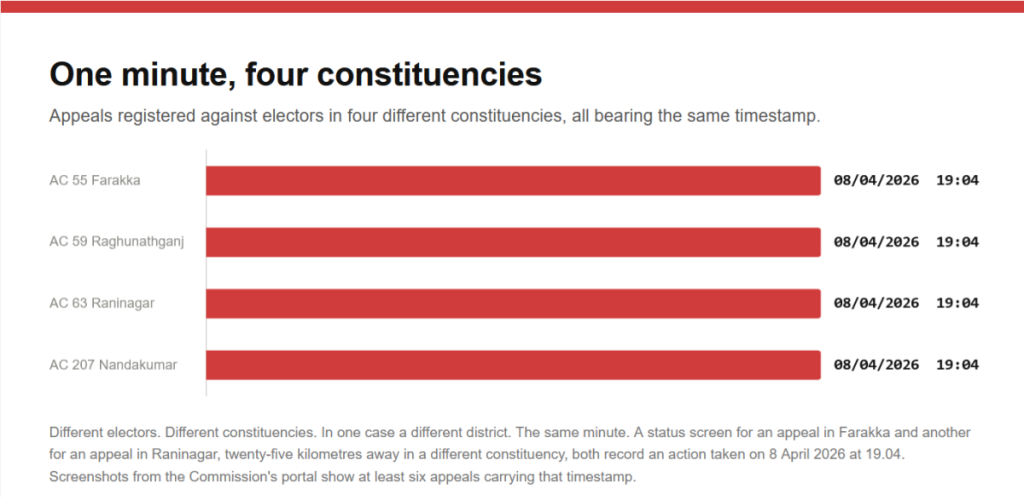
At 7.04 pm on April 8, an appeal was registered against a voter in assembly constituency 55 in West Bengal. At precisely 7.04 pm, another was registered against a voter in constituency 59. Another in constituency 63. Another in constituency 207.
The voters were different. The constituencies were different. In some cases, even the districts were different. The time was the same.
The appeal IDs were also built in the same pattern: APS2507E055…, APS2507E059…, APS2507E063…, APS2516E207…. Screenshots from the Election Commission’s appeal portal reviewed by The Wire show at least six such appeals carrying the exact timestamp 08/04/2026 | 19:04.
Other batches follow the exact same pattern. Appeals carrying the letter C were registered across several constituencies on April 5 between 7.12 pm and 7.15 pm.
A D-series appeal appears at 4.48 pm on April 6. The E-series appears at 7.04 pm on April 8. An F-series appeal appears at 6.28 pm on April 10.
Four evening moments across six days. Not four days on which many people happened to file, but four instants, each recorded to the minute, shared by every appeal in its batch regardless of which district or constituency it concerns.
A status screen for an appeal in Farakka records an action taken on April 8 at 19:04 PM. A separate status screen for an appeal in Raninagar, 25 kms away in a different constituency, records the exact same timestamp of April 8 and 19:04 pm.
The uniform execution across divergent geographical jurisdictions indicates a centralised script running over an electoral list rather than individual filings by field officers.
The structure of the number also says the same thing. An appeal brought by a person records when that person acted, which is why the 20-character format carries a date. An appeal generated in bulk has no individual moment to record, so the format carries the constituency instead and lets one letter stand for the batch.
What the field staff saw
Field accounts from Booth Level Officers (BLOs) across multiple districts corroborate the automated nature of these challenges. Officers holding booth enumeration records noted that electors cleared during judicial adjudication were found to have pending challenges without having been served prior notice or filing documentation themselves.
Their accounts agree on the essentials: Electors who had gone through adjudication and were restored to the supplementary lists were found, on checking, to have appeals pending against them. Those electors had filed nothing and had been told nothing. And within a booth, the appeals carried one date and one time.
The same thing was being said in public at the time. On April 20, in a Facebook group used by BLOs in West Bengal, one wrote that 80% of the restored electors checked in their booth showed an appeal pending, that none of them had filed anything, and that every appeal carried the same date and time, April 5 at 7.13 in the evening.
A second replied that the same appeared in their booth, with every appeal timed April 8 at 19:04 pm.
That is the E batch, to the minute, described by a field officer four months before the commission told the Supreme Court that such appeals existed at all.
Sixteen lakh of them
On September 16, in its reply to an application in Derek O’Brien versus Election Commission of India, the commission disclosed the composition of the appeals before the tribunals for the first time.
Of 38,31,429 (roughly 38 lakh) appeals filed, 22,21,118 (22 lakh) came from voters whose names had been excluded or deleted. And 16,10,311 (16 lakh plus) were appeals against inclusion.
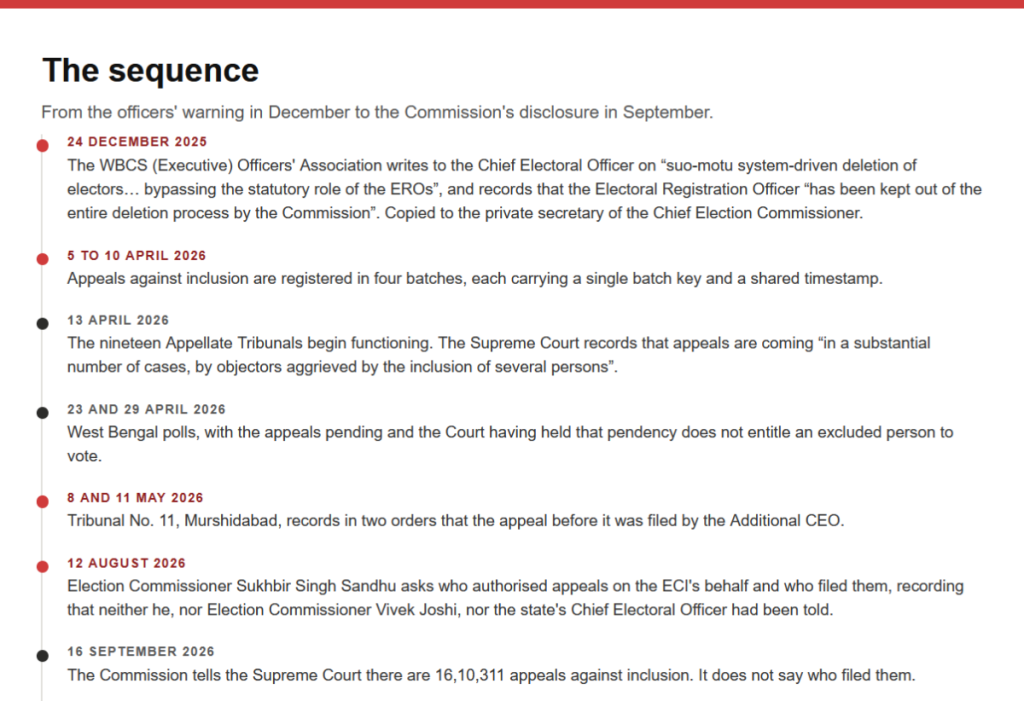
Set against the 32,77,360 (roughly 32 lakh) electors, the judicial officers examined and cleared 49.1%, or roughly one appeal seeking removal for every two people a judge had allowed to stay.
The commission gave the court the number, but it did not say who had filed them.
The officers said in December that the system was acting alone
The pattern has a precedent in the same revision, recorded by the officers who were supposed to be administering it. Four months before the April batches, the association of officers legally responsible for the rolls had told the commission that deletions were being executed by a system, over their heads, without the hearing the statute requires.
On December 24, 2025, three weeks after the enumeration phase closed and a fortnight after the draft roll was published, the WBCS (Executive) Officers’ Association wrote to the Chief Electoral Officer of West Bengal. The subject line of their email reads, “Suo-motu system-driven deletion of electors from the draft electoral rolls in West Bengal in the ongoing SIR process bypassing the statutory role of the EROs.”
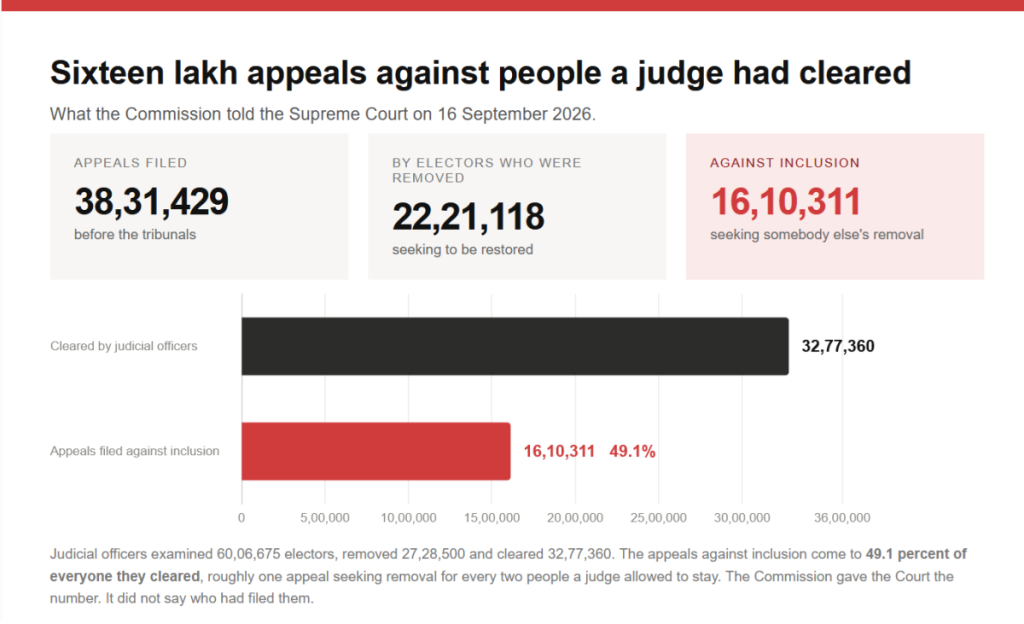
The letter states that a considerable number of electors whose enumeration forms had not been returned were deleted from the draft rolls on alleged grounds of death, migration, absence, or duplication. It sets against that Section 22 of the Representation of the People Act 1950, under which an ERO must give a person a reasonable opportunity of being heard before deletion.
“It is observed that names of electors might be deleted from the electoral roll without the knowledge of the ERO who is the competent authority as per the statute. The common people who will be affected by such action will only blame the ERO without knowing that the ERO has been kept out of the entire deletion process by the Commission,” the letter states.
A copy was forwarded to the private secretary of the Chief Election Commissioner.
What the tribunals are being asked to decide
The two Murshidabad orders show what happens after one of these appeals reaches a bench.
In the Farakka case, the ground pleaded was a mismatch between the parent’s name in the current roll and in the 2002 roll. The tribunal was not satisfied by the enumeration form or the PAN card.
It directed the elector to prove his parentage through documents approved by the Election Commission, and, because he was born after 1987, to satisfy it under the Citizenship (Amendment) Act, 2003, that his mother “must be a citizen of India or at least not an illegal migrant at the time of the birth of this incumbent”.
In the Raghunathganj case, the ground was an age discrepancy. The 2002 roll recorded her as 21. Her enumeration form gave her date of birth as January 1, 1987. The tribunal noted that on the enumeration form she would have been 15 in 2002 and “naturally could not have any voting right.”
Her name appears in the 2002 roll, in Bengali, in a form that differs from the one on the current roll. She was directed to appear and prove that the two entries are the same person, and to bring documents “to prove her claim to be a citizen of India.”
The order refers to her throughout as “this alleged citizen”. It also records that she had filed her own appeal, writing that her voter card was deleted and that it “is not only essential for voting but is also required for various official and personal purposes.” The tribunal notes that her appeal “has not been registered separately”.
Effectively, this means an elector restored by a judicial officer, then appealed against by the electoral administration, then required to establish her citizenship, could not get her own appeal onto the register while the one against her proceeded.
Some tribunals give reasons, others do not
Tribunal No. 11 in Murshidabad issues hearing notices that state a reason against each name. A notice issued on June 16, listing eight appellants in Raghunathganj, for a virtual hearing on July 14, gives grounds such as parentage linkage, enumeration form illegible with mapping not established and documents submitted for parentage linkage.
Six of the eight appeal numbers on it are 17-character numbers in the E batch, all for constituency 059.
The notice issued by Appellate Tribunal No. 16 for Uttar Dinajpur, dated May 18, for a hearing on May 22, lists thirty appellants in 35-Raiganj with appeal number, EPIC number, name and constituency. It gives no reason against any of them. All 30 appeal numbers are 20-character numbers and all thirty carry the same filing date, April 13, which is the day the tribunals began functioning.
On the accounts available, notices in Cooch Behar and Purba Bardhaman are issued in the same form, without stating why the elector has been called.
The audit trail is now the story
The ECI has not yet clarified why more than 16 lakh challenges were filed by the commission, how the electors were selected and what explains the batch pattern visible in the appeal records.
The question can be answered without speculation.
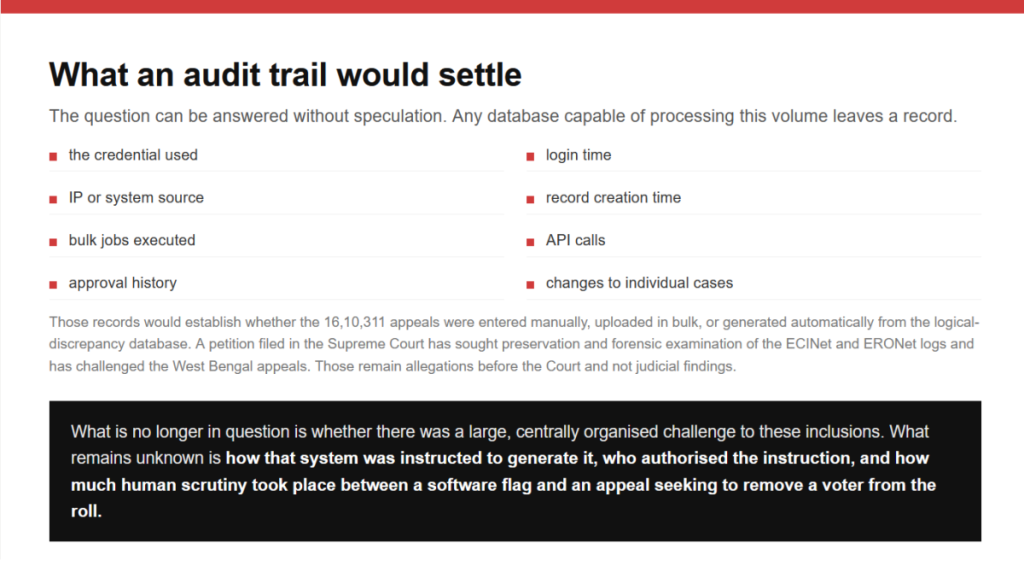
Every modern database system capable of processing this volume of records should leave an audit trail like the credential used, login time, IP or system source, record-creation time, bulk jobs executed, API calls, approval history and changes made to individual cases.
Those records could establish whether the 16.10 lakh appeals were manually entered, bulk uploaded or automatically generated from the logical-discrepancy database.
A petition filed in the Supreme Court this week has now sought preservation and forensic examination of ECINet and ERONet logs and has challenged the 16.10 lakh West Bengal appeals. Those remain allegations before the Court, not judicial findings.
But the documents already available narrow the question considerably.
What remains unknown is no longer whether there was a large, centrally organised challenge to these inclusions.
It is how that system was instructed to generate it, who authorised that instruction and how much human scrutiny, if any, took place between a software flag and an appeal seeking to remove a voter from the electoral roll.