

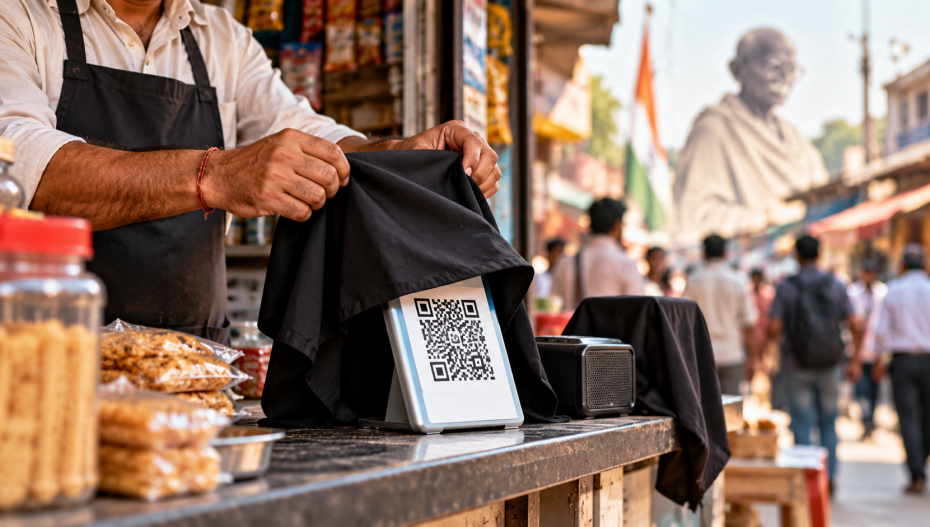
On October 2, several trader and business groups across India plan to put their UPI QR codes, sound boxes and other digital payment devices under black cloth.
The symbolic protest, being called “No UPI Day,” is aimed at opposing the proposed 0.4% Merchant Discount Rate (MDR) on certain UPI transactions above ₹2,000. The charge is stated in the story as being scheduled to take effect from October 15.
The protest is being led from Maharashtra, where the Maharashtra Chamber of Commerce, Industry & Agriculture (MACCIA) has called on traders to observe Gandhi Jayanti as No UPI Day. MACCIA president Ravindra Mangave said trader associations in other states have also been approached.
MACCIA, along with its 500 affiliate associations, also plans to meet the Maharashtra chief minister to put forward their demands.
Why are traders opposing the charge?
For traders, the concern is mainly about the additional cost of accepting digital payments.
AICPDF national president Dhairyashil Patil said traders and distributors often work with thin margins. Their argument is that adding a fee to digital transactions could increase their operating costs, particularly for businesses that receive a large number of UPI payments.
Shankar Thakkar, national president of the All India Edible Oil Traders Federation (AIEOTF), also said trader organisations are strongly opposed to the proposed 0.4% MDR on UPI payments above ₹2,000.
The organisations supporting the protest include the Federation of Retail Traders Welfare Association (FRTWA), All India Consumer Products Distributors Federation (AICPDF), All India Mobile Retailers Association (AIMRA), All India Jewellers and Goldsmith Federation (AIJGF) and AIEOTF.
What exactly is the proposed MDR?
MDR, or Merchant Discount Rate, is the fee charged to a merchant for accepting a digital payment.
According to the information in the story, P2P UPI payments would not attract MDR. However, P2M transactions above ₹2,000 would carry a 0.40% fee, capped at ₹300.
Payments made to small vendors under the P2PM category would continue to remain free of MDR. This category covers small vendors receiving up to ₹1 lakh a month through UPI and is particularly relevant to rural and semi-urban businesses.
The proposed change therefore has a direct bearing on merchants handling larger-value UPI payments.
UPI has already become a major part of daily business
The scale of UPI payments shows why the proposed charge has become a concern for traders.
In August 2026, UPI processed 15.51 billion P2M transactions, with a combined value of ₹8.95 trillion.
According to the information provided, transactions above ₹2,000 made up around 67% of the total P2M transaction value.
Maharashtra recorded the highest transaction volume among the states listed, with 2,387.27 million transactions worth ₹2.78 trillion.
It was followed by Karnataka with 1,267.99 million transactions worth ₹1.76 trillion, Uttar Pradesh with 1,264.90 million worth ₹1.53 trillion, Tamil Nadu with 998.58 million worth ₹1.51 trillion and Telangana with 964.23 million transactions worth ₹1.47 trillion.
There were also 10,879.59 million unclassified transactions worth ₹11.61 trillion, for which NPCI did not receive location data.
From groceries to fuel, businesses are already using UPI at scale
The data also shows how widely UPI is being used across different business categories.
Groceries and supermarkets recorded 3,995.82 million transactions worth ₹86,881.84 crore in August.
Fuel service stations recorded 772.90 million transactions worth ₹44,193.12 crore, while digital gold purchases accounted for 249.21 million transactions worth ₹2,488.52 crore.
Electronics shops recorded 82.18 million transactions worth ₹11,112.68 crore. Securities brokers and dealers recorded 84.12 million transactions, with a value of ₹63,667.21 crore.
The listed categories are not exhaustive, but they indicate the range of businesses where UPI payments are being used.
Petroleum dealers also raise the issue
The concern is not limited to retail traders.
Senior officials from the Ministry of Petroleum and Natural Gas met representatives of the All India Petroleum Dealers Association (AIPDA) to discuss the dealers’ demand for an exemption from MDR on UPI transactions.
The issue has also reached the capital markets.
SEBI Chairperson Tuhin Kanta Pandey said the regulator would examine concerns raised by stockbrokers over the new MDR for large UPI fund transfers.
For capital-market transactions, the MDR mentioned in the story is 0.02%, with a ₹300 cap. It applies to payments involving mutual funds, brokers and dealers, and investment advisers.
Traders say UPI has helped reduce cash
Trader groups are also making a broader argument about the role of digital payments.
Thakkar said the rise of UPI has made the retail payment chain more transparent. A transaction can move digitally from a customer to a retailer, then to a wholesaler and finally to a manufacturer or supplier.
Each payment leaves a transaction record, reducing the need to handle cash at different stages of the chain.
Trader organisations argue that putting a cost on these transactions could make maintaining this digital payment chain more expensive for businesses.
For now, October 2 is being positioned as a symbolic show of opposition. But trader groups have indicated that the issue may not end with the one-day protest.
Thakkar said that if the government does not take an appropriate decision, trader organisations could decide on a further agitation strategy and intensify the protest.
Also Read: Adani Airports Eyes ‘Single-Digit’ Regulated Revenue As Navi Mumbai Takes Centre Stage