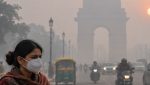



Delhi has recorded its most polluted Diwali in five years, raising fresh concerns about the city’s worsening air quality. But the bigger question now is whether the pollution figures being reported are showing the complete picture or whether the actual situation is much worse than what the official numbers suggest.
While residents struggled to breathe in the polluted air after Diwali celebrations, environmental experts raised questions about missing data from several air quality monitoring stations. They alleged that some of the highest pollution readings were missing from the official records, creating doubts about how accurately Delhi’s pollution levels were being reported.
And this is where the issue becomes bigger than just another discussion about rising pollution. The debate is now also about transparency, accountability and whether people are being given the correct information about the air they breathe every day.
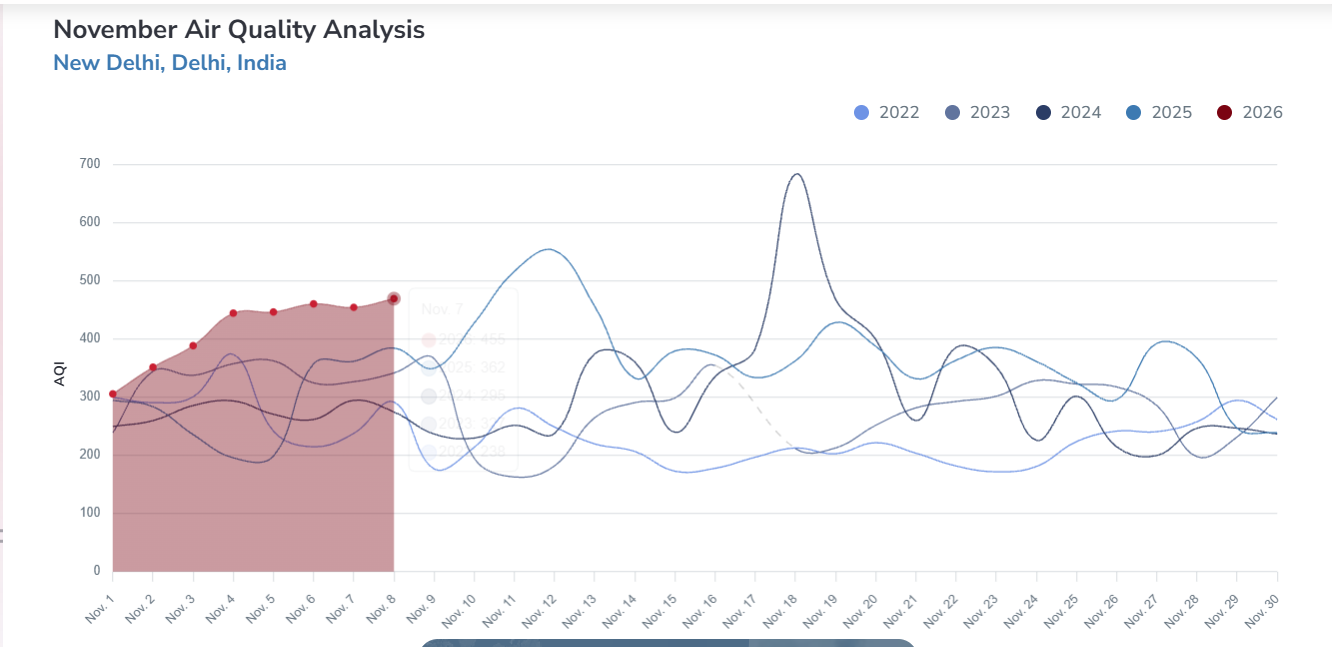
The concerns are not without numbers. According to an analysis by EnviroCatalysts, a non-government think tank, at least 19 air quality monitoring stations operated by the Delhi Pollution Control Committee (DPCC) recorded PM2.5 levels above 1,000 micrograms per cubic metre late on Sunday night and early Monday.
PM2.5 refers to very tiny particles in the air, smaller than 2.5 microns. These particles are particularly concerning because they can enter deep into the lungs when people breathe.
However, despite these extremely high readings, the corresponding data from these stations was not reflected in the Central Pollution Control Board’s (CPCB) records for the same period.
The missing data has raised another important question. Between 10 pm on Sunday and 4 pm on Monday, Delhi’s 59 monitoring stations were expected to provide a total of 1,062 hourly readings. But 258 readings were missing from the CPCB data.
In simple terms, nearly 24% of the expected pollution readings were not available in the official records during this 18-hour period.
Environmental experts believe these missing readings could make the pollution situation appear less serious than it actually was.
According to reports, the founder and lead analyst at EnviroCatalysts, told that the missing information suggested that the official figures could be understating the pollution crisis. He also questioned why extremely high PM2.5 readings, including levels of 1,000 micrograms per cubic metre or more, appeared to be missing while unusually low readings were still included.
The problem was particularly visible during the hours when firecracker celebrations were at their peak.
An analysis by the Centre for Research on Energy and Clean Air (CREA) found that the number of monitoring stations failing to report pollution data increased as Diwali night progressed.
At 7 pm on Sunday, only one monitoring station was not reporting data. By 10 pm, the number had increased to seven. Around midnight, 29 stations were missing readings. Even at 2 am on Monday, 23 stations were still not reporting data.
This is important because these were also the hours when pollution levels were rising across the city.
The absence of readings during such a crucial period has raised questions about whether the official data is capturing the actual pollution exposure faced by Delhi residents.
Another point that caught the attention of environmental experts was the fall in Delhi’s Air Quality Index (AQI) on the day after Diwali.
Delhi recorded an AQI of 376 on Diwali Sunday. On Monday, the figure came down to 344.
Normally, pollution from firecrackers is expected to make the air worse on the day after Diwali. However, this time, the official AQI showed an improvement.
Experts described the decline as unusual, particularly when several monitoring stations had failed to report data during the hours of peak pollution.
However, such a decline has happened before. In 2022, Delhi also recorded a similar fall after Diwali, so the change cannot automatically be treated as evidence of manipulation.
For comparison, Delhi’s AQI in 2021 stood at 314 on Diwali and increased to 382 the following day. In the days after Diwali that year, the AQI reached 462, the worst air quality recorded in the decade covered by the report.
The CPCB had not commented on the missing readings or the fall in AQI after Diwali at the time of the report.
For people living in Delhi, the question is not just about what number appears on a government website. It is about the air they are actually breathing.
The executive director of the Centre for Science and Environment (CSE), questioned the disappearance of monitoring data during the hours of peak Diwali pollution.
She said the situation on the ground clearly showed the seriousness of pollution exposure. According to her, reliable official data is necessary not only to make people aware of the situation but also to ensure that institutions remain accountable and take steps to control pollution.
Her point is simple: even if pollution readings disappear from monitoring records, the health emergency does not disappear with them.
Radhey Shyam Sharma, head of the Department of Environmental Studies at Delhi University, also raised concerns about the lack of transparency.
He said that during a public health emergency, people must have access to clear and reliable information about the pollution levels around them.
He also pointed out that an average AQI figure may not always show the actual pollution levels people experience during peak hours. Pollution can rise sharply at certain times and locations, and a city-wide average may not fully reflect that exposure.
Sharma stressed that official data should clearly mention where the readings were recorded, when they were recorded and what pollution levels people were exposed to.
He also highlighted that private agencies and government agencies may use different methods to calculate and present pollution figures. This makes transparency even more important.
While environmental experts are questioning the reliability of the official figures, the issue has also entered the political debate in Delhi.
Senior Aam Aadmi Party (AAP) leader Saurabh Bharadwaj accused the Delhi government of what he called “data fraud”. He alleged that air quality monitoring stations were being switched off to make the city’s pollution levels appear lower than they actually were.
Bharadwaj also questioned the installation of 20 new air quality monitoring stations. He claimed that several of these stations had been placed in relatively open and green areas with lower traffic and population density.
According to him, choosing such locations could bring down the overall pollution average recorded across the city.
He also made allegations about the monitoring station in Jahangirpuri, claiming that water was being sprinkled near it to lower pollution readings.
Bharadwaj cited the missing readings on Diwali night while questioning the government’s pollution monitoring exercise.
However, these allegations have not been independently established. The missing data and the claims of deliberate manipulation are two separate issues, and the latter requires proper investigation and evidence.
The Bigger Question: What Is Delhi’s Actual Air Quality?
At the centre of this entire debate is something that people often take for granted: the air they breathe.
For someone living in Delhi, pollution is not just a figure on an AQI dashboard or a political argument between two parties. It is part of everyday life.
People have to step out for work, children have to go to school, and thousands of people have to travel across the city every day. They cannot simply stop breathing or stay indoors whenever pollution levels rise.
And when the air itself becomes a problem, the situation is much more serious than a disagreement over official numbers.
The concern is also about whether people are getting the complete picture. If nearly one-fourth of the expected pollution readings are missing during an important period, how can residents be sure that the figures being shown reflect the actual situation?
The responsibility of monitoring agencies is not just to publish an AQI figure every day. They must also make sure that the information is complete, clear and available to the public, particularly when pollution reaches dangerous levels.
Political parties can argue over who is responsible, and experts can question the monitoring system. But at the end of the day, it is the people living in Delhi who have to face the consequences.
Because clean air is not a political demand or a luxury. It is a basic need. And if people cannot even trust the numbers telling them whether the air they breathe is safe, then the problem becomes even bigger.
Also Read: Delhi Was Already Gasping Before Diwali; Firecrackers Push AQI To 1,331